|
Musee d'Orsay introduction Site Home - What's New?-Feedback - About Jack-Travel/Art Links |
|
|
|
Eiffel tower, a genesis and anecdotes Champ de Mars-Rue Cler-Hotel des Invalides Eglise Saint-Louis Dome Invalides Musee Rodin Anecdotes of a prestigious neighborhood Rue du Bac-Chapel of miraculous
medal-Museé Maillol Musee d'Orsay: medium level and end of visit
|
Paris-7th arr-Musee d'Orsay-Introduction |
|
|
Times
are over when the irritated Parisian wondered why they needed a new museum in a
city already crawling in these institutions. Could he suspect that the Musee du
Jeu de Paume, opened in 1947 to display the impressionist paintings from the
Louvre museum, next to the light of the Tuileries would be packed and become
much too small to house the constant growing collection? But sometimes different circumstances can end up to a magnificent ending. At
the very moment that the “Direction of French museums” was looking
desperately for now oxygen to display all these masterpieces, the enormous, ram
shackled nave of the gare d’Orsay, only used for suburb transport, was doomed
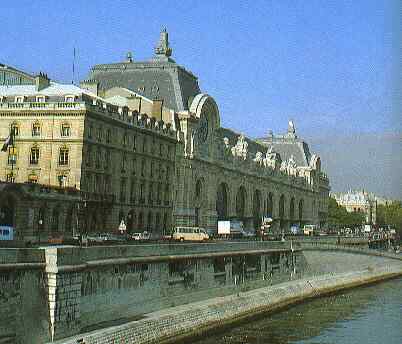
for destruction. The transfer for the paintings of the Jeu de Paume was decided. But what was this gare d’Orsay and what is its story? The station was
built in a record time, from 1898 until 1900 by architect Victor Laloux. For
that epoch the construction was daring and the
building was ready exactly on time for world fair of 1900. It was set just on
the left bank side of the Seine in order that the passengers arriving from the
south of France should be right away in the middle of the city. Wealthy
passengers could stay in a large luxury hotel right next to the station, one of
the last examples of “1900 eclectic-rococo-Napoleon III"
The Routard reminds us that Gaulenti was
soon criticized by some, (I quote): denouncing the "pharaonism" (bad
tongues even said "mussolinian style") and principally the 2 enormous
blockhouses in the back. Just jealousy!! Let’s give Gae Aulenti the credit
having succeeded to multiply the volumes and the architectural surprises: the
visitor is not obliged to pass through dozens of identical galleries. And the
displayed works have the advantage of 17000 square meter of display surface,
zenithal and natural lighting.” (end of quote) Bibliography:
--Vie et histoire des arrondissements de Paris, ed.Hervas, 1985-1988, 20
volumes- Le piéton de Paris, by L.P. Fargue, ed.Gallimard 1997—Rive Gauche,
une expérience unique, by Cl.Evrard, ed.Albin 1991--Guides du Routard 1998,
ed.Hachette, Les 20 arrondissments
de Paris, by Martine Constans, Renaissance du Livre 1998--Orsay museum in Parijs,
by H.Witteveen, ed.Spectrum |