|
Rue Cler in Paris, Champ de Mars Hotel des Invalides Site Home - What's New?-Feedback - About Jack-Travel/Art Links |
|
|
|
Eiffel tower, a genesis and anecdotes Champ de Mars-Rue Cler-Hotel des Invalides Eglise Saint-Louis Dome Invalides Musee Rodin Anecdotes of a prestigious neighborhood Rue du Bac-Chapel of miraculous medal Museé Maillol Musee
d'Orsay Musee d'Orsay: medium level and end of visit
|
Paris-7th arr-Champ de Mars-Rue Cler-Hotel des Invalides |
|||
|
Leaving the Eiffel tower
adventure, notice that this tower rises above a perfectly symmetric designed
planned to perfection area. “Behind “ the tower you have the jardins du
Trocadero (the 16th arrondissement) connected to the left bank by the
pont d’Iéna, surrounded by the two semi-circles of the Palais Chaillot. In
“front” of the tower, the meticulous, geometric well cared –off park du
CHAMP DE MARS. It was an area where wine was cultivated and vegetables grown ,
sold by merchants to the customers. It was in fact designed
to connect the “ECOLE MILITAIRE” and the Seine. Mme de Pompadour created
this place to drill ” an train
500 “gentilshommes” to serve in the ranks of the king’s army. A certain
young man, named Napoleon Bonaparte stayed for a while between its walls. He
left in 1785 with the rank of sub-lieutenant with the comments:" I will go
very far if circumstances will permit. The Ecole Militaire is still today a
training and management centre for the French army.
Let’s continue the walk.
Make a left into the boulevard de la Motte Piquet, cross the boulevard Bousquet
and the first street to the left is the RUE CLER, a lively, colourful market
street. In the rue du Camp de Mars, except the presence of one of my favourite
inexpensive Parisian charm hotels “Hotel du Champ de Mars”, you can buy
wonderful cheese at the shop of Anne-Marie-Cantin. Superb quality of cheeses,
even in her international branches like in Brussels. Return rue Cler and make a
right at the rue de Grenelle (excellent bread at bakery Poujouran!). Suddenly we
are standing in front of the Invalides. Don’t worry: the canons of the former
house of war invalids are out of order! ;-)They only symbolically threaten the
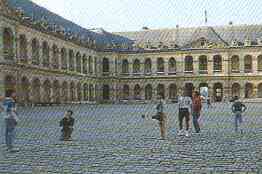
car traffic on the Esplanade. The INVALIDES is a huge
ensemble. Different parts constitute this monumental ensemble. It’s in 1671 that Louis XIV decides the construction of a
“hotel-barrack” for war invalids. He creates l'Institut National des
Invalides that houses up to 4000 people. This was the idea of the king:"
let's not cut out of the world, those who served the nation so well). But instead of the first planned barrack, the architect Bruant builds an
immense severe but harmonious façade, making it one of the greatest
achievements of the reign of Louis XIV. As the hotel is built far from the Seine
shore, Robert de Cotte organizes a splendid esplanade in 1704 (500 meters long,
250 meters wide.
The MUSEE DE L’ARMEE
occupies the two sides of the cour d’honneur, making it one of the richest in
the world. It exposes harnesses, uniforms, swords, old rifles and other arms, of
which the rapier of Francois 1er and the martial equipment of Henri
II. A section is dedicated to WWI and WWII. For this last war a lot of
testimonies and documents. (Quote Routard de Paris): you can see the original edition of
"Mein Kampf". Also an incredible nazi propaganda leaflet trying to demonstrate that the dollar paid the Jewish war and discovering
the proof on the bill itself! Moving
section the clandestine press, fake papers, etc... Terrible photographs of the
Pathology museum of Buchenwald. Bibliography: Vie et histoire des
arrondissements de Paris, ed.Hervas, 1985-1988, 20 volumes- Le piéton de Paris,
by L.P. Fargue, ed.Gallimard 1997—Rive Gauche, une expérience unique, by
Cl.Evrard, ed.Albin 1991-Dictionnaire historique des rues de Paris, by
J.Hillairet, ed.Minuit 1985, |