|
Dome de Invalides Napoleon grave Musee Rodin Site Home - What's New?-Feedback - About Jack-Travel/Art Links |
|
|
|
Eiffel tower, a genesis and anecdotes Champ de Mars-Rue Cler-Hotel des Invalides Eglise Saint Louis Anecdotes of a prestigious neighborhood Rue du Bac-Chapel of miraculous medal Museé Maillol Musee
d'Orsay Musee
d'Orsay Musee d'Orsay: medium level and end of visit
|
Paris-7th arr-Eglise Saint Louis-Dome Invalides-Musee Rodin |
|||||||
|
The army church of
SAINT-LOUIS (with 3 naves) impresses us principally by its stiff design. The
only decoration you see are flags and banners, captured after fierce and bloody
battles from enemies who didn’t ask France to invade them and would have
preferred to be left in peace! The famous Turenne was buried here in a crypt in
1800. In 1840, Louis-Philippe decided to accomplish the vow of Napoleon that his
body would rest “on the shores of the Seine, amidst this French he people he
had loved so much”. When the “ashes” returned on September 15, they were
stored provisorely during 20 years in the chapelle Saint-Jerome, at the left
side of one of the naves of the church, the time needed to build a dignified and
worthy imperial memorial for this great man for some, criminal butcher for
others. (I refuse to debate about that, I’m only a travel writer;-)) Let’s proceed to the
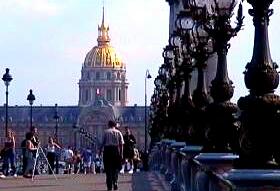
DOME DES INVALIDES. Under the gilded cupola of the dome you’ll find one of the
most beautiful monuments built in Paris since the Renaissance period. Originally
the church of Saint-Louis and the Dome formed one and only church! On Sundays
the Royal family assisted under the cupola in a separated space, located in the
gothic nave, the same mass as the soldiers and wounded of Saint-Louis. (Saint is
just a surname, since it was one of the most cruel and merciless king France
ever had, read Victor Hugo about him!).
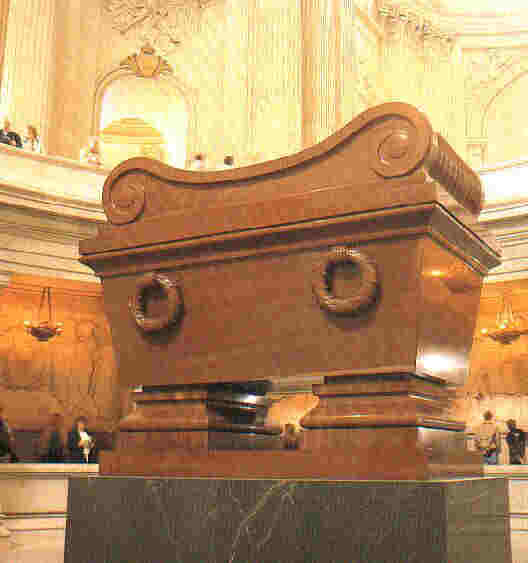
When the ashes of Napoleon arrived in 1840, the Dome was rebuilt and transformed into a gigantic mausoleum.
If you feet are still able
to drag you;-) take the rue de Tourville getting out of the Dome to the
boulevard des Invalides, make a left and you are in the rue de Turenne.
This museum is exemplary
the way it is presented. You can experience how a great Parisian hotel
particulier looked under the Ancien Regime with its sculpture populated garden
and interior decorations. The first interior courtyard shows already some of his
masterpieces: “Les Bourgeois de Calais”, “La Porte de l’Enfer”, “Le
Penseur” and “Balzac”. In the garden, restored in 1927, the “Appel aux
Armes” and “Ugolin”. The famous “Baiser” is to see in the Grand Salon.
Loiter around and admire a lot of other masterpieces you even never heard of.
Two halls are dedicated to the
women Rodin loved: Camille Claudel, sister of the poet, the duchesse de
Choiseul, lady Sackville-West and Mme. Elisseieff. On the 1st floor you can admire the works Rodin bought from his friends:
3 superb Van Gogh, a Renoir, a Monet and even an Edvard Munch. Splendid.
Even if you are not a
Rodin admirer you will be undoubtedly conquered by the fairy tale, magnificent
garden behind the museum. It radiates such a peace and charm! The garden has been completely restructured. A sinuous path has been
created, a poetic itinerary, on the theme "the sources".
Bibliography:
--Vie et histoire des arrondissements de Paris, ed.Hervas, 1985-1988, 20
volumes- Le piéton de Paris, by L.P. Fargue, ed.Gallimard 1997—Rive Gauche,
une expérience unique, by Cl.Evrard, ed.Albin 1991-Dictionnaire historique des
rues de Paris, by J.Hillairet, ed.Minuit 1985, |