|
Orsay is THE museum of the second part of
the 19th century. Painting, sculpture, architecture, decorative arts and
graphics, photography, all is concentrated in these spaces, just music and
literature are not included. It constitutes an intelligent approach to art and
houses different styles, some almost unknown to the public. However 35 million
visitors entered the last 12 years and can be considered as the most beautiful
window-display in the world for the art of the second half of the 19th century
and the beginning of the 20th!
Let’s be practical. The museum is open
Tuesday, Wednesday, Friday and Saturday from 10.00-18.00, Thursday until 21.45
and Sunday 9.00-18.00. Closed on Mondays, Christmas day and New years day.
The main entrance is through the rue Bellechasse.
For the ones who need some food at noon (they exist! even among the Orsay
visitors) there is a restaurant, set in a luxurious cadre (painted ceilings,
painted panels, gildings), for a correct quality and reasonable prices, like a
rapid formula under 100 FF (FF (buffet hors-d'oeuvre, dessert and wine pichet).
On the superior level, Cafe des Hauteurs, open 10 am- 5 pm, much less expensive,
near the Degas pastels. You can eat very well there: small salads between 1 € and
1.50 €.
Notice that the collections of the museum
are completed by a series of the most diverse kind (concerts, films,
conferences, etc…) The collections are from different sources: the Louvre for
the period 1848-1900, the Jeux de Paume for the impressionists, the palais de
Tokyo for the post-impressionist collections non transferred to the centre
Pompidou. But over the last years, the museum followed a dynamic policy of
acquisitions like the "Creation du monde" by Courbet, Les Dechargeurs
and "la Manneporte" by Monet, "Portrait de Mme.Cezanne" by
Cezanne, the extraordinary "Nuit etoilee" by Van Gogh. Other exploit
of the museum: the entry of a Whistler, "Variations in purple", also
"Flodden Field" by Burne-Jones. The curator dreams about other
acquisitions of the Northern schools: Munch, Mondriaan, Klimt,
Feuerbach......Alas! They are financially unreachable!
Ok, we’re inside. I'm not going to
enumerate here everything there is to see. The museum offers free of any charge
a very well made folder with plans by each level and description of all
galleries. I will stick to the more significant works and artistic currents.
 |
|
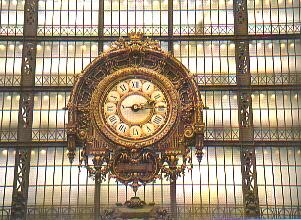
Orsay great clock |
Right away we are struck by the grandeur
and magnificence of the view we have in front of us. Who would have expected
such a view! A central alley, bordered with remarkable sculptures of the second
Empire testifies of the divers currents of romanticism. Notice the "
Danse", " Ugolin" and “Les quatre parties du Monde” by
Carpeaux (on the balcony-terrace), sculptures by Rude, Barye, an original
haut-relief in plaster of "La Porte d'Enfer" by Rodin, dozens of
bronzes from Degas, busts of Dalou, sculptures of Bourdelle and Maillol. At the
two sides of the have where you can have an idea of the so-called school of
"peintres pompiers", sort of official and academic painters of the
19th century. I personally hate this period of decadence in French painting and
would not advise to lose your time if you are in a hurry. They had their success
in their times but are practically forgotten today. The choice to display them
received many critics and gave heavy polemics.
But at a certain point in the central alley
you’ll find rooms on your right side dedicated to Ingres, Delacroix, and their
followers to whom the impressionists owe a lot.
The rooms at the left side of the central alley, the "salle
Daumier", represented by 36 busts of caricatures and paintings testifying
his taste of colour, luminous contrasts and deformed faces. A
remarkable " Gallerie de portraits de celebrites du juste milieu" and
his so expressive oils: "Scenes de comedie, "Les Voleurs et
l'ane", "Don Quichotte et la Mule morte"etc...
In the following rooms , Millet
(l’Angelus, les Glaneuses, Le Printemps), Rousseau (Une avenue, Foret de
l’Isle Adam), Corot (danse des Nymphes, In the rotunda room, the main
masterworks of Courbet, "L’enterrement a Ornans", "l'Atelier
d", "les Falaises d'Etretat "," la Source", "la Creation du Monde".
If you continue now on the left, here are the galleries dedicated to the impressionists
before 1870. Monet (Femmes au jardin, Dejeuner sur l’Herbe, yes! ,
it is imitated from fragments of "Le Dejeuner sur l'Herbe" by Manet),
Pissarro (Geleé Blanche) and Sisley (Passerelle d’Argenteuil), Boudin ( Plage
a Trouville), Jongkind (La Seine et Notre-Dame à Paris). Follows
the salle Manet with his “Emile Zola”, “Olympia”, “Le Balcon” and
“Le Fifre”. Monticelli and his realism is not really my cup of tea. Look in
the area for 2 small rooms reserved for pastels by Degas, Millet, Fantin-Latour,
Boudin, Manet and Mary Cassatt.
At the end of the transversal alley on the
right the “Decorative arts” are presented, with a miniature model of the
quartier de l'Opera and in the ballroom on the floor, astounding decoration and
exhibition of some typical ornaments of the "IIIrd Republic"
academism.
Bibliography:
--Vie et histoire des arrondissements de Paris, ed.Hervas, 1985-1988, 20
volumes- Le piéton de Paris, by L.P. Fargue, ed.Gallimard 1997—Rive Gauche,
une expérience unique, by Cl.Evrard, ed.Albin 1991--Guides du Routard 1998,
ed.Hachette, Les 20 arrondissments
de Paris, by Martine Constans, Renaissance du Livre 1998--Orsay museum in
Parijs, by H.Witteveen, ed.Spectrum
|
