|
Eiffel tower, its history and genesis Site Home - What's New?-Feedback - About Jack-Travel/Art Links |
|
|
|
Eiffel tower-Genesis and anecdotes Champ de Mars-Rue Cler-Hotel des Invalides Eglise Saint-Louis Dome Invalides Musee Rodin Anecdotes of a prestigious neighborhood Rue du Bac-Chapel of miraculous medal Museé Maillol Musee
d'Orsay Musee d'Orsay: medium level and end of visit
|
Paris-7th arr-Eiffel tower-a genesis and anecdotes |
|
|
There is a myth about the
tower of Mr.Eiffel which (by the way Gustave Eiffel was from German origin)
could well have usurped his name, but more about that later). It is said that no
Parisian was ever on it, because it is a thing not to do for a real
“Parisien”. The climb is something for hillbillies and guys from the
countryside, foreign tourists included. But if you question them thoroughly, the
Parisians admit that they have been at least once in their life on the Eiffel
tower—like a sort of pilgrimage to Mecca---. After all, without that you
couldn’t be a good Parisian;-).
The inauguration of the
tower, by president Sadi Carnot, took place in 1889 without too much publicity,
to satisfy a request from Eiffel who hated public appearances. A few guests of
honour like the prince of Wales climbed the tower on feet, since the elevators
weren’t ready at that time. It took them an hour to climb the 1789 stairs.
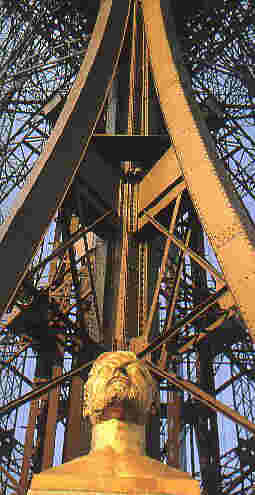
Today, we rush high speed in renovated elevators to the “garconniere” of the
great Gustave on the third floor, high up 300 meters in the summit of that
“disgraceful skeleton” like Guy de Maupassant described it. You can meet the
wax statue of Eiffel and Thomas Edison in this garconnière, renovated, like the
whole Eiffel tower in the 80’s. Eiffel liked to take his guests of honour to
his apartment. Today, there is not much left of it but a reporter of last
century described it “ with a pretty parlour, antechamber, dining room, bed
room, a few untidy small rooms and a very special garret, brightly lit during
the night. He invited his guests for dinner at “Brébant (no “Jules Verne”
at that time;-)) like that evening of 11th of September 1889 with
Thomas Edison and the composer Charles Gounod, who had just signed a petition
against “that abominable pilar of riveted steel”. The tower had also his adventurers: some tried to jump with a parachute that didn’t open because of the humidity, like Marc Gayet, a hunchback. Quoting the guide du Routard: "A reporter who came down the stairs from the first floor by bicycle arrived triumphantly but was arrested by the local police for a " provoking unlawful mob". A hot airship made the tour of the tower once and was dashed down on the structure; no harm done except the panic of a pregnant lady on the third floor who delivered her baby in the elevator taking her back. The tour saw about 400 suicides since its existence: only 2 survived. (unquote) Bibliography: Vie et histoire des
arrondissements de Paris, ed.Hervas, 1985-1988, 20 volumes- Le piéton de Paris,
by L.P. Fargue, ed.Gallimard 1997—Rive Gauche, une expérience unique, by
Cl.Evrard, ed.Albin 1991-Dictionnaire historique des rues de Paris, by
J.Hillairet, ed.Minuit 1985,---Eiffel, l’homme et son œuvre, by A.Lapeybie
(ed. Miniut 1988), ---Anecdotes et secrets de polichinelle d’une construction,
by J.Francisque, article from a Figaro litteraire 1997. |