|
When you descend to the medium level don’t miss the collection Max and
Rosy Kaganovitch with Van Gogh’s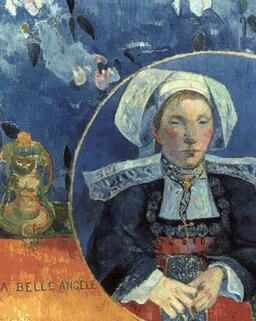 “Hospital at St.Remy”, "Paysannes
Bretonnes" by Gauguin and several Derain, Vlaminck, Cezanne. We are at the
final, but still important part of this wonderful museum. The medium level. It
is essentially dedicated to sculpture and decorative arts.
In a sort of ancient ballroom the “official” painting of the 19th
century is presented like Bonnat, Laurence, Cabanel, Puvis de Chavannes, and
Cormon. More illustrious names could be Gervex, Gerome, Bougereau. I confess
that this part and epoch of French painting is not at all in my taste, usually I
pass it quickly. But “tous les gouts sont dans la nature, n’est-il pas ?”
Get
outside on the balcony where a lot of sculptures stand waiting for you to admire
them. A monumental sculpture by Barrias: “Chasseurs d’Alligator”, Rodin:
“l’Age d’Airain”, “Ugolin”, “Balzac”, “Porte de l’Enfer”
and the admirable "Age Mur" by Camille Claudel. On the side of the rue
de Lille, the balcony shows sculptures dating after 1900: Maillol “Méditerannée
“, “Le Désir”. “Hospital at St.Remy”, "Paysannes
Bretonnes" by Gauguin and several Derain, Vlaminck, Cezanne. We are at the
final, but still important part of this wonderful museum. The medium level. It
is essentially dedicated to sculpture and decorative arts.
In a sort of ancient ballroom the “official” painting of the 19th
century is presented like Bonnat, Laurence, Cabanel, Puvis de Chavannes, and
Cormon. More illustrious names could be Gervex, Gerome, Bougereau. I confess
that this part and epoch of French painting is not at all in my taste, usually I
pass it quickly. But “tous les gouts sont dans la nature, n’est-il pas ?”
Get
outside on the balcony where a lot of sculptures stand waiting for you to admire
them. A monumental sculpture by Barrias: “Chasseurs d’Alligator”, Rodin:
“l’Age d’Airain”, “Ugolin”, “Balzac”, “Porte de l’Enfer”
and the admirable "Age Mur" by Camille Claudel. On the side of the rue
de Lille, the balcony shows sculptures dating after 1900: Maillol “Méditerannée
“, “Le Désir”.
Inside again, the continuation of the
ballroom with a glorification of the field works. Remarkable works (even if too
academic or outrageously lyrical for certain), like “Les Foins” by
Bastien-Lepage, “La Forge” by Cormon, “, "La Paye des Moissonneurs"v by Leon Lhermitte (1882), "The
Docks of Cardiff" fantastic fresco of popular life by Lionel Walden.
 Continuing we arrive in the Symbolists section, a reaction against
Naturalism and Impressionism, letting us penetrate the world of dream and
thoughts of the artists. ”Sérénité” by Henri Martinand “La Roue de la
Fortune” by Burne-Jones . Art Nouveau, coming from Belgium wit the evident
concern to eradicate the previous formulas, uses new techniques materials like
ceramics, enamel and stained glass. This movement found its expression mainly in
architecture (a trip to Brussels and Antwerp is highly recommended to see a lot
of houses in that style!!), and decorative arts represented here by jewels
(Lalique), furniture, vases (Gallé), . Wandering around we will pass different
foreign 19th century European painting schools (Vienna, Glasgow and
Chicago). More Vuillard, Maurice Denis. In a small room, works of Matisse (Luxe, calme et volupté),
Rousseau (La Charmeuse de serpents), Klimt
(Rose bushes under the trees), Munch “Nuit d’été à Asgaarstrand"
remind us of an international art panorama of the beginning of the 19th
century. Continuing we arrive in the Symbolists section, a reaction against
Naturalism and Impressionism, letting us penetrate the world of dream and
thoughts of the artists. ”Sérénité” by Henri Martinand “La Roue de la
Fortune” by Burne-Jones . Art Nouveau, coming from Belgium wit the evident
concern to eradicate the previous formulas, uses new techniques materials like
ceramics, enamel and stained glass. This movement found its expression mainly in
architecture (a trip to Brussels and Antwerp is highly recommended to see a lot
of houses in that style!!), and decorative arts represented here by jewels
(Lalique), furniture, vases (Gallé), . Wandering around we will pass different
foreign 19th century European painting schools (Vienna, Glasgow and
Chicago). More Vuillard, Maurice Denis. In a small room, works of Matisse (Luxe, calme et volupté),
Rousseau (La Charmeuse de serpents), Klimt
(Rose bushes under the trees), Munch “Nuit d’été à Asgaarstrand"
remind us of an international art panorama of the beginning of the 19th
century.
Bibliography:
--Vie et histoire des arrondissements de Paris, ed.Hervas, 1985-1988, 20
volumes- Le piéton de Paris, by L.P. Fargue, ed.Gallimard 1997—Rive Gauche,
une expérience unique, by Cl.Evrard, ed.Albin 1991--Guides du Routard 1998,
ed.Hachette, Les 20 arrondissements
de Paris, by Martine Constans, Renaissance du Livre 1998--Orsay museum in
Parijs, by H.Witteveen, ed.Spectrum—Orsay und die Impressionisten, by W.
Shulers (ed.Deltas, Munchen 1995), Musee d’Orsay, by the ministere de la
communication et de la culture (ed. Musees nationaux 1986)
|
