|
Musee d'Orsay upper level Site Home - What's New?-Feedback - About Jack-Travel/Art Links |
|
|
|
Eiffel tower, a genesis and anecdotes Champ de Mars-Rue Cler-Hotel des Invalides Eglise Saint-Louis Dome Invalides Musee Rodin Anecdotes of a prestigious neighborhood Rue du Bac-Chapel of miraculous medal-Museé Maillol Musee
d'Orsay Musee d'Orsay: medium level and end of visit
|
Paris-7th arr-Musee d'Orsay-Upper level-Impressionists and neo-Impressionists |
|||||||||||
|
Since all he works exposed in these galleries are famous works I will
mention the most famous and important. First of all, in the collection Moreau-Nelaton, "Hommage
to Delacroix" by Fantin-Latour, "Coquelicots" We can see Monet
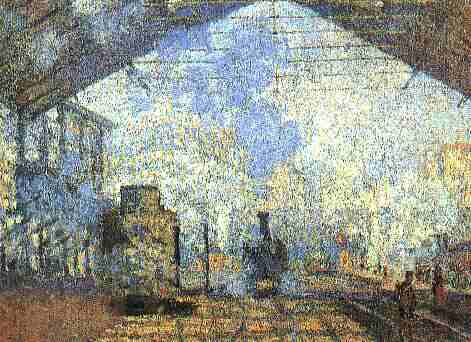
(La Gare Saint-Lazare, Regates a Argenteuil, the series of les Cathedrales de
Rouen, Impression soleil levant, les Dindons), Pissarro (Les Toits rouges),
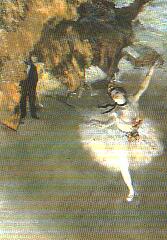
Sisley (Inondation a Port-Marly), Berthe Morisot (Le Berceau), Degas (L’Absinthe,
à la Bourse, Chevaux de courses, Danseuses bleues), Manet (Sur la Plage),
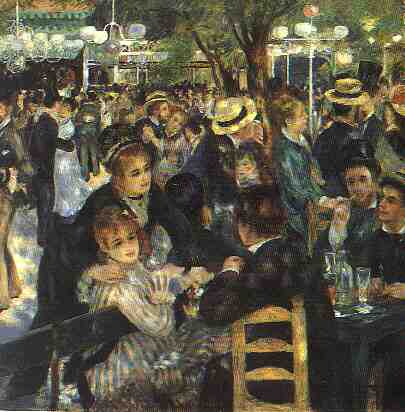
Renoir (Danse à la ville, Le Bal du Moulin de la Galette, La Balancoire), Les
Baigneuses) and the famous "Dejeuner sur l'Herbe " by Manet. You have a beautiful Whistler (mother of the artist), Renoir again with
"Les Baigneuses", "Jeunes Filles au Piano", "Danse a la
Campagne", Caillebotte (Raboteurs de parquet and l'Absinthe), and the soft
pastels of Degas (les Repasseuses) not to miss, secluded in 2 small rooms barely
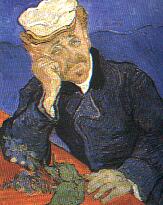
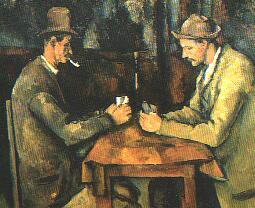
lighted (near the cafeteria)--pastels don't support the light— The collection of docteur Gachet, friend of the impressionists (however I
suspect him to be a visionary collector and knew what he gained from his
friendships), permitted the entry in the national collections of an impressive
number of works by Van Gogh (Portrait de l'Artiste peint a St.Remy, Portrait du
docteur Gachet, the church of Auvers-sur-Oise, l’Arlesienne, la Chambre a
Arles) and Cezanne
In the neo-impressionist section let’s
single out Odilon Redon, Toulouse-Lautrec (La Toilette, Jeanne Avril dansant, le
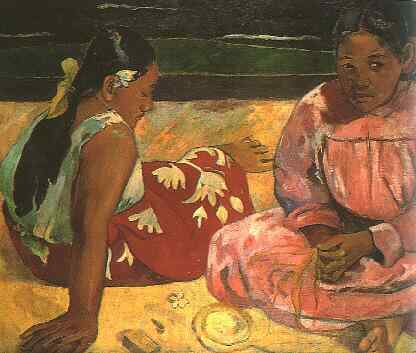
Douanier Rousseau (which I don't particularly like) and the school of Pont-Aven
around Gauguin (La Belle Angele, Femmes de Tahiti, le Cheval Blanc, le Repas),
Emile Bernard and finally the Nabis with small sized paintings of Pierre Bonnard,
Maurice Denis, Vuillard, Felix Vallotton and Sérusier. Notice thta an entire hall
is dedicated to the pastels of Toulouse-Lautrec: Jane Avril, La Clownesse Cha-U
-Kao, La Toilette, Le Lit.
Having
sore feet? Want a rest? Get to the cafeteria and have a cup before going down again
to the last part of the museum: the medium level with other post-impressionist
paintings, Art deco, Art Nouveau, etc…. Bibliography: --Vie et histoire des arrondissements de Paris, ed.Hervas, 1985-1988, 20 volumes- Le piéton de Paris, by L.P. Fargue, ed.Gallimard 1997—Rive Gauche, une expérience unique, by Cl.Evrard, ed.Albin 1991--Guides du Routard 1998, ed.Hachette, Les 20 arrondissements de Paris, by Martine Constans, Renaissance du Livre 1998--Orsay museum in Parijs, by H.Witteveen, ed.Spectrum—Orsay und die Impressionisten, by W. Shulers (ed.Deltas, Munchen 1995) |
 Largely provided by natural light thanks to
the immense glass-case, these spaces are ideal to show and enhance the beauty
and valor of the very important collection of that period. You can follow the
history of the impressionist movement starting from the pavilion, a movement
that grouped in 1874 about 165 paintings of thirty participants always
“refused” by official jury’s: Cezanne, Monet, Degas, Sisley, Renoir,
Pissarro…..The work of Monet “Impression, soleil levant”, qualified by a
critic as “impressionism” in the negative and mockery way of the word, is
the origin of the movements name. Seven other “non official” exhibitions
took place until 1886, while Caillebotte joined the artists in 1876, became
their maecenas, and bequeathed his collection to the State. In 1879 the group
welcomed the American Mary Cassatt and Gauguin. Seurat and Signac joined in
1886.
Largely provided by natural light thanks to
the immense glass-case, these spaces are ideal to show and enhance the beauty
and valor of the very important collection of that period. You can follow the
history of the impressionist movement starting from the pavilion, a movement
that grouped in 1874 about 165 paintings of thirty participants always
“refused” by official jury’s: Cezanne, Monet, Degas, Sisley, Renoir,
Pissarro…..The work of Monet “Impression, soleil levant”, qualified by a
critic as “impressionism” in the negative and mockery way of the word, is
the origin of the movements name. Seven other “non official” exhibitions
took place until 1886, while Caillebotte joined the artists in 1876, became
their maecenas, and bequeathed his collection to the State. In 1879 the group
welcomed the American Mary Cassatt and Gauguin. Seurat and Signac joined in
1886.