Site Home - What's New? -Feedback - About Jack- Travel/Art Links

Venice
|
Site Home - What's New? -Feedback - About Jack- Travel/Art Links |
|
|
|
Venice |
|
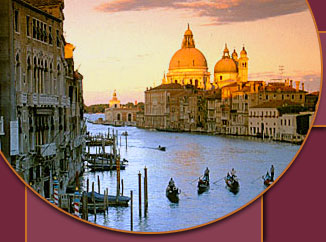
Venice visit-Canal Grande-From Accademia to Palazzo Mocenigo |
||||
|
Santa
Maria
Peggy
|
From Fondaco dei Turchi to Palazzo Tiepolo Papadopoli
From Ca' Loredan to Ca' Rezzonico
Ca' Rezzonico to San Marco-End of Canal palaces
|
|||
We must choose now, getting out of the Galleria Della Academia. Left or right bank of the Canal Grande? Let's cross the water and stay on the left bank. Up to Palazzo GIUSTINIAN-LOLIN (17th century), just before the Rio San Vidal. A large façade, connecting two gothic palaces. Richard Wagner composed his second act of "Tristan und Isolde" here. Today it houses a foundation:" The Scuola di Musica Antica Venezia " where music students can perfect their skills, take part in the chamber music sessions and in group lectures. 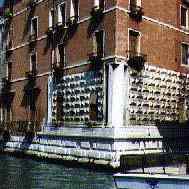 Continuing along the Canal we stumble upon the Rio del Duca. Here is another palace: "CA' DEL DUCA, 15th century, which was never completed. Two undistinguished buildings were erected on the original foundation but had the original structure been completed, it would have been the largest private palace in the city. Tiziano had a workshop here in 1514. Even in its truncated state the Ca' del Duca is powerful and impressive, and introduced several new features to Venice. The variety of the sharply accented stonework of the basement and ground floor is in marked contrast to any building built in the city before this time. The basement level in most Venetian palaces was usually completely undecorated. Here it is composed of carefully marked Istrian stone blocks. In this detail the Ca' del Duca influenced a number of later palaces. Continuing along the Canal we stumble upon the Rio del Duca. Here is another palace: "CA' DEL DUCA, 15th century, which was never completed. Two undistinguished buildings were erected on the original foundation but had the original structure been completed, it would have been the largest private palace in the city. Tiziano had a workshop here in 1514. Even in its truncated state the Ca' del Duca is powerful and impressive, and introduced several new features to Venice. The variety of the sharply accented stonework of the basement and ground floor is in marked contrast to any building built in the city before this time. The basement level in most Venetian palaces was usually completely undecorated. Here it is composed of carefully marked Istrian stone blocks. In this detail the Ca' del Duca influenced a number of later palaces.It's quite a stroll to reach our next palace, the famous PALAZZO GRASSI, 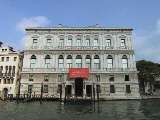 passing the San Samuele pier. A beautiful 18th century palace, predecessor of the neo-classic style, restored by the FIAT group (the cars), a restoration successfully succeeded by Gae Aulenti, the Italian architect who transformed the gare d'Orsay in Paris to the wonderful museum it is now. The Palazzo Grassi houses today a lot of prestigious thematic exhibitions: from futurisme with the Phoenicians to Marcel Duchamp and Tinguely. passing the San Samuele pier. A beautiful 18th century palace, predecessor of the neo-classic style, restored by the FIAT group (the cars), a restoration successfully succeeded by Gae Aulenti, the Italian architect who transformed the gare d'Orsay in Paris to the wonderful museum it is now. The Palazzo Grassi houses today a lot of prestigious thematic exhibitions: from futurisme with the Phoenicians to Marcel Duchamp and Tinguely. A perfect compromise between tradition and modernity, it fulfils all the needs of the modern museum visitor, allying the charm of a noble Venetian home. If I have a good advice to give you, don't hesitate to loiter around in the neighbourhood, very agreeable with all its art shops, antique dealers and little trattorias and restaurants. Next palace with some significance is the massive built PALAZZO MORO LIN, 17th century, also known as the 'thirteen' windows building. After that, the PALAZZO CONTARINI DELLE FIGURE, (16th century, nice to see but more interesting are, to the left of it, four palaces joined together, near the San Toma pier.
These are the CASE DEL MOCENIGO, also called PALAZZO MOCENIGO. The third one (counting from the right) was occupied by Lady Mary Wortley Montague in the 18th century and by Byron (as a plaque tells us) in the 19th. He hired the whole palace for 200 pounds a year. Spoiled by an army of servants, he wrote his poetry. His stay had a dramatic end. After a big quarrel, threatening with knives, his housekeeper with whom he had an affair jumped into the Grand Canal. The palace was owned by the illustrious family Mocenigo, who gave seven doges to Venice! The last heir, Alviso Nicolo Mocenigo, bequeathed it to the city in 1954. |
||||