|
You are eager to see the
Grand Canal? Let’s start right away! Let’s buy a ticket on vaporetto no.1. From stop S.Zaccaria or San Marco, wherever you want. The ride will be
slow and will stop at all piers. Buy the ticket direction Piazzale Roma and try
to get a seta on the left side—and if you’re darn lucky, on the foreside of
the ship.
no.1. From stop S.Zaccaria or San Marco, wherever you want. The ride will be
slow and will stop at all piers. Buy the ticket direction Piazzale Roma and try
to get a seta on the left side—and if you’re darn lucky, on the foreside of
the ship.
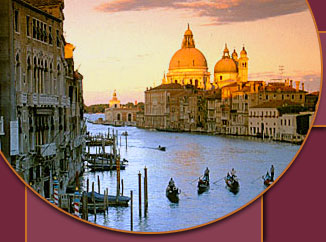
“Canalezzo” that’s how
the Venetians call the Canal Grande. Still the main artery of Venice and the
only one to be named “Canal”, the others are called “rio”. 3.8 km long,
70 m wide and sometimes 5m deep, it has the shape of an upside down “S”.
More than 100 “palazzi” look out on the canal. Some are magnificently
restored, others look sad and shabby.
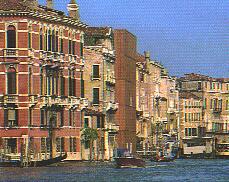 The wealthiest families
had to have a palace on the Canal Grande on ancient times. And even more, the
location made commerce a lot easier. The Palazzo was used as office and
habitation. Venetians, clever businessmen understood very quickly the importance
of outside aspects for their clientele. As the 100 palaces along the Canal were
built over a period of 500 years, we can tell the history of the city through
its architecture, integrating all styles and influences. The wealthiest families
had to have a palace on the Canal Grande on ancient times. And even more, the
location made commerce a lot easier. The Palazzo was used as office and
habitation. Venetians, clever businessmen understood very quickly the importance
of outside aspects for their clientele. As the 100 palaces along the Canal were
built over a period of 500 years, we can tell the history of the city through
its architecture, integrating all styles and influences.
Most of the palaces were built in brick, the cheapest, lightest and easiest to
transport at that time. Indeed, the pile work foundations needed light material.
The ingeniosity of Italian architects created palaces that are still standing,
for a few almost 700 years. Why not 700 years more? I’d like to answer that
affirmatively but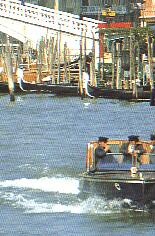 unfortunately the city is undermined by pollution and mass tourism. The
foundations have been altered, luxury and magnificence has disappeared, only the
facades remain.
unfortunately the city is undermined by pollution and mass tourism. The
foundations have been altered, luxury and magnificence has disappeared, only the
facades remain.
The very few still living inside the palaces cannot assume the high costs,
financial charges, housekeeping and maintaining cost. Looking at them we cannot
imagine how cold and humid it can be inside. That’s why I proposed the
vaporetto. But be aware that one time is not enough. You should repeat it, the
promenade lasts 45 min during the day.
But the most magic, the instant that you will really plunge in Venice’s
charming atmosphere is at night. A few palaces are still lit inside and shadows
go and come, adding to the mysterious ambience.
I will start to describe and name all important palaces from the moment we leave
the San Marco station, just after the customs house on your left where the
church SAN MARIA DELLA SALUTE welcomes us.
But that’s for next essay.
Bibliography
Italian hours, by James
Henry-Venice, a traveller’s companion, by John Julius Norwich-The Companion
guide to Venice, by Hugh Honour-Venice and its lagoon, by Giulio Lorenzetti.
|