Site Home - What's New? -Feedback - About Jack-  Travel/Art Links

Venice

Hotel Ca'Zose

On line hotel booking in Venice

Venice visit-Canal Grande-Left bank from Ca' Loredan to Ca' Rezzonico


Embarking
on vaporetto
no.1


Santa Maria
della
Salute-
Peggy
Guggenheim
story


 Peggy
Guggenheim
museum
of modern
art


 Galleria
dell
Accademia


From Accademia to Palazzo Mocenigo

Eating Venice and wine bars

Four days diary of a great love

hotel recommendations


Venice main page


Canal Grande main page


Rialto Bridge


The Rialto market


From Rialto to Palazzo Labia


From Fondaco dei Turchi to Palazzo Tiepolo Papadopoli


From Ca' Loredan to Ca' Rezzonico


Ca' Rezzonico to San Marco-End of Canal palaces

Loredan-Farsetti palaces

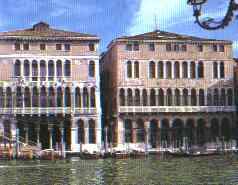
We continue on the right bank with the PALAZZO CA' DANDOLO-FARSETTI and CA' LOREDAN CORNER,two small but beautiful palaces, separated by an alleyway of the end of the 12th century, squeezed between more important palazzi, birthplace of the doge Dandolo. He planned the fall of Constantinople. Another fine example of Byzantine-Venetian style of the 12th and 13th century. Houses the Venice municipality today.
At the estuary of the canal de San Luca, at the San Toma vaporetto stop, here is the immense and severe looking PALAZZO GRIMANI, built on the spot of an ancient Byzantine edifice in the beginning of the 16th century, Renaissance style, work of a Verona architect, Michele Sammichelli. As usual, it presets a three parts composition with a small backyard. The façade is decorated with polychrome marble. Actually the siege of the Appeals Court. 

Pisani-Moretta

The PALAZZO PISANI MORETTA, is a late gothic building of the end of the 15th century. Near the Rio San Paulo it is a private home today. Its superior floors are decorated by large quadrilobated windows with six bays and crossed arches. A monumental staircase was added later at the end of the central parlour. Tiepolo and Veronese decorated the ballroom, which is still served for that purpose. 
In the winding of the Canal Grande, where the Rio San Pantalon comes out, stands the PALAZZO BALBI, big, late Renaissance, recognizable by its two decorative turrets. Built between 1582 and 1590, the architectural elements of its façade show that the 16th century taste evolutes to more liberty and plasticity, early signs of baroque; Its from its windows that Napoleon enjoyed the Venetian regatta, specially held for him. Today it houses the siege of the Regional Council of the Veneto region. 
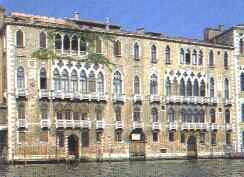
One of the most visible and impressive Palazzi is the CA' FOSCARI, doubled by the same palazzo called PALAZZO GIUSTINIAN. Magnificent example of Venetian gothic architecture, this palace, first of its kind to be built on 4 levels, marked the transformation of the Grand Canal in the 15th century, which will

Palazzo Giustinian

 peak in the Renaissance and baroque period. The great English artist Ruskin described it as the noblest example of gothic architecture in Venice in the 15th century. It was built for the doge Foscari in 1437, and then occupied by the duke of Mantova, this palace received a lot of prominent figures like Henri III of France in 1574. Today the Ca' Foscari is the siege of the University of Venice. The palazzo Giustinian is the continuity of the façade of the Ca' Foscari. Wagner composed here the second and third act of "Tristan und Isolde". 

Ca' Rezzonico

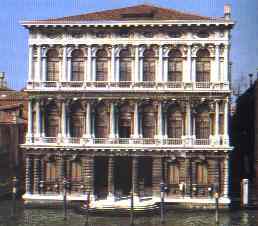
The museum of the 18th century Venice is houses in the CA' REZZONICO. The building of this magnificent palace started in 1667, ordered by the Bon family to the ever-present Baldassare Longhena. The building had a long series of misfortunes and it is finally Rezzonico who finished the building in 1712, leaving the works to the architect Giorgio Massari.
The museum retraces the Venetian life lie it was in the 18th century. A lot of treasures, assembled since 1934, furniture, paintings and decorative objects found in numerous villas and Venetian palaces. You can visit a gigantic ballroom, enhanced by a series of remarkable architectural perspectives, a throne room with an admirable rococo ceiling painted by Tiepolo, the last of the great Venetian decorators. You ca dream about the fastuous Venice period when Casanova organized its famous orgies, games, balls, masquerades. The second floor opens on privet apartments, where the English poet JOHN BROWNING died. The museum should have been reopened this year. Let's hope they held the dead line.

Bibliography

The Companion guide to Venice, by Hugh Honour-Venice and its lagoon, by Giulio Lorenzetti, Venice-A thousand Years of Culture and Civilisation, by Peter Lauritzen-Heures Italiennes, by Henry James (La difference 1985)- Venice, a Literary Companion, by Ian Littlewood's 
The World of Venice, by Jan Morris.