|
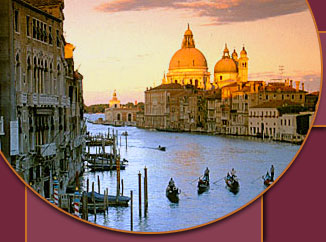
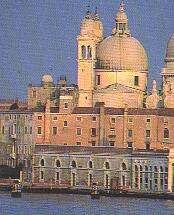
SANTA MARIA DELLA SALUTE is
a baroque church devoted to the Virgin to thank her for stopping a
 plague
epidemics (50,000 dead). The architect was Baldassare Longhena who died before
the church was completed in 1687. Inside the church, vast and luminous, you are
surprised by its sobriety and purity of its forms. The biggest masterpiece
inside is the famous “Nozze di Canaa” (1551), absolute masterwork of
Tintoretto. On the ceiling splendid fresco of Tiziano Vecello “Abraham’s
sacrifice” and a youth work of the same Tiziano, “Saint-Marc on a throne”.
Since 1670 there is a solemn procession starting at Piazza San Marco on 16th
of November to ask the Virgin to keep them in good health (salute). The main
dish for this occasion is “la castradina” (mutton stew). plague
epidemics (50,000 dead). The architect was Baldassare Longhena who died before
the church was completed in 1687. Inside the church, vast and luminous, you are
surprised by its sobriety and purity of its forms. The biggest masterpiece
inside is the famous “Nozze di Canaa” (1551), absolute masterwork of
Tintoretto. On the ceiling splendid fresco of Tiziano Vecello “Abraham’s
sacrifice” and a youth work of the same Tiziano, “Saint-Marc on a throne”.
Since 1670 there is a solemn procession starting at Piazza San Marco on 16th
of November to ask the Virgin to keep them in good health (salute). The main
dish for this occasion is “la castradina” (mutton stew).
 |
|
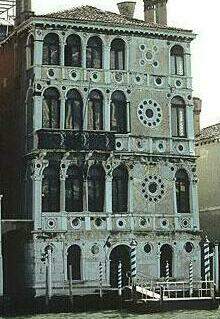
Palazzo Dario |
Continue on the same side of the canal to the magnificent PALAZZO DARIO
at the angle of the Grand Canal and rio della Torreselle. Pretty asymmetric façade,
encrusted with polychrome marbles. The fireplace is characteristic for Venetian
architecture. But don’t trust this apparent beauty, since this palazzo is
cursed since 1487!!! Shivering part: strange diseases, ruined fortunes, suicides
or accidents even more bizarre, it seems that the walls of this edifice curse
its inhabitants. Last of these cases: a billionaire compromised in embezzlements
committed suicide in 1993. Woody Allen –often in Venice—wanted to buy it.
But when he heard about all the misery that happened to former owners he changed
his mind.
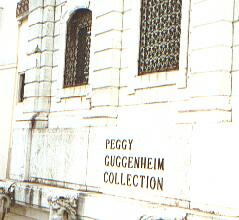 Next the palazzo DEI VENIER DEI LEONI, a white building, better known as the
Palazzo Nonfinito (not finished palace). Built in 1749 by Lorenzo Boschetti it
has only one floor. Because this
palazzo prevented the view on the lagoon of the owners of the Ca’ Grande, the
powerful Corner family, on the other side of the canal, they managed to stop the
completion of the building.
Next the palazzo DEI VENIER DEI LEONI, a white building, better known as the
Palazzo Nonfinito (not finished palace). Built in 1749 by Lorenzo Boschetti it
has only one floor. Because this
palazzo prevented the view on the lagoon of the owners of the Ca’ Grande, the
powerful Corner family, on the other side of the canal, they managed to stop the
completion of the building.
The Nonfinito houses the splendid contemporary GUGGENHEIM COLLECTION.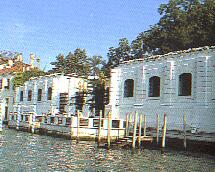
Open 11.00-18.00. Closed on Tuesday. Tel 5206288.
After her childhood with her parents, very wealthy and a bit mad American
entrepreneurs, Peggy Guggenheim had a tumultuous life, between modern painting
and love affairs. In 1921, at the age of 23, she comes over to Paris to live
there. After a first mistake marriage, she opens a museum in London in 1938. She
passes her 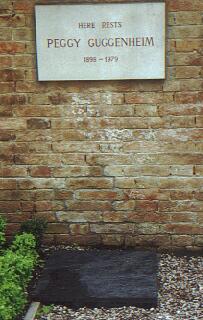 time during WW II buying art works at the arte of one a day!! This
will be the core of the collection that we can all admire today. She marries Max
Ernst and returns to New York to open another museum-gallery. Shesupports a lot
of contemporary artist financially (like Pollock during 5 years) and organizes
temporary exhibitions. In 1948 she is invited the Venice Biennale to present her
collection. time during WW II buying art works at the arte of one a day!! This
will be the core of the collection that we can all admire today. She marries Max
Ernst and returns to New York to open another museum-gallery. Shesupports a lot
of contemporary artist financially (like Pollock during 5 years) and organizes
temporary exhibitions. In 1948 she is invited the Venice Biennale to present her
collection.
It's in 1949 that she buys the palazzo to house her collection. In 1962 she
receives the honorary citizenship of Venice because she offered the city one of
the most important modern art collections in Europe (I would say she deserved it!!
It’s the least Venice could do for her). In 1979, a few months before she died,
someone asked her: ”How are you, Peggy?”, she answered” Not too bad for a
dying woman” .The muse of the surrealists was buried in the palazzo garden
together with her 14 little dogs.
Next essay, a visit of the museum.
Bibliography
Italian hours, by James
Henry-Venice, a traveller’s companion, by John Julius Norwich-The Companion
guide to Venice, by Hugh Honour-Venice and its lagoon, by Giulio Lorenzetti.
Venice-A thousand Years of Culture and Civilisation, by Peter Lauritzen- l’Art
Venitien, by Terisio Pignatti (Flammarion, 1992), Heures Italiennes, by Henry
James (La difference 1985)
|