|
 Just
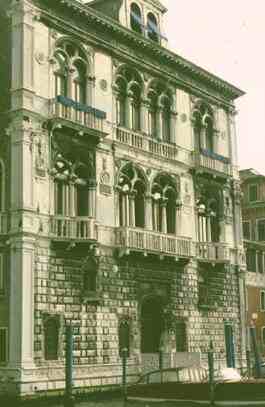
before the S.Angelo stop stands the maybe most beautiful Renaissance palace of
Venice: the Palazzo CORNER-SPINELLI. A jewel of Renaissance architecture, built
by Mauro Codussi. The building is recognizable by its double arched windows and
rustic Just
before the S.Angelo stop stands the maybe most beautiful Renaissance palace of
Venice: the Palazzo CORNER-SPINELLI. A jewel of Renaissance architecture, built
by Mauro Codussi. The building is recognizable by its double arched windows and
rustic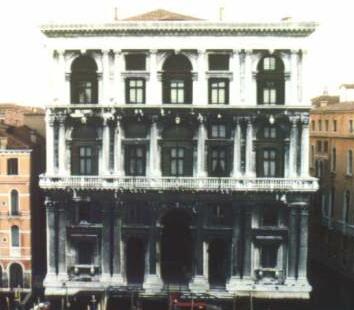 work on the ground floor. It served as model for a lot of other Venetian
buildings like the Palazzo Vendramin Calergi.
work on the ground floor. It served as model for a lot of other Venetian
buildings like the Palazzo Vendramin Calergi.
Go on along the canal and shortly before the San Silvestro stop you’ll see the
PALAZZO GRIMANI. Immense and severe building, dating about 1550, Renaissance
style, and built by a Verona architect, Michele Sammicheli. It’s very
impressive and houses the “Court of Appeals” today.
The town hall of Venice is located in one of the next palaces: the PALAZZO
LOREDAN E FARSETTI, 12th-13th century, an ensemble of two palaces, which still
show their fine arched windows long the inferior façade, the real genuine
Byzantine-Venetian style of the 12th-13th century.
Before arriving at the famous RIALTO Bridge, there is still a lot to see and to
experience. Look at the canal, more especially from the bridge: gondolas,
vaporetti, motorboats, garbage boats, skiffs and barges.
But let’s start about this landmark, one of the finest in Venice: the Rialto.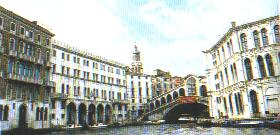
Remember Shylock arguing with Bassanio in the Merchant of Venice by Shakespeare?:
I will buy with you, sell with you, talk with you, walk with you, and so
following: but I will not eat with you, drink with you, nor pray with
you…(aloud) What news on the RIALTO? Who is he comes here?”
For very obscure reasons, maybe due to the marine vocations of The
“Serenissima”, Venice hesitated a long time before launching a bridge,
worthy that name, over the Grand Canal.
The citizens of the “serenissima” who wanted to cross the Canal until the
13th century, had to hire a fragile embarkation and the help of its owner. The
adventure was maybe cheap, but a risky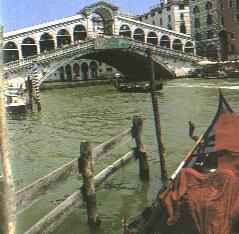 adventure to embark and disembark, especially when a mean wave roll attacked the
Grand Canal. Finally, at the level of the Rivo Alto, a first floating bridge was
composed by connecting barges. It was a practical solution for the boats using
the Grand Canal, since the connected boats were disconnected in a jiffy, but was
very uncomfortable for the pedestrians. You can see the bridge on the painting
“Miracle of the Cross on the Canal Grande by Carpaccio in the Museo dell’
Accademia. In 1264, a wooden drawbridge, the Ponte de la Moneta was launched
between the two banks. But it burned down in 1310, rebuilt and collapsed again
in 1444 when a huge crowd invaded the bridge to see the marriage of the Marquise
of Ferrara. Another wooden bridge was built, but improved with a central
drawbridge, leaving the passage for ships having a high tonnage. But time is
cruel and soon the bridge looks more like an old ruin as a mean of transport
passage. 1524: a courageous decision is made: the next Rialto bridge will be in
STONE. A great competition among architects is launched (Palladio, Vignola,
Michel Angelo) and it’s finally the project of Da Ponte, which is adopted and
ends with the actual Rialto Bridge of 1591. Twenty-eight metres long, seven and
a half metres height, it has only one arch, surmounted by a stone portico,
sheltering two rows of boutiques.
adventure to embark and disembark, especially when a mean wave roll attacked the
Grand Canal. Finally, at the level of the Rivo Alto, a first floating bridge was
composed by connecting barges. It was a practical solution for the boats using
the Grand Canal, since the connected boats were disconnected in a jiffy, but was
very uncomfortable for the pedestrians. You can see the bridge on the painting
“Miracle of the Cross on the Canal Grande by Carpaccio in the Museo dell’
Accademia. In 1264, a wooden drawbridge, the Ponte de la Moneta was launched
between the two banks. But it burned down in 1310, rebuilt and collapsed again
in 1444 when a huge crowd invaded the bridge to see the marriage of the Marquise
of Ferrara. Another wooden bridge was built, but improved with a central
drawbridge, leaving the passage for ships having a high tonnage. But time is
cruel and soon the bridge looks more like an old ruin as a mean of transport
passage. 1524: a courageous decision is made: the next Rialto bridge will be in
STONE. A great competition among architects is launched (Palladio, Vignola,
Michel Angelo) and it’s finally the project of Da Ponte, which is adopted and
ends with the actual Rialto Bridge of 1591. Twenty-eight metres long, seven and
a half metres height, it has only one arch, surmounted by a stone portico,
sheltering two rows of boutiques.
|
 |
|
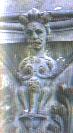
Man with clawed foot on Cammerlenghi |
A legend tells that
a couple of Venetians ironised by saying: “If this bridge is built one day,
let claws grow between my thighs”. “And that fire consumes my belly “added
his wife. The prophecy became true and you can still see on the façade of
the Palazzo Camerlenghi, the sculpted capitals immortalizing the careless wish:
a clawed foot sticks out of the belly of a squatted man, while fire creeps
slowly to the women. It’s now a strategic liaison point between the two
commercial poles of the city and highly animated by a constant passage of very
busy Venetians and less busy tourists.
Note that the Rialto Bridge was the only possibility to cross the Canal until
the Ponte dell’ Accademia was built in 1854.
Bibliography
The Companion guide to Venice, by Hugh Honour-Venice and its lagoon,by Giulio Lorenzetti, Venice-A thousand Years of Culture and
Civilisation, by Peter Lauritzen-Heures Italiennes, by Henry James (La difference 1985)- Venice, a Literary Companion, by Ian Littlewood's-The World of Venice, by Jan Morris.
|