The FONDACO DEI TURCHI is a typical example of a storage house of the Veneto-Byzantine era. It was built in the 14th century by Giacomo Palmieri, being for a time the residence of the Duke of Ferrara and then rented to Turkish merchants from 1621 to 1838. The interior decorations were so beautiful and impressive that it has been used frequently by the Venetian Senate for official receptions. Despite of that it was one of the most important "casa-fondace" (storage houses) of Venice. When the house was practically on the verge of collapsing into irrecoverable ruins, it was rebuilt mid 19th century. Unfortunately "rebuilt" is a wrong term, since the original style of the edifice was completely denatured. Since 1924 it houses the museum of Natural Sciences (Museo Civico di Storia Naturale). Dusty collections of fossils and stuffed animals, even a genuine dinosaur skeleton, having a lot of success with children.
The FONDACO DEL MEGIO, separated by the canal Fondaco dei Turchi is a 15th centurybuilding, used as wheat silo.
 |
|
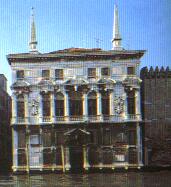
Belloni-Battaglia |
Now comes the PALAZZO BELLONI-BATTAGLIA, a gothic edifice, refurbished by Baldassare Longhena. Notice the heavy of the artists with the truncated tympana, large coat of arms, jutted stonewalls between the windows. The 1st floor has an indented cornice surmounted by a tympanum.
Next Palazzo you cannot miss the CA' PESARO, ancient home of the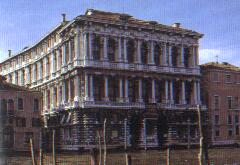 very powerful Pesaro family and today a double museum (Gallery of international Modern art and Oriental museum). It's another superb patrician, splendid baroque building from the architect Baldassare Longhena (we owe him the Santa Maria della Salute church), and we can affirm it is one of the most impressive along the Canal Grande. It was Longhena's last work since he died in 1682. (The building took almost 100 years, and was continued by Antonio Gaspario) in 1710). The Museo d'Arte Orientale has a very rich collection of Japanese items of the Edo epoch (1615-1868), and also Chinese and Indonesian (more than 30,000 pieces). I'm not sure you will be able to see the modern art collection: last time I was there it was closed due to works.
 |
|
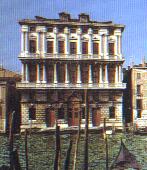
Corner della Regina |
Next place, the CORNER DELLA REGINA, where Caterina Cornaro, future queen of Cyprus, was born in the first construction that stood on this spot. Domenico Rossi built a high, severe, and narrow palazzo in 1724, isolated between two alleys. On its façade, you can see 17th elements and neo-classic motives.
Next to the Rialto bridge, a nice, intense yellow palazzo, built between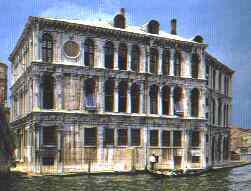 1525 and 1528, the PALAZZO CAMERLENGHI. Ancient home of the "camerlenghi" (treasurers) of the city. They were busy with the city finances and other legal institutions and opened a jail in the 16th century, mostly peopled by unsolvable persons. Money, money! Notice that this palazzo is one of the few in 1525 and 1528, the PALAZZO CAMERLENGHI. Ancient home of the "camerlenghi" (treasurers) of the city. They were busy with the city finances and other legal institutions and opened a jail in the 16th century, mostly peopled by unsolvable persons. Money, money! Notice that this palazzo is one of the few in
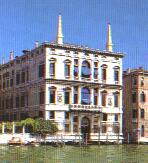 Venice that stands lonely, in solitary, with all facades presenting the same degree of perfection and finishing touch. Venice that stands lonely, in solitary, with all facades presenting the same degree of perfection and finishing touch.
To finish this article, here is the PALAZZO TIEPOLO-PAPADOPOLI, built about 1550 by Guglielmo dei Grigi, a grandiose edifice, appearing with a central portal and windows called "serliana", divided by jutted lintels. Next to it a series of entirely rebuilt or damaged Byzantine palaces, like the two Palazzo Dona, the palazzo Businello and Barzizza, evoke the intensity and dense population of this area in the 12th and 13th century, because of the proximity of the Rialto markets.
Bibliography
The Companion guide to Venice, by Hugh Honour-Venice and its lagoon, by Giulio Lorenzetti, Venice-A thousand Years of Culture and Civilisation, by Peter Lauritzen-Heures Italiennes, by Henry James (La difference 1985)- Venice, a Literary Companion, by Ian Littlewood's
The World of Venice, by Jan Morris.
|