|
From Roussillon and the
Provencal Colorado we have only a few miles to drive along winding roads until
APT.
APT with its 11,000 inhabitants was first a Roman town, than Episcopal city
since the 5th century. The city had a lot to endure since the
barbarians looted and razed the city regularly. But in these dark ages life went
on and patiently every destroyed building was reconstructed. In modern Apt we
could have forgotten this history wouldn’t we see the cathedrale Sainte-Anne,
originally so old that it grew discreetly like a parasitic plant into the
surrounding houses. It has two crypts: an antique of the 1st century and a
"modern" of the 11th century. Next to the church we can still see the
Tour de la Bouquerie with a modest campanile middle 18th century. The
campanile of Sainte-Anne, almost invisible from the street is much nicer and
from 1569. Unfortunately it was rather damaged during the revolution. 
I found Apt, coming from so much beautiful Provencal nature a bit boorish
with its uninteresting old streets but romantic squares. But as always, the
beauties are hidden and you must discover them. First the cathedral I just
talked about and second, you are not allowed to miss the Saturday morning market
when the whole region is gathered around the odours and colours of the Provence.
Diverse sorts of fruit, fruits confits (the best in the world), vegetables,
Provencal honey and local made potteries.
From Apt you can drive on the D 48 to the highest point in the Luberon via
Saignon. But be prepared for a narrow, winding and sometimes very steep road.
It’s quite near to SAIGNON from where you dominate the valley in a splendid
way. Magnificently leaning with the back to a with a superb view on. Nice Roman
church and little streets full of charm. SAIGNON doesn’t only give us a view
of the valley de Calavon but also on the plateau des Claparedes. We start now
another short but impressive journey along a very winding road in fact a dead
end road finishing in SIVERGUES. “Attention, fin de route” says a warning
sign at the entrance of the hamlet. It is barely a hamlet, just a gathering of a
few houses looking like small fortresses amidst high rocky walls where I suppose
a lot of grottos must be hidden.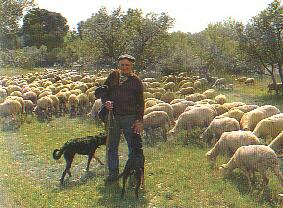
The isolated position of Sivergues attracted a lot of “waldenzes”
(Protestants) in the 14th and 15th century that mingled
without problems with the local Catholic population. At the worst moments of
“waldenzes “ chasings and pogroms by the baron of Oppede, the entire
population of Sivergues must have fled to the million years old grottos. Luckily
the fury of the massacres didn’t penetrate until this godforsaken place.
Today Sivergues is a vacation village, maybe one of the most beautiful of the
Luberon because it is so uneasy to get there, not much guide books talk about
talk about being at the end of a sort of blind-alley. And forget the
decent comfy hotel! In quiet times it is a dream
of old trees, purple irises, quiet houses and silent mountains all around.
Bibliography
« Circuits de decouvertes du Luberon », by Morenas F &C ,
Auberge de Jeuness Saignon (Vaucluse 19987-1992), "Guide de la Provence
mysterieuse" by Jean-Paul Clebert (Ed.Sand, 1986), "Provence", by
Jacques-Louis Delpal (ed.Natahn Paris 1987), "A guide to Provence", by
Michael Jacobs (ed;Viking, London 1988), "Luberon, carnets d'un voyageur
attentif", by Ollivier-Elliot Patrick,(ed. Edisud Aix-en-Provence 1991),
"Dictionnaire de la Provence medievale", by Jean Favier (Fayard, Paris
1993) « Provence des campaniles », by Etenne Sved (1971)
|