Bonnieux Lacoste Luberon Provence Site Home - What's New? -Feedback - About Jack- Travel/Art Links

Provence
|
Bonnieux Lacoste Luberon Provence Site Home - What's New? -Feedback - About Jack- Travel/Art Links |
|
|
|
Provence |

|
Jack's Provence travels |
|
Cavaillon, starting point of another grand tour
|
Luberon-Combe de Lourmarin-Bonnieux-Lacoste |
Cabrières d'Avignon, Mur de la Peste, Bories
Gordes and abbaye de Senanques
Gorges de Veroncle, Murs, grottoes de la Barigoule
Roussillon, ochre but a not so idyllic destiny
Buoux, Pertuis, Ansouis, Cadenet, abbey of Sylvacane
|
|
| Restaurant recommendations | Hotel recommendations | ||
|
Correction by Mr.Rip Green) Let’s return to Lourmarin
via the road north, the D 943 direction Bonnieux. This highly acclaimed canyon-like road,
which often gives you the impression you’re driving through Zion
National park or Bryce canyon, cuts deep into the narrow valley, sometimes only
a narrow chasm, and allows unfortunately only the passengers to enjoy the stunning
scenery. The driver has to concentrate on the winding and dangerous road!!
Especially in high season when bicycle riders are legion. At the fork to Apt we
take the D 36 left to Bonnieux. After 2 km we’ll see on the left side a large
parking space with a signboard (red bordered) with the inscription “Route DFCI
Cretes”. This is a forest road to the “Foret des Cèdres”, accessible with
your car when the barrier is open, which is NOT often in the summer (fire
danger). The first 5 km leads you to a second barrier where you have to get out
of the car and proceed on foot if you want to see the breathtaking panoramas over
the valley bordered by the plateau de Vaucluse with the towering Mont Ventoux.
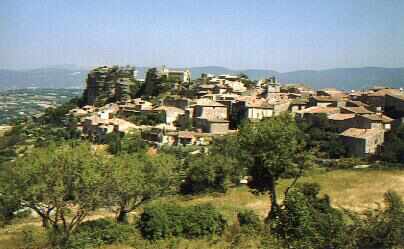
While walking you will discover incredible views of Bonnieux, Lacoste,
Roussillon and Apt. But let’s return
from
this little expedition and continue on the D 36 to Bonnieux. First we pass a typical
Roman bridge on the road to Apt. Quite a few world celebrities
have retired to this place, but live in
complete anonymity, avoiding us, the outsiders that we are. The
“Musée de la Boulangerie “ is worth a visit. It is located in an old
house on the main street at 12 rue de la Republique. A big collection of all the
tools used in the art of baking are on display. Notice that wherever you walk, you smell cedar, although they
are only 100 years old. Taking the advice of a guide, we entered the bakery of Henri
Tomas. The woman was charming! They told us that only Americans from San
Francisco and Boston come to Bonnieux - very curious!
Most of the inhabitants of the Luberon were followers of a Protestant sect called the “Waldenzes”. The Catholic repression was terrible. All of the villages and cities belonging to the "wrong" party were razed, destroyed, burned and all the inhabitants were slaughtered to the last man, woman and child. Why do I mention all of this? Because the difference between Bonnieux and Lacoste is the difference between Catholic and Protestant. As Catholic as Bonnieux was, Lacoste was even more Protestant. While driving, the scenery might seem idyllic and look like a something from a movie about gallant, chivalrous knights. The truth is much more cruel. After the destruction of Merindol and Cabrieres d’Aigues, Jean Meynier, the baron of Oppède, arrived in 1545 in Lacoste. It became a year of total disaster. Despite the deal made with the local aristocracy that nothing would happen if they opened the gates, as soon as the soldiers entered, a real mass murder started: it was apocalyptic. Men were thrown over the cliffs, women also -- but only after being raped. Fire was set in all the houses and only the chateau escaped thanks to the intervention of the vice-president of the Aix parliament. This chateau is located on the highest point in Lacoste. It became famous much later when the marquis de Sade lived in it from 1771 to 1778. Yes, the famous one. He was imprisoned in the Bastille and when he died his janitor bought the castle. The elderly owner, Andre Bouer, restored it slowly and patiently but only partly. The American professor
Michael Jacobs, who stayed a while in Lacoste for the Cleveland Institute of
Arts, admitted in his Provence book that he always found Lacoste “slightly
sinister”. The Provence specialist Jean-Paul-Clebert says the same thing about
his own village Oppede-le-Vieux and I will add my deux centimes worth by saying
that despite the sun, beauty of nature, colours and wind I too find some places that
give me an uneasy feeling. Bibliography: "Notes
d'un voyage dans le Midi de la France" by Prosper Merimée (Ed.Adam Biro,
Paris 1989), "Guide de la Provence mysterieuse" by Jean-Paul Clebert (Ed.Sand,
1986), "Guide du Routard Provence 1998 (Ed.Hachette), "Provence",
by Jacques-Louis Delpal (ed.Natahn Paris 1987), "A guide to Provence",
by Michael Jacobs (ed;Viking, London 1988), "Luberon, carnets d'un voyageur
attentif", by Ollivier-Elliot Patrick,(ed. Edisud Aix-en-Provence 1991) |
|||