|
The second route through the
Luberon starts again from Cavaillon. It will lead us through the magnificent
southern slopes of the Plateau du Vaucluse, where we will visit typical villages
like Cabrières-d’Avignon and Murs and even will go to the Cistercian abbey de
Senanques. But behind all these sunny facades we must know that (if we are open
minded to such unpleasant history) once the region was drenched with blood
during the Protestants massacres and their ordeal. Starting from Cavaillon, we
will pass through Cabrieres, the “bories” village near Gordes, Senanque, les Gorges de Veroncle, Murs, Roussillon, Apt, Saignon, Sivergues and
end with a visit to the lavender rich plateau des Claparèdes and end in
apotheosis on the mighty Fort de Buoux.
But let’s visit our base city, before we forget to do it: CAVAILLON.
CAVAILLON doesn’t make a big impression on first sight. Like so many cities
where we pass at the speed of 100 miles/h, Cavaillon looks at bit sleepy, but
the miracle happens every time if we make the effort to step out of the car and
loiter without to many cultural ambitions through the “centre historique”.
Cavaillon is a peaceful city, located in the middle of an immense orchard where
it grows a lot of fruit and vegetables sold all over the world.
The ideal
parking place is the Place du Mos from where you have different options. Climb the rocky
slope of Montagne Saint-Jacques to the chapelle Saint-Jacques (12th
century). Or loiter around in
the adjoining Cours Bournissac which has plenty of agreeable
cafes with large terraces and the old-style Cafe Fin de Siècle, where it is so
good to sit in the warm morning sun, sipping coffee and reading the morning
newspaper.
It would be unwise to attribute touristy qualities to Cavaillon, even
if I would advise to loiter in the streets around the roman style cathedral
NOTRE-DAME-DE-SAINT-VERAN and try to visit the inside, despite the opening hours
policy are so bizarre that you will have almost no chance to be lucky;-). It has
also a charming small cloister, full of charm and freshness.. The cathedral was
probably built in the 12th century, burned by a protestant leader, the Baron des Adrets in
1562. An even much greater catastrophe happened to the cathedral when it was
“restored” the hard way in the 19th century.
Not to miss is the SYNAGOGUE, closed on Saturday of course, located in the rue
Hebraique, first "compulsory" Jewish ghetto from 1453, symbol of
exclusion and tolerance all together, typical of the Papal States. This one was
built in the 18th century, and is considered as one of the jewels of
French Judaic art. The interior of the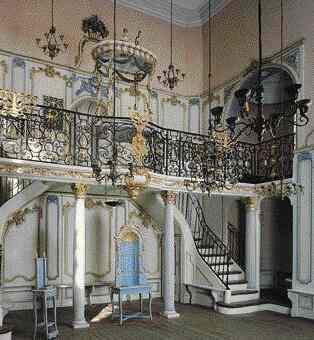 synagogue is, thanks to its incredible
rococo interior, a unicum in the area. It kept all its original decoration of
gracious Louis XV wainscoting with superb bronze chandeliers, the sacred arch where the torahs are kept.
One of the most spectacular is the tribune of the rabbi, where he read the holy
scriptures. A double staircase faces the tabernacle containing the sacred
Torahs. On display very precious and beautiful cult objects like mezuzahs,
menorahs, centuries old torahs, prayer books (siddours) and shabbat
used objects in silver. Another unicum is the small, well conserved
Jewish bakery with its matzoth furnace to bake the unleavened bread on Pessah. The story
of the presence of the Jews in Cavaillon is worth an explanation. Jews, having
received permission from the pope to settle down in the area under his
supervision had to wear yellow hats, lived separately in the ghetto described
above, closed every night with a chain. In this area there were three other
ghettos like this: in Avignon, Isle-sur-Sorgue and Carpentras. Why did so
many Jews come to this area around Avignon? Simply because a lot of foreigners,
princes and dignitaries lived and frequented the pope court (in Avignon), and
since all money business handling was strictly forbidden for the Christians, the
Jews, whose only source of income it very often was, came as saviours in need!
The first settlement in Cavaillon was about 200 but it expanded in the 18th
century unto 2,000. synagogue is, thanks to its incredible
rococo interior, a unicum in the area. It kept all its original decoration of
gracious Louis XV wainscoting with superb bronze chandeliers, the sacred arch where the torahs are kept.
One of the most spectacular is the tribune of the rabbi, where he read the holy
scriptures. A double staircase faces the tabernacle containing the sacred
Torahs. On display very precious and beautiful cult objects like mezuzahs,
menorahs, centuries old torahs, prayer books (siddours) and shabbat
used objects in silver. Another unicum is the small, well conserved
Jewish bakery with its matzoth furnace to bake the unleavened bread on Pessah. The story
of the presence of the Jews in Cavaillon is worth an explanation. Jews, having
received permission from the pope to settle down in the area under his
supervision had to wear yellow hats, lived separately in the ghetto described
above, closed every night with a chain. In this area there were three other
ghettos like this: in Avignon, Isle-sur-Sorgue and Carpentras. Why did so
many Jews come to this area around Avignon? Simply because a lot of foreigners,
princes and dignitaries lived and frequented the pope court (in Avignon), and
since all money business handling was strictly forbidden for the Christians, the
Jews, whose only source of income it very often was, came as saviours in need!
The first settlement in Cavaillon was about 200 but it expanded in the 18th
century unto 2,000.
The Jewish community was seen in the 18th century as an an
independent republic , having its own laws, judges, but strictly forbidden to
make business with the gentiles (papal ordinance!).
A very important economic
fact that happened to Cavaillon was the building of a canal maze that irrigated
the soil and thanks to a warm and sunny climate made Cavaillon to one of the
most famous vegetable regions of France, without mentioning the world famous
yellow melons “les melons de Cavaillon” ! Originally from India, the melon
found its way to Cavaillon in the 15th century.
Ah! The melon! Gives you right the taste, feeling and smell of sun and vacation!
But enough now, we know Cavaillon by now and want to go on…that’s for next
article, driving to the Plateau du Vaucluse.
Bibliography
"La
Provence et le Comtat Venaisin, Arts et Traditions Populaires", by
B.Fernand (Aubanel, Avignon 1992), "Guide de la Provence mysterieuse" by Jean-Paul Clebert (Ed.Sand,
1986), "Guide du Routard Provence 1998 (Ed.Hachette), "Provence",
by Jacques-Louis Delpal (ed.Natahn Paris 1987), "A guide to Provence",
by Michael Jacobs (ed;Viking, London 1988), "Luberon, carnets d'un voyageur
attentif", by Ollivier-Elliot Patrick,(ed. Edisud Aix-en-Provence 1991),
"Dictionnaire de la Provence medievale", by Jean Favier (Fayard, Paris
1993)
|