|
The beginning of this tour
is completely off beaten path. I cannot remember a guide describing the village
we are going to visit but to feel the dark Provence we must do it.
We leave Cavaillon driving on the D2 direction Apt until the intersection with
the N 100, we cross this busy highway and a few hundreds meters later we take
left on the D 110 to CABRIERES-D’AVIGNON. 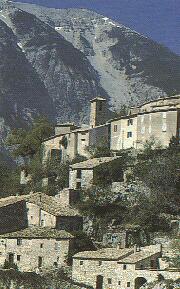 It is one of those sleepy villages
along the slope of the plateau du Vaucluse where you don’t spot anything
particular at first sight. But its history is terrible. The religious riots
drenched this village with blood in the 16thy century. Children’s heads were
cut off, women were raped and murdered, pregnant woman trampled by horses, all
living protestant was killed and burned by the baron of Oppede and his troops.
This was the mentality of these regions in medieval ages. And what was left of
Cabrieres was put on fire. It is one of those sleepy villages
along the slope of the plateau du Vaucluse where you don’t spot anything
particular at first sight. But its history is terrible. The religious riots
drenched this village with blood in the 16thy century. Children’s heads were
cut off, women were raped and murdered, pregnant woman trampled by horses, all
living protestant was killed and burned by the baron of Oppede and his troops.
This was the mentality of these regions in medieval ages. And what was left of
Cabrieres was put on fire.
Today, the village is one of those where you could put the question: has it any
sense to remind all these horrors that happened 500 years ago? I would say yes;
you feel it in the air. The “clash” of the mass murder still wanders through
the roofs and narrow streets. This feeling occurs not only because, even during
working days, you see nobody in the streets, but it are the silent witnesses
like the chateau, aside from the village giving that feeling. With its manly
heavy watchtower and main building it gives an impression of deadly tiredness,
too much suffering.
At the foot of the castle a plaque indicates “LE MUR DE LA PESTE” (Wall of
the Plague). It served as protection against the deadly plague epidemic in 1720.
It came from a ship in Marseille and spread out like the wind. It reached Apt
and a wall was set up hastily (20 km long), to try to stop the penetration of
the terrible illness. The wall was guarded by soldiers who had the order to
shoot, kill and burn everybody, as well as its clothes, trying to climb the
wall.
A good idea would be to drive the car in western direction Lagnes and after 1.2
km in a hairpin bend we park the car. From here you can see the restored wall,
looking to the north. You could even jump over a chain and follow a private path
through the scrub, orienting us towards the wall. The climb along the wall, not
higher than an average man, testifies again for the so typical atmosphere in
Provence. A double face, a double decor that makes us think and makes us more
humble than the sunny enthusiasm of the classic tourist literature.
We continue our itinerary
direction Gordes. Just before arriving, we see panels pointing us to the most
famous “BORIE-VILLAGE” of Provence. A “borie “is a modest and
unpretending home, built with lose stones just posed one on the other. What is special is that the stones are put together so
cleverly that the construction ends points to the top. This kind of building
exists in the Mediterranean since centuries. “Trulli” in Apulia, "caselle”
in Luguria, Kreta and Sardinia, Syria and Spain. In the French Alps it is called
a “souleiaire”, a barn exposed to the sun, and in west of the Durance they
call it a “cabanon”, even if it doesn’t resemble at all to a borie. The
serious “Guide Bleu” announces that these bories were used on weekends by
youngsters to make love and why not?? But wherever we will see them and all the
myths told around them, the scientists found out not one is older than the 17th
century.
The BORIE-VILLAGE near Gordes is a special example of the borie culture. You can
see here how big a borie could be. There is one of 20 m long and 10 m high,
while other bories are grouped and surrounded by different walls. It was
restored by Pierra Viala since 1960 and is now owned by the city of Gordes, with
well organized visiting hours.
Next article we visit Gordes
and the abbey of Senanque.
Bibliography:
"La
Provence et le Comtat Venaisin, Arts et Traditions Populaires", by
B.Fernand (Aubanel, Avignon 1992), "Guide de la Provence mysterieuse"
by Jean-Paul Clebert (Ed.Sand, 1986), "Provence", by Jacques-Louis
Delpal (ed.Natahn Paris 1987), "A guide to Provence", by Michael
Jacobs (ed;Viking, London 1988), "Luberon, carnets d'un voyageur attentif",
by Ollivier-Elliot Patrick,(ed. Edisud Aix-en-Provence 1991), "Dictionnaire
de la Provence medievale", by Jean Favier (Fayard, Paris 1993)
« Provence,
terre de meurtres et viols », by P.Vilbralat.
|