|
Next superb village in the Luberon is
GORDES.
I say superb, because I find it superb and so do all the travel guides. But with
Gordes I have a strange relation. Gordes is mostly a “picture”, a
“photography”, like the colour chromo on an expensive Swiss month calendar,
taken from the valley beyond and with the view of its marked style of buildings
and its chateau, high up there on a frightening rock formation. Hooked on a
scarped headland where the light plays different tonalities, according to the
hours of the day.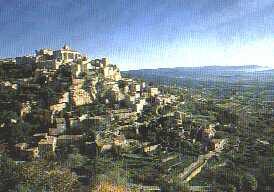
Some readers will jump out of their chairs but when I drive into Gordes it looks
empty (off season of course), because the inhabitants are in the fields or in
the café. Off season it is not more than an insignificant assemblage of
uninteresting small streets leading to a square where the Renaissance castle of
Gordes is located. Of season there is even the need of a “library-bus” to
climb up to the village paid by the ministry of Culture to this forgotten
backcountry. Fifty years ago the village was almost deserted but that's maybe
why it suddenly attracted so many painters and intellectuals. Vasarely for
instance, who bought the chateau to house his collection in it.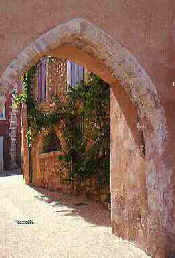 He donated it to the village after
restoring it. And since the museum reopened the village became THE place for
summer tourism. Painters and intellectuals give it a new life.
He donated it to the village after
restoring it. And since the museum reopened the village became THE place for
summer tourism. Painters and intellectuals give it a new life.
Wow! In the summer months Gordes and its small streets are as busy as the
boulevard of a major bathing resort, tourists and painters enjoying the
beautiful view on the large valley between the plateau du Vaucluse and the
Luberon range. Impossible to park your car without being punctured
immediately 15 FF. The chateau is visited for the musee Vasarely that should be
inside (should be, since the family Vasarely is in big dispute! and Vasarely
died two years ago).You can admire, at the first floor, the second largest
Renaissance fireplace of France. 4 km north of Gordes there is also, for the
amateurs, the “Musee du Vitrail” (Stained Glass museum) with mostly works of
Frederique Duran.
Leaving
Gordes, an exciting adventure awaits us when we take the D 177 west of the
village direction Venasque and start a breathtaking descend along a winding road
cut out in the rocky wall.
In the immense valley that will soon open before your eyes with a
superb view on the Cistercian abbey of SENANQUES nestled in a dell of greenery.
The edifice is one of the most beautiful of France. 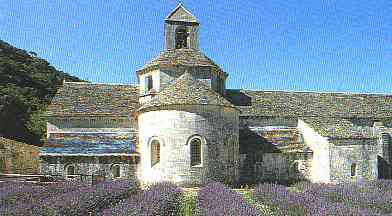 The two other Cistercian
abbeys being Thoronet and Silvacane. The two other Cistercian
abbeys being Thoronet and Silvacane.
Founded in 1148 by Cistercian monks of the Simiane family, who can be considered
as the oldest nobility of Provence who owned practically whole Provence, they
received everything to bring all to a good end. To return to the bloody history
of the area, just notice that the “Waldenzes” (Protestants), who were (remember my previous
articles?) massacred and expelled from their villages of Gordes, Cabrieres or
Merindol, super excited and looking for vengeance, took Senanques as symbol of
the Catholic repression and put the abbey into fire after having killed all the
monks that didn’t manage to escape. What an epoch!!
Senanques never was the same after that fatal blow. Vague restoration programs
aborted and the monks slowly left the place. Père Dimier in his book “L’Art
Cistercien” says: “the last monk died in 1715 and was not more than an
impotent old man.”. But it returned to its religious destination between 1854
and 1969. Two monks live here again since 1988, coming from the Iles de Lerins.
Today the abbey is open for the public but only if you pay. You can even (if
you’re lucky), listen to Gregorian chants by bare foot monks on ice-cold
pavements. From the hall, stairs lead you to the ”dormitorium”, sleeping
room, a long gallery with gothic vaulted roofs.
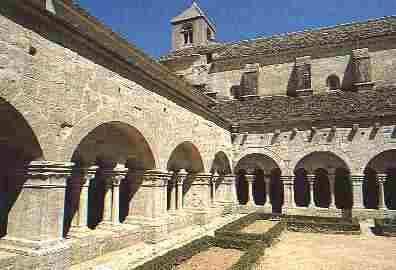
Visit the cute cloister also. There is
even a good library where you can buy books about medieval history and religion.
About the “Waldenzes”, nothing although I saw a few books over the
“Cathars “ in Languedoc.
The real enjoyment is to loiter around the abbey and admire the lavender fields
(like on the picture), if you’re lucky to be there in July.
Next, we will go to Murs via the gorges de Veroncle.
Bibliography:
"La Provence et le Comtat Venaisin,
Arts et Traditions Populaires", by B.Fernand (Aubanel, Avignon 1992),
"Guide de la Provence mysterieuse" by Jean-Paul Clebert (Ed.Sand,
1986), "Provence", by Jacques-Louis Delpal (ed.Natahn Paris 1987),
"Luberon, carnets d'un voyageur attentif", by Ollivier-Elliot
Patrick,(ed. Edisud Aix-en-Provence 1991), "Dictionnaire de la Provence
medievale", by Jean Favier (Fayard, Paris 1993)
, " Provence, terre de meurtres et viols ", by P.Vilbralat.
|