Buoux Pertuis Ansouis Cadenet abbaye de Sylvacane Luberon Provence Site Home - What's New? -Feedback - About Jack- Travel/Art Links

Provence
|
Buoux Pertuis Ansouis Cadenet abbaye de Sylvacane Luberon Provence Site Home - What's New? -Feedback - About Jack- Travel/Art Links |
|
|
|
Provence |
|
Jack's Provence travels |
|
Cavaillon, starting point of another grand tour
|
Luberon-Buoux-Pertuis-Ansouis-Cadenet-Abbey de Sylvacane |
Cabrières d'Avignon, Mur de la Peste, Bories
Gordes and abbaye de Senanques
Gorges de Veroncle, Murs, grottoes de la Barigoule
Roussillon, ochre but a not so idyllic destiny
Buoux, Pertuis, Ansouis, Cadenet, abbey of Sylvacane
|
|
BUOUX is a hamlet, not even
a village, off the beaten path and has a hell of a chram! You can eventually lunch in the Auberge de la Loube, where
the hors d’oeuvre are famous. Served on an enormous plateau is composed by 17
different items. Quality change with seasons. Best is off-season late fall or in
the winter. If you still can move after all this food, move to the FORT DE BUOUX.
The best moment to visit is on an early morning. I would even say an apotheosis
of the two circuits I proposed through the Luberon. After the Auberge de de la
Loube, drive a short while through the valley of Aiguebrun and stop at the sign
“Colonie de vacances”. You have there a small parking lot for the visitors
of the fort. There is still some walking to do along a small path to the fort.
Climbing we will see curious rock formations with inscriptions and witnessing
that human hand has worked here already for over a thousand years. Suddenly we
see a medieval watchtower as warning of an enormous defensive system that
extended on a rock formation of 80 meters and climbs until 556 to the dungeon on
top. Pay your entrance fee and walk over enormous pebbles, prehistoric homes
carved in the rock and a covered water reservoir still filled with water. One of
the wonders of Buoux is the field with proto historic silos for food, deeply
hacked in the rocky soil. The first impression of the fort is that of a great
aesthetic strength thanks to hi high position under an immense sky always
scattered with green oaks. Bibliography |
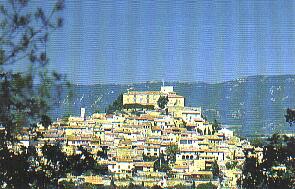 PERTUIS with its 12,500
citizens has some very old buildings like the Tour Saint-Jacques (14th
century) and the bell tower (13th century), the church
Saint-Nicolas (16th century) with a beautiful retable.
Leaving Pertuis you’ll see
after 6 km the “Tour d’Aigues” with the ruins of a 16th
century castle rebuilt in the 18th
century. In the chateau two museums are to visit: the Musee des faiences
and the musee de l’Histoire du Pays d’Aigues.
PERTUIS with its 12,500
citizens has some very old buildings like the Tour Saint-Jacques (14th
century) and the bell tower (13th century), the church
Saint-Nicolas (16th century) with a beautiful retable.
Leaving Pertuis you’ll see
after 6 km the “Tour d’Aigues” with the ruins of a 16th
century castle rebuilt in the 18th
century. In the chateau two museums are to visit: the Musee des faiences
and the musee de l’Histoire du Pays d’Aigues.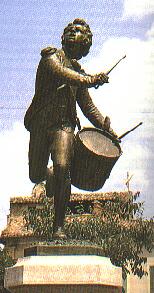 church (14th century) has a nice Provencal clock tower.
On the main square there is a statue
representing a “Le tambour d’Arcole” the tambour player of Napoleon. There
is a nice musee de la Vannerie, "museum of basket-making".
church (14th century) has a nice Provencal clock tower.
On the main square there is a statue
representing a “Le tambour d’Arcole” the tambour player of Napoleon. There
is a nice musee de la Vannerie, "museum of basket-making".