|
Heading on the D 973 we
arrive in MERINDOL, a “typical” Provence village with its cosy ochre square,
reuniting the “Mairie”, the grocery shop and the Maison de la Presse.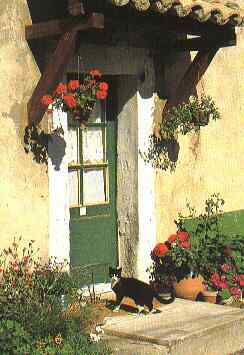 It
lies at the foot of powerful slopes, being a part of the so-called
“Petit-Luberon”. High above we see the ruins of an old village, destroyed
during the cruel religion wars with the baron de Oppede. It’s a steep climb,
only for hysteric amateurs. I preferred to continue my route to Lauris, 8km more
to the west. A village with a name like that cannot be ugly. You will not find
the name in any guide, oh yes only one, because Joseph Garnier, the local hero
introduced the asparagus culture. Just stop a moment at the corner of the rue du
Portail and rue Sainte-Marguerite and enjoy the sight of a grocery shop at one
side, and a moving saint-Catharine with child niche on the otherside. Take now the D 27 and in a
few minutes we arrive in LOURMARIN.
It
lies at the foot of powerful slopes, being a part of the so-called
“Petit-Luberon”. High above we see the ruins of an old village, destroyed
during the cruel religion wars with the baron de Oppede. It’s a steep climb,
only for hysteric amateurs. I preferred to continue my route to Lauris, 8km more
to the west. A village with a name like that cannot be ugly. You will not find
the name in any guide, oh yes only one, because Joseph Garnier, the local hero
introduced the asparagus culture. Just stop a moment at the corner of the rue du
Portail and rue Sainte-Marguerite and enjoy the sight of a grocery shop at one
side, and a moving saint-Catharine with child niche on the otherside. Take now the D 27 and in a
few minutes we arrive in LOURMARIN.
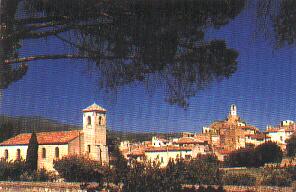 This very cute village, becoming quite
popular in the summer is a village where I spent a few days some time ago. The
village has his usual share of pottery bakers, weavers and joiners. Here the
site not to miss is the Chateau. The old palais Vieux dates from the 15th
century and has a tower giving you a magnificent view of the Luberon. The palais
Nouveau is in Renaissance style and worth the visit. It was the property of the
family d’Agoult, a name that will pop up regularly in old villages with a
castle. Bought in the twenties by a rich industrial from Lyon it was tastefully
restored. He ruined himself almost with the expenses having bequeathed the
castle to the Academie des Arts in Aix, you can visit it today, but only with a
guide (every day, except Tuesday from No1 to March 31). It has always been a meeting place for writers, thinkers and musicians. By
the way, Albert Camus lived in Lourmarin and is buried in the local cemetery,
after dying in an automobile accident in 1960. The street where he lived is
called rue Albert Camus.
This very cute village, becoming quite
popular in the summer is a village where I spent a few days some time ago. The
village has his usual share of pottery bakers, weavers and joiners. Here the
site not to miss is the Chateau. The old palais Vieux dates from the 15th
century and has a tower giving you a magnificent view of the Luberon. The palais
Nouveau is in Renaissance style and worth the visit. It was the property of the
family d’Agoult, a name that will pop up regularly in old villages with a
castle. Bought in the twenties by a rich industrial from Lyon it was tastefully
restored. He ruined himself almost with the expenses having bequeathed the
castle to the Academie des Arts in Aix, you can visit it today, but only with a
guide (every day, except Tuesday from No1 to March 31). It has always been a meeting place for writers, thinkers and musicians. By
the way, Albert Camus lived in Lourmarin and is buried in the local cemetery,
after dying in an automobile accident in 1960. The street where he lived is
called rue Albert Camus.
An erudite guide who will hold your breath for 45 min and tell you
everything about this castle with its very beautiful rare
furniture and a very nice painting of the Leonardo da Vinci school, Le Joueur de
Luth. And what to say about the most surprising feature to se in this castle! A
fireplace! What's so special about a fireplace? It is simply sustained by big
Aztec statues!
After Lourmarin we have two
possibilities: enter the land of “Aigues”, climatologically speaking the
most agreeable part, but not on the tourist priority. The other one is to choose
the COMBE DE LOURMARIN, through the valley of Aiguebrun, direction Bonnieux and
Apt. But let’s just make a
small incursion in the “Pays d’Aigues”. Via the D 56 via Vaugines to
CUCURON. Vaugines
is a village that could not exist elsewhere than in Provence. That’s also the
reason why the French movie director Claude Berri located his famous Marcel
Pagnol’s film “Manon des Sources” here. From Vaugines to CUCURON it’s
only a few minutes, Cucuron the favourite village of Alphonse Daudet, placing
the village as Cucugnan in his novels “Lettres de mon Moulin”. Climbing
the rocks behind the village, we can see Cucuron as an untidy opera décor. From
our high point of view we see also the roman-gothic church tower crowned with a
cast-iron weathercock and the cross of the counts of Toulouse. For those who
have plenty of time they can continue towards Ansouis (D 56), and La Tour
D’Aigues but the let’s return to Lourmarin and do the famous Combe de
Lourmarin. That’s for next article.
Bibliography:
"Notes d'un voyage dans
le Midi de la France" by Prosper Merimée (Ed.Adam Biro, Paris 1989),
"Guide de la Provence mysterieuse" by Jean-Paul Clebert (Ed.Sand,
1986), "Guide du Routard Provence 1998 (Ed.Hachette), "Provence",
by Jacques-Louis Delpal (ed.Natahn Paris 1987), "A guide to Provence",
by (ed;Viking, London 1988), "Luberon, carnets d'un voyageur
attentif", by Ollivier-Elliot Patrick,(ed. Edisud Aix-en-Provence 1991)
|