Luberon Menerbes Oppede Robion Site Home - What's New? -Feedback - About Jack- Travel/Art Links

Provence
|
Luberon Menerbes Oppede Robion Site Home - What's New? -Feedback - About Jack- Travel/Art Links |
|
|
|
Provence |
|
Jack's Provence travels |
|
Cavaillon, starting point of another grand tour
|
Luberon-Menerbes-Oppède-Robion |
Cabrières d'Avignon, Mur de la Peste, Bories
Gordes and abbaye de Senanques
Gorges de Veroncle, Murs, grottoes de la Barigoule
Roussillon, ochre but a not so idyllic destiny
Buoux, Pertuis, Ansouis, Cadenet, abbey of Sylvacane
|
| hotel recommendations | ||
|
Let’s leave Lacoste along
the D 109 direction MENERBES. This perched village is one of my favourites in
this part of Provence, but I will not impose you the history of all the houses,
porches and churches. It is much more fun to loiter through the streets and to
enjoy panoramas, views over the deep lands from this giant rock looking like a
steam ship! The best period is on a quiet spring day, when the sky is blue and
when yellow and purplish red wallflowers spread their odour.
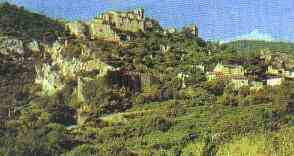
The chateau of Oppéde used
to be the propriety of the Counts of Toulouse, who left the whole territory to
the pope in 1274. But when much later, the anti-pope Pedro de Luna-alias
Benedictus XIII fortifies the small village to resist the “legitimists”,
using Catalan mercenaries, he could only stop them for 2 years and had to
surrender but only after having destroyed the castle very thoroughly. The
village lost its inhabitants with the years, fleeing the brutal reign of the
local lords, of who a certain Jean was responsible for a lot of mass murders of
Protestants in the Luberon. About
1910 all inhabitants left the uneasy rock village to establish in the lower Oppède-les-Poulivets.
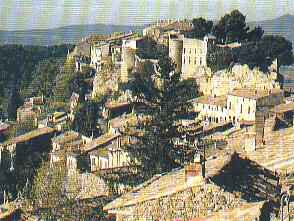
Nevertheless, Oppède le Vieux has an undeniable charm. Maybe because it is
partially abandoned. There is nothing to see in or around the village: streets,
paths or alleys are uncomfortable to walk on, like on a dirt road. Beside a cafe
on the small central square of the village, one or two shops: nothing and
zip. Just a few paved streets leading
through the few streets where people are living. Bibliography "Notes d'un voyage dans le Midi de la France" by Prosper Merimée (Ed.Adam Biro, Paris 1989), "Guide de la Provence mysterieuse" by Jean-Paul Clebert (Ed.Sand, 1986), "Guide du Routard Provence 1998 (Ed.Hachette), "Provence", by Jacques-Louis Delpal (ed.Natahn Paris 1987), "A guide to Provence", by Michael Jacobs (ed;Viking, London 1988), "Luberon, carnets d'un voyageur attentif", by Ollivier-Elliot Patrick,(ed. Edisud Aix-en-Provence 1991) |
 Unknown
and underestimated by the tourists because the village doesn't have nor a hotel
or trendy restaurant.
Unknown
and underestimated by the tourists because the village doesn't have nor a hotel
or trendy restaurant.