|
Views of Venice were very much "in " in the 18th century. Gallery 17 gives you a very good idea with paintings of Canaletto and Guardi. Pietro Longhi created charming scenes of daily life in Venice.
If your time schedule permits, continue and don't miss gallery 20. Big format paintings, It's what is called "teleri" painting series expressing the vital aspects of the 15th century Venice.
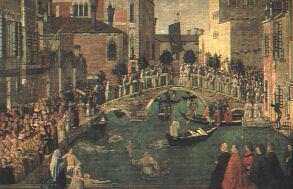
Eight enormous paintings, created by the ceremonial painters of that era: Gentile Bellini (brother of Giovanni) and Vittore Carpaccio. It's especially the "Legend of the Holy Cross" which is interesting. It is said that the kingdom Cyprus offered a part of the holy cross to the Scuola Giovanni Evangelista in 1369.
 |
|
Miracle of the Cross |
The eight "teleri" show the different adventures that happened to the cross. Gentile Bellini's "Procession on the Piazza San Marco"1496), shows an episode where the dying son of a merchant recovers when his father kneels in front of the cross. Other painting, "The miracle of the cross at the canal of San Lorenzo" (1500), by the same painter, tells us that the cross fell in the canal and was saved by the administrator of the Scuola. Notice also the painting by Carpaccio: "The healing of the fool" (1496) where you can see the wooden Ponte Rialto which collapsed in 1524. The fool is to see on the upper balcony. I was astonished to see how Venice has stayed more less the same as 500 years ago! Carpaccio succeeds to recreate the atmosphere of Venice.
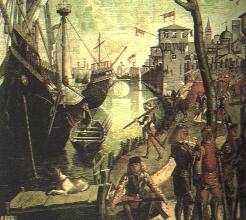
Gallery 21 is mainly dedicated to the "Legend of Saint-Ursula", a series made between 1495 and 1500 for the Scuola di Sant'Ursola, and are the most evident example of the story telling painting of the 15th century Italy. The story itself is classic. Saint Ursula, the daughter of the Christian king of Brittany, marries the son of the king of England at the condition he becomes a Christian and that she would be entitled to make a pilgrimage to Rome with 11,000 virgins.
 |
|
Legend of St.Ursula |
The whole bunch, Ursula and the
virgins were slaughtered during their trip by the Huns.
Let's finish with gallery 24. A triptych of Andrea Vivarini and Giovanni d'Alemagna combine the already upcoming Renaissance style with the gothic. Tiziano Vecello's "Tempe march of Maria" forms a dignified farewell to the museum.
Just a few words about Venice's greatest Renaissance painters.
Giovanni Bellini (1430-1516) was the first to drive the Venetian Renaissance to such high level. He was contemporary to other great artists like Paolo Ucello, Fra Filippo Lippi and Donatello working in Padova and Venice. He was much influenced by his brother in law, Andrea Mantegna, from Padova, very rational and master of perspective. Bellini added humanity to this cold realism. That influenced other great masters like Giorgione (1477-1510), who died very young from the black plague, but whose creative imagination and renewed approach of light and colour makes him a predecessor of modern art.
And then you have Tiziano (1485-1576), an unequalled control of rich colours and harmonious composition, the most wanted painter in Europe. His competitors were Veronese (1528-1588) and the very productive Tintoretto (1518-1594), with its dramatic light effects.
Bibliography
The Companion guide to Venice, by Hugh Honour-Venice and its lagoon, by Giulio Lorenzetti, Venice-A thousand Years of Culture and Civilisation, by Peter Lauritzen- l’Art Venitien, by Terisio Pignatti (Flammarion, 1992), Heures Italiennes, by Henry James (La difference 1985)- The Galleries of the Accademia, by Francesco Valcanover
|