| Main
Antwerp page
Antwerp
Zoological garden
Antwerp by foot, its
insolent and secret
treasures
Introducing
the walk Keyserley-Leysstraat-Meir
Meir
shopping, slowly loitering to Rubens house
Rubens, his life and
his house
Bird
market-Bourla theatre - more shopping
Shopping streets to Groenplaats
Area
around Antwerp Cathedral
Cathedral of Our-Lady
Grote
Markt and Town hall
Guild
houses-Vlaaykensgang
Hoogstraat and Grote
Pieter Potstraat
Printers museum
Plantin-Moretus
Museum Mayer van
den Bergh-Maagdenhuis
Strolling
to the Carolus Borromeus church
Rockoxhuis-
Rubens tomb at St.Jacobskerk
Cogels-Osylei area, unique in the world (1)
Cogels
Osy area, unique in the world (2)
|
Born in Siegen near Koln,
Germany, on the 28th of June 1577, where his Flemish family had found
refuge. He returned to Antwerp only when ha was 12 years old. His precocious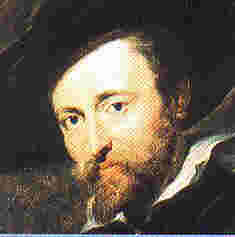 attraction to art and antiquity will soon orientate his
destiny. Like many other artists,
he learned a lot from his sojourn in Italy. This influence will stay the rest of
his life, inspiring his work, even the architecture of his home. Rubens will
live his best years during the reign of the infant Isabella. His school gains
international reputation. Flanders being a sort of Spanish colony at the time
the archduke Albert appoints him to be the Courts painter in Brussels in 1609.
From 1622 on, Rubens travels all over Europe as ambassador, representing
Flanders in a splendid way. He dies in Antwerp in 1640 and is buried in the
Saint-Jacobs church. attraction to art and antiquity will soon orientate his
destiny. Like many other artists,
he learned a lot from his sojourn in Italy. This influence will stay the rest of
his life, inspiring his work, even the architecture of his home. Rubens will
live his best years during the reign of the infant Isabella. His school gains
international reputation. Flanders being a sort of Spanish colony at the time
the archduke Albert appoints him to be the Courts painter in Brussels in 1609.
From 1622 on, Rubens travels all over Europe as ambassador, representing
Flanders in a splendid way. He dies in Antwerp in 1640 and is buried in the
Saint-Jacobs church.
The house he built in 1610
will be the one he will live the rest of his life. Designed after his own plans,
influenced by the Italian Renaissance style, beautiful and practical, perfectly
disposed, as well as for the pleasure of the eyes and life as for the functional
necessities of his work, he will conceive and execute here most of his master
works. A rough estimation is that he produced 2500 works during his life.
Obviously the painters pupil union didn’t exist at that time to temper the
zeal of the master! ;-) Work had to be done with a strict discipline and
organization. The project was almost more important than the final product
because it emanated from the artist himself, while a part of the work was done
by his pupils. A few famous ones were Anthony Van Dijck, Jacob Jordaens, the
Velvet Brueghel….
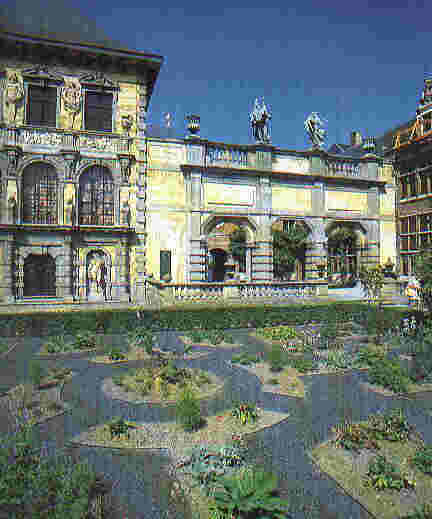
If the facades on the street
side are quite sober, the monumental baroque exuberance explodes in the inner
courtyard. Obviously, Rubens took his inspiration in Italy for his garden and
decorations. Not only did he decorate the area with niches, frontons, not only
did he enhance the interior facades with garlands, he edified two different
building face to face, connected by a genuine “ triumph arch”, sort of
magisterial synthesis of the Flemish and Italian character of the house.
The perspective on the
garden and the garden pavilion completes the décor. The Rubens house is
considered as one of the masterpieces of Flemish baroque, just like the
admirable “Grand Place” in Brussels or the beautiful Saint-Charles Borromeus
church in Antwerp.
 |
|
Rubens house garden |
If
the part of the wing where he lived is the traditional reflection of the Flemish
patrician house, vast and comfortable, disposed with taste and enhanced with
master pieces, it’s above all his personal museum and work ateliers, that
arouse, even during his lifetime, “ astonishment from strangers and admiration
from visitors”. An inventory, made just after he died, revealed nearly 300
works he owned and from the greatest painters: Jan van Eyck, Hugo van der Goes,
Quinten Metsys, Brueghel the Elder, Tiziano, Veronese, Raphael….without
counting a lot of his friends and pupils (only from Adriaan Brouwer he had 17
paintings!!). You can see a few today in his art cabinet that ends in a
“hemicycle museum where he kept an important collection of antiquities he
brought from Italy. It defies imagination!: sculptures, sketches, tapestries,
books, gravures, medals, ivory objects, precious stones….
In the rooms on the first
floor Helena Fourment portrait is exposed here. She gave him five children, to
add to the three he had from a previous bed. As the visit goes on, the rooms follow each other, the one more beautiful
than the other. Cordoba leather,
rare objects...
Don’t leave the house
without visiting the Renaissance dining room with the famous self-portrait
immortalizing him in all his success. Or the grand atelier where the great man
received his guests of honour and where the possible future clients could
appreciate from a distance the work of the numerous collaborators brushing large
panels planned by a Rubens project. He prepared a sketch adapted to the budget
of the client. Then he let the realization to his atelier--or did it
himself--and often added his finishing touch giving it a personal cachet. You
will see here a beautiful "Annunciation”: dynamic composition, like
always, fresh colours, moving expressions.
It’s from that atelier
that, during years, genial works, numerous masterpieces, often of an impressive
dimension, destined for churches, monasteries, religious convents and palaces
and who make today the pride of most of the museums all over the world.
|
