| Main
Antwerp page
Antwerp
Zoological garden
Antwerp by foot, its
insolent and secret
treasures
Introducing
the walk Keyserley-Leysstraat-Meir
Meir
shopping, slowly loitering to Rubens house
Rubens, his life and his house
Bird
market-Bourla theatre - more shopping
Shopping streets to Groenplaats
Area
around Antwerp Cathedral
Cathedral of
Our-Lady
Grote
Markt and Town hall
Guild
houses Vlaaykensgang
Hoogstraat - Grote Pieter Potstraat
Printers museum
Plantin-Moretus
Museum Mayer van
den Bergh-Maagdenhuis
Strolling
to the Carolus Borromeus church
Rockoxhuis-
Rubens tomb at St.Jacobskerk
Cogels-Osylei area, unique in the world (1)
Cogels
Osy area, unique in the world (2)
|
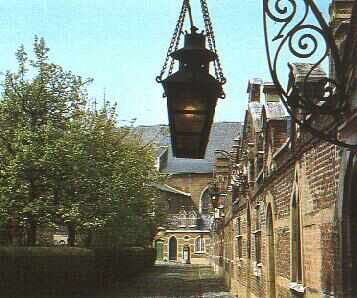 Exiting from café
“Pelgrom” continue the Pelgrimstraat until the end. At the Reynderstraat you
will see at the other side of the street another famous Antwerp tavern, just
elected as “THE tavern of the year” by the European cafes association. “De
Groote Witte Arend” with its interior courtyard and small chapel next to a
gallery of contemporary art. Exit the Witte Arend and continue to the left. At
the corner of the Reynderstraat and the Hoogstraat make a right. The “HOOGSTRAAT”,
first Antwerp pedestrian street, redesigned in the seventies, existed already in
the 13th century. It housed the broadcloth industry. Jacob Jordaens
birth house is at no.13. A pity that a fire destroyed all wooden houses and
facades in 1443. Today, the street is a very good sample of the Antwerp
architecture over the ages. Look at houses no.3 and 5 (Renaissance style). Built
in 1580 they were transformed in the 19th century. The house at no.11
has a Second Empire façade. You will notice that a lot of houses wear a name.
That was usual in the 16th century. Like here “De Gulden Cop”,
“Den Grooten Gulten Schild” and “Den Wolsack” at nos. 15, 15a and 17.
They all date from the second half of the 16th century but certain
parts (like the baroque porch, right) has been added. Exiting from café
“Pelgrom” continue the Pelgrimstraat until the end. At the Reynderstraat you
will see at the other side of the street another famous Antwerp tavern, just
elected as “THE tavern of the year” by the European cafes association. “De
Groote Witte Arend” with its interior courtyard and small chapel next to a
gallery of contemporary art. Exit the Witte Arend and continue to the left. At
the corner of the Reynderstraat and the Hoogstraat make a right. The “HOOGSTRAAT”,
first Antwerp pedestrian street, redesigned in the seventies, existed already in
the 13th century. It housed the broadcloth industry. Jacob Jordaens
birth house is at no.13. A pity that a fire destroyed all wooden houses and
facades in 1443. Today, the street is a very good sample of the Antwerp
architecture over the ages. Look at houses no.3 and 5 (Renaissance style). Built
in 1580 they were transformed in the 19th century. The house at no.11
has a Second Empire façade. You will notice that a lot of houses wear a name.
That was usual in the 16th century. Like here “De Gulden Cop”,
“Den Grooten Gulten Schild” and “Den Wolsack” at nos. 15, 15a and 17.
They all date from the second half of the 16th century but certain
parts (like the baroque porch, right) has been added.
Always animated, the
Hoogstraat is also very seducing due mainly to her close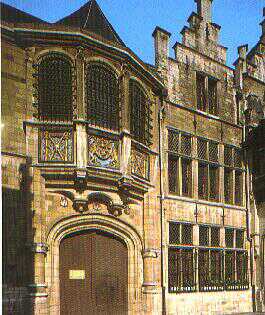 location to the Grote
Markt and the quays of the Scheldt. This old street attracts a lot of loiterers,
especially during the weekend. Shops have replaced the old craftsmen and lives
mainly of tourism. The KLEINE PIETER POTSRAAT to the left, bordered by small
little workmen houses now mostly rearranged into apartments. Students, old
people, artists live here. The street comes out on the GROTE PIETER POTSTRAAT
that connects the SUIKERRUI to the VLASMARKT. location to the Grote
Markt and the quays of the Scheldt. This old street attracts a lot of loiterers,
especially during the weekend. Shops have replaced the old craftsmen and lives
mainly of tourism. The KLEINE PIETER POTSRAAT to the left, bordered by small
little workmen houses now mostly rearranged into apartments. Students, old
people, artists live here. The street comes out on the GROTE PIETER POTSTRAAT
that connects the SUIKERRUI to the VLASMARKT.
Well known for its trendy
cafes, especially the tavern “Het Spiegelbeeld”, the Grote Pieter Potstraat
houses also a few picturesque restaurants. Always very animated on Monday nights
in the summer when the cathedral carillons give a concert, the Grote Pieter
Potstraat attract mostly youngsters who come to have a good time in the numerous
cafes with strange names. The street ends in the Suikerrui, which was originally
a canal forming the first defence line of the city. Today it’s packed with 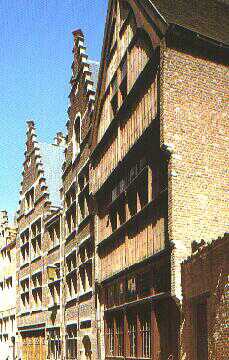 restaurants and houses the “Ethnographical Museum”.
Take the direction of the
Vlasmarkt returning to the Grote Pieter Potstraat. Look at the house at no24 (Potstraat)
called “Den Hopsack” with a decorated façade dating 1624. At the VLASMARKT
make a left. At no.26-30 a vast house with interior courtyard. It is the old
“Ouden Munte” from the 16th century where the money was made. At
the end of the street, make a right and you’re again the Hoogstraat. At the
corner of the street look up to the Virgin and her Child of end 17th
century. What is more beautiful than this mother look, tender compassion of the
Virgin towards Jesus? Notice that in the 18th century more than 500
statues of the virgin decorated Antwerp streets. At the beginning of the 20th
century, only 260. At no.70-72 of the Hoogstraat used to be a “hospitality
Saint-Julien” giving food and lodging for the poor and pilgrims passing in the
city.
Turn around and take the
Heilige Geestestraat, bordered by beautiful houses of the end of the 16th
century. Stop at no.9, a patrician house very well conserved and restored.
“Den Gulden Cop” or “Huis Draecke”. It’s a typical example of a
hanseatic house with interior courtyard, interior chapel, hexagonal tower from
1540, and a gallery that used to come out in the Hoogstraat.
|
