| Main
Antwerp page
Antwerp
Zoological garden
Antwerp by foot, its
insolent and secret
treasures
Introducing
the walk Keyserley-Leysstraat-Meir
Meir
shopping, slowly loitering to Rubens house
Rubens, his life and his house
Bird
market-Bourla theatre - more shopping
Shopping streets to Groenplaats
Area
around Antwerp Cathedral
Cathedral of
Our-Lady
Grote
Markt and Town hall
Guild
houses Vlaaykensgang
Hoogstraat and Grote
Pieter Potstraat
Printers museum
Plantin Moretus
Museum Mayer van
den Bergh-Maagdenhuis
Strolling
to the Carolus Borromeus church
Rockoxhuis-
Rubens tomb at St.Jacobskerk
Cogels-Osylei area, unique in the world (1)
Cogels
Osy area, unique in the world (2)
|
 Now
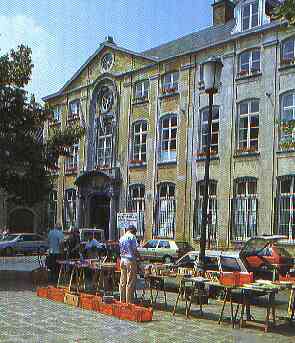
an absolute must. Stop at the Vrijdagmarkt, nice cute small square that is
dominated by the 18th century façade of the MUSEUM PLANTIN MORETUS.
There is some magic in this vast house built around a garden and reuniting the
ateliers and living spaces of the family Plantin and then Moretus, the greatest
and finest pioneers of printers after Gutenberg. They will put the base of
modern typography. And this magic will not only seduce those who are interested
in the history and genesis of printing, books, maps and more. Coming from
Touraine in France, Christophe Plantin established himself in 1548 in Antwerp,
organized his printing atelier and library in this house in 1576. He printed
1860 books in “all the languages of the Christian world” and the prestige of
the house became so great that king Philippe II of Spain promoted him to his
official printer. Moretus, his son in law, continued his work, still imitated by
his successors, who abdicated only in 1876. So we see that during three
centuries, the same family printed and exported loads of bibles, breviaries and
mass-books. Now
an absolute must. Stop at the Vrijdagmarkt, nice cute small square that is
dominated by the 18th century façade of the MUSEUM PLANTIN MORETUS.
There is some magic in this vast house built around a garden and reuniting the
ateliers and living spaces of the family Plantin and then Moretus, the greatest
and finest pioneers of printers after Gutenberg. They will put the base of
modern typography. And this magic will not only seduce those who are interested
in the history and genesis of printing, books, maps and more. Coming from
Touraine in France, Christophe Plantin established himself in 1548 in Antwerp,
organized his printing atelier and library in this house in 1576. He printed
1860 books in “all the languages of the Christian world” and the prestige of
the house became so great that king Philippe II of Spain promoted him to his
official printer. Moretus, his son in law, continued his work, still imitated by
his successors, who abdicated only in 1876. So we see that during three
centuries, the same family printed and exported loads of bibles, breviaries and
mass-books.
Try to come on a Friday when the “Vrijdagmarkt” is in full operation. A
popular market, bargaining, selling, buying at the best possible price. The
vendors, standing like barkers shout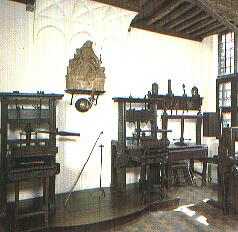 prices to make them rise like in a real exchange hall: folklore!!
Let’s look at the façade of the museum. The 18th century facade hides a
beautiful patrician edifice. Transformed into a remarkable museum, every hall
brings an essential element of the history of printing. Unique in its genre, the
house is a remarkable illustration of the refinement of intellectual and
cultural life in a fascinating period.
The interior has been very well remade as in the time of Plantin. Sumptuous
apartments, hand presses, cases full of lead characters, printing material,
fabulous private library and print cabinet.The correctors hall is full of
ancient fine types.
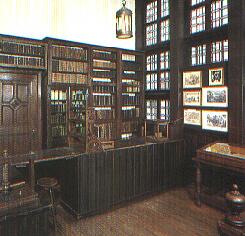 Where
do I feel the most emotion? I admit: it is in the shop-library, with its set of
shelves, its wooden counter, its account book. You have the impression that the
door will open and that a humanist will enter the boutique to ask for an
exemplary of the last work of Justus Lipsius. Where
do I feel the most emotion? I admit: it is in the shop-library, with its set of
shelves, its wooden counter, its account book. You have the impression that the
door will open and that a humanist will enter the boutique to ask for an
exemplary of the last work of Justus Lipsius.
Don't be intimidated by the technical aspect: everything is very well explained
in several languages.. And more, this museum presents the rarest and most
valuable manuscripts and "enluminures" (coloured prints) and
“incunables” like the famous bible "Biblia Regia or Biblia Polyglotta"
in 5 languages (Hebrew, Greek, Latin, Syriac and Chaldean) dated 1572, as rare
and beautiful as the Gutenberg bible, Mercator maps, an important, a magnificent
Gutenberg bible.....You will be sensible to the slightly austere atmosphere, as
it should be in a beautiful Flemish interior: walls covered with Cordoba
leather, Audenaerde and Brussels tapestries, 18 Rubens paintings, sculptures,
terracotta, porcelains, lacquered
tables ivory encrusted, creaking floors, open fires covered with delft tiles,
everything evokes the luxurious atmosphere from old times.
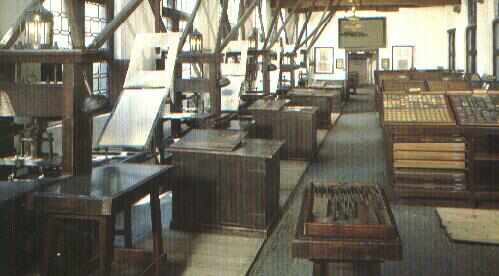
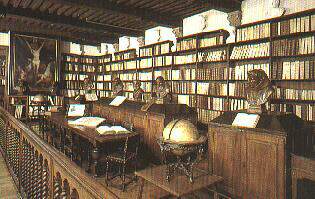
Of course you will have to see the characters room, the foundry, the master’s
office and the 16th century library with 20,000 inestimable volumes!
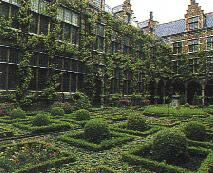
Here, everything is only refinement, luxury and intelligence. Don’t leave
without having seen the interior courtyard.
|