| Main
Antwerp page
Antwerp
Zoological garden
Antwerp by foot, its
insolent and secret
treasures
Introducing
the walk Keyserley-Leysstraat-Meir
Meir
shopping, slowly loitering to Rubens house
Rubens, his life and his house
Bird
market-Bourla theatre - more shopping
Shopping streets to Groenplaats
Area
around Antwerp Cathedral
Cathedral of
Our-Lady
Grote
Markt and Town hall
Guild
houses Vlaaykensgang
Hoogstraat and Grote
Pieter Potstraat
Printers museum
Plantin-Moretus
Museum Mayer van
den Bergh-Maagdenhuis
Strolling
to the Carolus Borromeus church
Rockoxhuis-
Rubens tomb at St.Jacobskerk
Cogels Osy area,
unique in the world (1)
Cogels
Osy area, unique in the world (2)
|
This is going one of your biggest surprises in your Antwerp visit: a little out of centre, take the tram no.11 and get off at the "Draakplein " and walk (1 minute) to Cogels-Osylei, and the surrounding streets. You are in the Zurenborg district and there is no way you will ever see such a quarter ever again! No place in Europe you will find such a choice of different architectures. All houses and buildings are
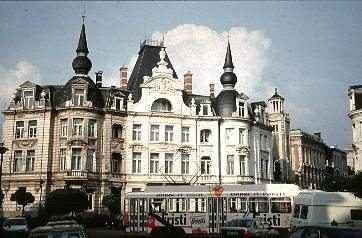 miraculously preserved in their Art Nouveau, néo-renaissance, néo-gothique, néo-byzantin syle, Jugendstil, exteremely diversified on an architectural level. Nowhere else can such a panoply of neo-styles be admired. The district is not really very large, so the best way to visit it is by taking a stroll through the different streets. miraculously preserved in their Art Nouveau, néo-renaissance, néo-gothique, néo-byzantin syle, Jugendstil, exteremely diversified on an architectural level. Nowhere else can such a panoply of neo-styles be admired. The district is not really very large, so the best way to visit it is by taking a stroll through the different streets.
Six streets radiate around the Cogels Osy lei, all built end of 19th century. Loiter around, stop here, look there, you will discover extraordinary features you won't believe existed. Other street names are: Transvaalstraat (named after the visit of Paul Kruger to Antwerp), Dageraadplaats, Velodroomstraat. There are also several streets, which refer to the Battle of Waterloo: e.g. Waterloostraat. The few visitors I brought already into this area came back speechless. It's interesting to see how the wealthy bourgeoisie lived out its fantasy and wild dreams, by building immense hotels particuliers and so many varied styles. Including Italian, Tuscany villa styles, Venetian palaces, and French chateau looking with white stone. Imagine that at the end of the 60's the entire area was considered to be out of fashion, therefore often ridiculed (especially by the greedy real estate promoters) and proposed for demolition! If this would have happened, we could be considered as the forefathers of the Taliban, destroying world art
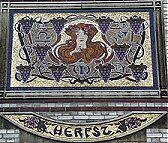 treasures. But luckily, some people kept their common sense and the project was abandoned. A lot of houses escaped demolition. treasures. But luckily, some people kept their common sense and the project was abandoned. A lot of houses escaped demolition.
A quick visit: start at the tram stop at the Draakplaats. The view on the Cogels Osylei is superb from here. Leave the Pretoriastraat on your left, don't take the Transvaalstraat, to the right. You will notice that a lot of names evoke the "Boers war" (South Africa), like the Krugerstraat. Cross the Tramplaats and enter the Cogels Osylei, walking on the left side of the street. At the balcony level of no.1, you will see small statue of…Brabo, emblem of Antwerp (see Grote Markt). Notice nos. 2-4, no 3 "Overvloed "(Abundance), , no. "Ooievaar (Stork). At nos. 13-15, two classic styled houses, with motives inspired by Antiquity. It is said that a lion tamer lived in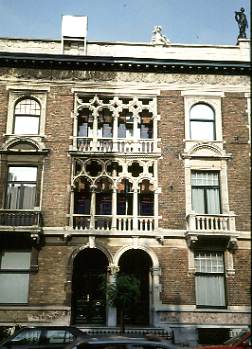 the big house at no.20. They were housed in giant cages. No need to say that the neighbourhood was not so happy about it. Look at the large villa at no. 25-29, grouping four lodgements, looking a bit disproportioned to the other houses in the street. the big house at no.20. They were housed in giant cages. No need to say that the neighbourhood was not so happy about it. Look at the large villa at no. 25-29, grouping four lodgements, looking a bit disproportioned to the other houses in the street.
At the roundabout, admire the four very wealthy villas apparently built in the same style, very opulent. Take now the Capiaumontstraat to the left. The house on the corner, with its small turret at the third floor, is magnificent. When you're in front of it, it turns into a Roman temple (to the right), dedicated to Euterpia. The turret is splendid.
Return to the Cogels Osy lei. At no.44, a house which façade is covered with hieroglyphs! The house at no. 50, "Tournesol" (sunflower), attracts a lot of attention. The "Klaverblad" (clover-leaf), has out of this world façade,
click here for part 2
Cultuurstad Antwerpen, by G. and F. Auwera (Hadewijch Antwerpen 1993), Tussen Leien en Singel, by G. Van Cauwenberg (Hadewijch Antwerpen 1987), Kunst en cultuurgids Anwterpen, by A. Thijs, S. Beele, P. De Laet, R. Mannaerts en J. Ruymaekers (Brepols Antwerpen 1993)Le clin d'oeil de l'Ange , by Françoise Mallet-Joris (Gallimard Paris 1983), La Flandre est un songe, by Michel de Ghelderode (La Rose de Chene, Bruxelles 1982), "De voorstad groeit--Antwerpen, Zurenborg, 1900 : een bouwmaatschappij creért haar wereld", by J. Possemiers.
|
