| Main
Antwerp page
Antwerp
Zoological garden
Antwerp by foot, its
insolent and secret
treasures
Introducing
the walk Keyserley-Leysstraat-Meir
Meir
shopping, slowly loitering to Rubens house
Rubens, his life and his house
Bird
market-Bourla theatre - more shopping
Shopping streets to Groenplaats
Area
around Antwerp Cathedral
Cathedral of
Our-Lady
Grote
Markt and Town hall
Guild
houses Vlaaykensgang
Hoogstraat and Grote
Pieter Potstraat
Printers museum
Plantin-Moretus
Museum Mayer van
den Bergh-Maagdenhuis
Strolling to the
Borromeus church
Rockoxhuis-
Rubens tomb at St.Jacobskerk
Cogels-Osylei area, unique in the world (1)
Cogels
Osy area, unique in the world (2)
|
Take now the Arenbergstraat,
look at he facades of the beautiful houses and make a right into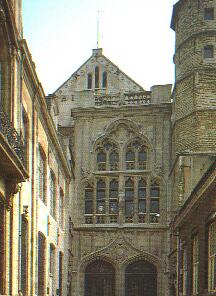 the Leopoldstraat. Next to the hospital, stands a botanical garden
“Kruidtuin” which used to be a laboratory for medicine students, refining
their botanical sciences in the 19th century. This botanical garden,
created by a science man Henri van Heurck (1838-1909) was also the trigger to
create the Antwerp Zoo. Around the small basin a lot of plants are
proliferating, more than 2,000 species. Robust cactuses grow in glass cases at
the end of the garden. A small alley leads to a charming Swiss chalet,
restaurant and tea-room, like a fairy-tale “gingerbread house”, like us
Antwerpenaars like to call it. Very agreeable but the food is not really to
recommend (-in my taste;-)) Now you will have to jump to another quarter. It’s
only a six minutes walk so I hope your sore
feet will support it ;-). Walk up to the Blauwmoezelstraat just behind the
cathedral, continue the Lijnwaadmarkt, stop a moment at the Torfbrug crossing
and peek through the windows of the tavern “’t Elfde Gebod”. (the 11th
commandment). 11th commandment?? What’s that? For us, Anversois,
that’s “Thou shalt DRINK!” ;-). Ivy covers the opposite cathedral walls
and this café, much frequented by many Dutch customers, is just typical Antwerp
and packed with statues of saints. Have a good beer or coffee if your palate
sticks already to you tongue. Let’s move on. A pretty statue of the Virgin
decorates the corner of the Lijnwaadmarkt and Melkmarkt. Make a left into the
Melkmarkt, enter the house “Den Cleynen en den Grooten Biecorf”, a house
with a 19th century façade but created already in 1559. Today it
houses several quality shops. . The “Vleminck Impasse” at the end of its
courtyard is worth a visit. Continue Eiermarkt, take the Sudermanstraat to the
left and then the second to the left, which is Korte Nieuwstraat. Next street to
the right and you will arrive at one of Antwerp’s other jewels: the church
CAROLUS BORROMEUS.
the Leopoldstraat. Next to the hospital, stands a botanical garden
“Kruidtuin” which used to be a laboratory for medicine students, refining
their botanical sciences in the 19th century. This botanical garden,
created by a science man Henri van Heurck (1838-1909) was also the trigger to
create the Antwerp Zoo. Around the small basin a lot of plants are
proliferating, more than 2,000 species. Robust cactuses grow in glass cases at
the end of the garden. A small alley leads to a charming Swiss chalet,
restaurant and tea-room, like a fairy-tale “gingerbread house”, like us
Antwerpenaars like to call it. Very agreeable but the food is not really to
recommend (-in my taste;-)) Now you will have to jump to another quarter. It’s
only a six minutes walk so I hope your sore
feet will support it ;-). Walk up to the Blauwmoezelstraat just behind the
cathedral, continue the Lijnwaadmarkt, stop a moment at the Torfbrug crossing
and peek through the windows of the tavern “’t Elfde Gebod”. (the 11th
commandment). 11th commandment?? What’s that? For us, Anversois,
that’s “Thou shalt DRINK!” ;-). Ivy covers the opposite cathedral walls
and this café, much frequented by many Dutch customers, is just typical Antwerp
and packed with statues of saints. Have a good beer or coffee if your palate
sticks already to you tongue. Let’s move on. A pretty statue of the Virgin
decorates the corner of the Lijnwaadmarkt and Melkmarkt. Make a left into the
Melkmarkt, enter the house “Den Cleynen en den Grooten Biecorf”, a house
with a 19th century façade but created already in 1559. Today it
houses several quality shops. . The “Vleminck Impasse” at the end of its
courtyard is worth a visit. Continue Eiermarkt, take the Sudermanstraat to the
left and then the second to the left, which is Korte Nieuwstraat. Next street to
the right and you will arrive at one of Antwerp’s other jewels: the church
CAROLUS BORROMEUS.
Imagine that before 1968,
cars crossed this pretty square and even passed under thearcade. Peopled with
artists, anarchists, and hippies in the sixties, the Jezuietenplaats attracts
its charm from the numerous pedestrian streets all around. Now called
Conscienceplaats it is one of the first Antwerp squares only reserved for
pedestrians. Make a tour of the square: opposite the baroque church you’ll see
the statue of Hendrik Conscience, author of the “Leeuw van Vlaanderen” (Lion
of Flanders”. He entered Flemish history as the one “who teached his people
to read…” Look now at the Church. The exuberant baroque façade, in a style
adopted by the Jesuits, is said to be partly the work of P.P.Rubens. It is and
will always be an absolute masterpiece of baroque religious architecture. A
novelty was the dashing tower; a real eye-catcher despite its height is only 58
meters. Broken up by Doric and Ionic pillars since it was dedicated to the
Italian archbishop Borromeo. Impressive are the numerous statues on the façade
with a Madonna and child in the fronton. Place of honour is for course for
Ignatius de Loyola, founder of the Jesuit order.
The interior is of an incredible wealth, even if it had to pay a heavy
toll to a grand fire in 1718 (39 ceiling paintings of Rubens!).
The church has three naves,
a choir in hemicycle and a rich furnishing patrimony. But the most beautiful
part of the church is the chapel of Our Lady at the south side. We are surprised
by the glowing colour game of the different marble sorts of the chapel. After
the suppression of the Jesuit order by the pope in 1773 the Jesuits had to leave
and the church became a Parrish church.
The Carolus Borromeus kerk is finally also a landmark of sacred music concerts.
Every Sunday at 11.30, the “All Antwerp” assists at the “Artists Mass”,
a mass sung for the Antwerp artistic gentry. The program is very alluring if you
se how many “non Catholics”, Jews and Protestants come sometimes to listen
to the concerts, your Jack included!
|
