| Main
Antwerp page
Antwerp
Zoological garden
Antwerp by foot, its
insolent and secret
treasures
Introducing
the walk Keyserley-Leysstraat-Meir
Meir shopping,
slowly loitering to Rubens house
Rubens, his life and his house
Bird
market-Bourla theatre - more shopping
Shopping streets to Groenplaats
Area
around Antwerp Cathedral
Cathedral of Our-Lady
Grote
Markt and Town hall
Guild
houses-Vlaaykensgang
Hoogstraat and Grote
Pieter Potstraat
Printers museum
Plantin-Moretus
Museum Mayer van
den Bergh-Maagdenhuis
Strolling
to the Carolus Borromeus church
Rockoxhuis-
Rubens tomb at St.Jacobskerk
Cogels-Osylei area, unique in the world (1)
Cogels
Osy area, unique in the world (2)
|
Starting the walk on the
Meir, the painter Anthony Van Dijck stares upon us from his new pedestal since
November 1992. The corner house of the Jezusstraat, on your right side, a
refurbished 18th century building with the homage statue to Lodewijck
Van Berckem, pioneer of diamond cutting and polishing. We are finally on the
large street called “Meir” which sinuous curve invited us to look at the
beautiful façade of the grands magasins “Tietz”, nowadays warehouse
“Innovation”. Bordered since the 17th century by vast manorial
buildings, it is only from 1850 on that insurance companies, banks and shipping
offices established their headquarters. Today, a few of these glorious buildings
remain: the building of the
“Feestzaal” (1908), the Osterrieth house, built by J.P.Baurscheit the Young
who built also the kings palace at no. 50. This Osterrieth house, one of the
finest houses in Antwerp, is a patrician house with carriage-entrance and
interior courtyard dating from the Austrian period, which is 1750. It houses
also a splendid collection of paintings and drawings only visible with a special
tour. The building “Arenberg” (corner Meir-Wapper) has a splendid façade,
often refurbished and lately by the store “Esprit”. The same with the house
Pijpelinckx at no 54 (19th century) wearing the name of Rubens mother, Maria
Pijpelinckx.
|
 |
|
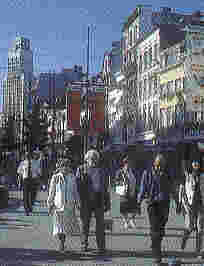
Meir centre of shopping
|
Every major department store
or clothes chain stores existing in Europe has a large branch on the ….Meir.
Display windows are identical to those of London, Paris, Amsterdam….Esprit,
Hey, Creymborg, Benneton, C&A, Marks & Spencer (unfortunately going to
disappear at the end of the year like all M&S on the European continent), and many more.
They attract a loyal clientele, mostly from Holland! Despite
the creation of an enormous shopping centre outside Antwerp in Wijnegem, the
Meir kept his customers, thanks to the animation and cultural inalienable
attraction. The cultural pedestrian starts his walk on the Meir and continues it
in the Schuttershofstraat (but that’s for later). The king’s palace at the
corner of Wapper-Meir found a cultural vocation since 1969, the I.C.C.
(International Cultural Centre). Designed by the architect Jan Pieter van
Baurscheit, the palace has a magnificent façade (decorated with Pompadour style
figurines). A lot of sovereigns lodged here during their visit to Antwerp:
Willem van Oranje, Leopold I, Leopold II, King Albert I, and queen Elisabeth.
The pavilion at the end of the courtyard is an exhibition space where
contemporary art is the major item.
But now it is time to leave
the Meir and enter Wapper, where a major MUST of every visit of Antwerp is
located: the RUBENS HOUSE, an architectural masterwork of Flemish baroque, where
the master, the “prince of Flemish painters” will orientate our steps in
this sumptuous palace that he build with his own design when he was 33 years
old. More
than an aesthetic revelation, this museum proposes a journey into the life of a
man. Rubens worked here all the rest of his life and lived here with the two
women he loved, Isabella Brant, died from the plague in 1626 and Helena
Fourment, Rubens married when he was 53 years old and she was barely 16. It’s
in this patrician house that he will execute most of his masterpieces. Radiating
genius, centrifugal, Pieter Paul Rubens is Flemish through his colours and
passions. “His life is the one that makes love life, from the beginning to the
end” said Eugène Fromentin. Grand lord and diplomat, speaking several
languages, Rubens left an indelible mark on universal art painting.
More about his life and the
visit of his house in my next article.
|
