| Main
Antwerp page
Antwerp
Zoological garden
Antwerp by foot, its
insolent and secret
treasures
Introducing
the walk Keyserley-Leysstraat-Meir
Meir
shopping, slowly loitering to Rubens house
Rubens, his life and his house
Bird
market-Bourla theatre - more shopping
Shopping streets to Groenplaats
Area
around Antwerp Cathedral
Cathedral of
Our-Lady
Grote
Markt and Town hall
Guild house
Vlaaykensgang
Hoogstraat and Grote
Pieter Potstraat
Printers museum
Plantin-Moretus
Museum Mayer van
den Bergh-Maagdenhuis
Strolling
to the Carolus Borromeus church
Rockoxhuis-
Rubens tomb at St.Jacobskerk
Cogels-Osylei area, unique in the world (1)
Cogels
Osy area, unique in the world (2)
|
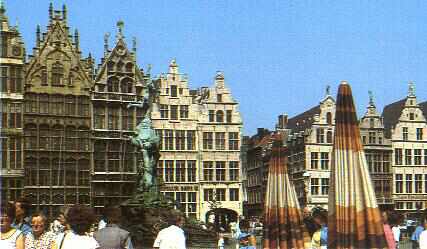 Around the
Grote Markt, the guild and corporation houses are the most beautiful of Belgium,
after those of the Brussels “Grand Place”. Most of them date from the 16th
century but some were restored or rearranged a century ago using the original
plans. Only a few houses are totally authentic, with their step gables like no.5
“Kuipershuis” (Coopers Hall) also called “De Gulden Mouw” (the golden
sleeve) and dates from 1579. The superior part of the house was restored
beginning 17th century. At no.7 “the vast house of Crossbowman’s
Hall, renamed Around the
Grote Markt, the guild and corporation houses are the most beautiful of Belgium,
after those of the Brussels “Grand Place”. Most of them date from the 16th
century but some were restored or rearranged a century ago using the original
plans. Only a few houses are totally authentic, with their step gables like no.5
“Kuipershuis” (Coopers Hall) also called “De Gulden Mouw” (the golden
sleeve) and dates from 1579. The superior part of the house was restored
beginning 17th century. At no.7 “the vast house of Crossbowman’s
Hall, renamed 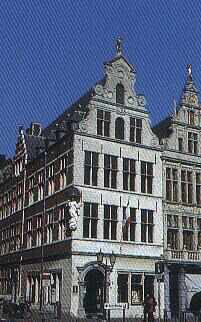 “Het
Pand van Spanje” (The Spanish house). 19th century shop, this
Hanseatic house was once a Music Academy and housed the members of the
Saint-Lucas guild, assembling the best Antwerp creators in the 16and 17th
century. At no.11 you have “Drapers Hall”. “Het
Pand van Spanje” (The Spanish house). 19th century shop, this
Hanseatic house was once a Music Academy and housed the members of the
Saint-Lucas guild, assembling the best Antwerp creators in the 16and 17th
century. At no.11 you have “Drapers Hall”.
At the other side of the Markt, at no.24, the houses “Het Gulden Schaap”
(the golden sheep) and “Sint-Jacob” (Saint-Jacob) are magnificent. The
central part of the building (formed by the two houses) is characteristic if the
Regency style, marking the transition between baroque and rococo. Conceived
about 1736 by Jan Pieter van Baurscheit. At no.38, the house “De balance”
(the balance), was owned by the Draper’s guild, the oldest of all Antwerp
corporations. Rebuilt after a fire in 1541, this house can be proud of having a
superb façade decorated by bas-reliefs illustrating the Drapers at their work.
At no. 40, the house “Roodenborgh” belonged once to the tanners and
shoemakers. Restored in 1644 and enhanced by a baroque façade, this house
–one of the most beautiful in Antwerp---became the home of the carpenters in
the 18th century. Entirely restored it’s today the meeting point of
numerous journalists. It has superb vaulted caves.
Return direction Town Hall to the Suikerrui, at the left side of Town Hall, have
a look at the statue of a dockworker, glorified by Constantin Meunier in 1885.
Take the Oude Koornmarkt, packed with restaurant, pizzerias and other cafes but
stop in front of no.26, the house “De Cluyse” which stone façade is one of
the oldest in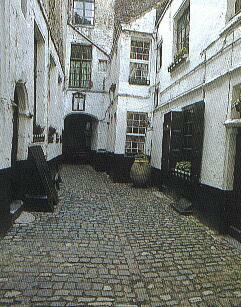 Antwerp.
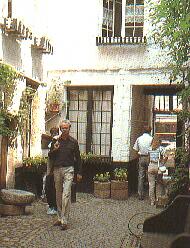
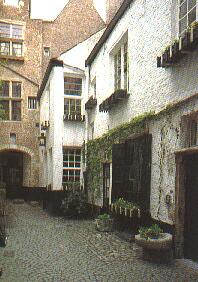
Continue to no.16 and penetrate inside the “VLAAYKENSGANG” where you will
have the feeling you’re back in the middle ages. It’s the smallest street of
Antwerp. “Vlaay” or “Vlaai” or even “Vla” means “tart” in Dutch.
Guaranteed excitement! We are in the fief of the bell ringers and Shoemakers of
the 16th century: the real tower carillon music amateurs gather here
on summer Monday nights when the invisible magician carillon player, high up in
its cathedral tower, embroids its lace arabesques in the velvet of the night….
Pas the very narrow corridor, bordered by modest and very old houses, still
inhabited today.
Antwerp.
Continue to no.16 and penetrate inside the “VLAAYKENSGANG” where you will
have the feeling you’re back in the middle ages. It’s the smallest street of
Antwerp. “Vlaay” or “Vlaai” or even “Vla” means “tart” in Dutch.
Guaranteed excitement! We are in the fief of the bell ringers and Shoemakers of
the 16th century: the real tower carillon music amateurs gather here
on summer Monday nights when the invisible magician carillon player, high up in
its cathedral tower, embroids its lace arabesques in the velvet of the night….
Pas the very narrow corridor, bordered by modest and very old houses, still
inhabited today.
Leave the Vlaaykensgang and take the Pelgrimstraat. At you left admire the view
on the spire of the cathedral. In the middle of this pedestrian street, where
you wouldn’t be able to move in the summertime because of the masses of people
going out for a drink or dance, the café “Pelgrom”, with its vast vaulted
caves offers you abbey beer at candlelight and attracts all those who like an
aperitif with chandeliers. Difficult to find a place there ends of the week,
especially in winter….
|