| Main
Antwerp page
Antwerp
Zoological garden
Antwerp by foot, its
insolent and secret
treasures
Introducing
the walk Keyserley-Leysstraat-Meir
Meir
shopping, slowly loitering to Rubens house
Rubens, his life and his house
Bird
market-Bourla theatre - more shopping
Shopping streets to Groenplaats
Area
around Antwerp Cathedral
Cathedral of
Our-Lady
Grote Markt and Town Hall
Guild
houses-Vlaaykensgang
Hoogstraat and Grote
Pieter Potstraat
Printers museum
Plantin-Moretus
Museum Mayer van
den Bergh-Maagdenhuis
Strolling
to the Carolus Borromeus church
Rockoxhuis-
Rubens tomb at St.Jacobskerk
Cogels-Osylei area, unique in the world (1)
Cogels
Osy area, unique in the world (2)
|
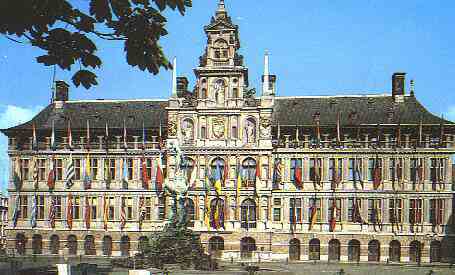 The very heart of old
Antwerp, “Grote Markt”. This Flemish name meaning “market” appears for
the first time in 1310. It’s only in the 16th century that “Grote
“(large) is added to distinguish it from another square. Town hall,
“Stadhuis” in Flemish, was built between 1561 The very heart of old
Antwerp, “Grote Markt”. This Flemish name meaning “market” appears for
the first time in 1310. It’s only in the 16th century that “Grote
“(large) is added to distinguish it from another square. Town hall,
“Stadhuis” in Flemish, was built between 1561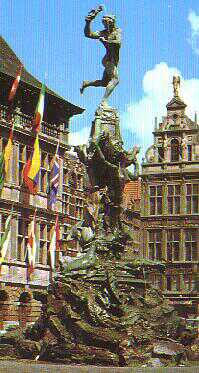 and 1564 by Floris De Vriendt,
called Floris, replacing the old house of the municipal magistrates dating from
the first half of the 15th century but being outdated to represent a
city, a great port becoming the absolute centre of world trade! Inaugurated in
February 1565, the edifice was ravaged by fire during the “Spanish furia” in
1576 and its reconstruction in 1579 lasted for 5 years. Damaged again by French
troops at the end of the 18th century, the building was refurbished,
inside like outside in the 19th century.
and 1564 by Floris De Vriendt,
called Floris, replacing the old house of the municipal magistrates dating from
the first half of the 15th century but being outdated to represent a
city, a great port becoming the absolute centre of world trade! Inaugurated in
February 1565, the edifice was ravaged by fire during the “Spanish furia” in
1576 and its reconstruction in 1579 lasted for 5 years. Damaged again by French
troops at the end of the 18th century, the building was refurbished,
inside like outside in the 19th century.
Antwerp’s
“Stadhuis” (City hall), is one of the oldest Italian Renaissance buildings
ever erected in Flanders and the Netherlands. Look at the façade measuring 68
meters horizontally. It is interrupted in the middle by a high frontispiece with
nook and fronton: an eagle with spread wings turned to the east (Aachen was then
the capital of the German Saint-Empire) crowns this forepart. Three coat of arms
on the façade: left the one of the duke of Brabant (golden lion on black
background), in the centre the coat of arms of the Spanish king Philippe II,
ruler of the 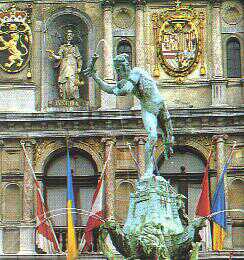 Netherlands, Flanders included) and on the right the
marquisate of Antwerp, reuniting the arms of the city and the bicephal imperial
eagle. Between the coat of arms you can see the statues of Wisdom and Justice,
virtues of Antwerp. And in front of City Hall, the bronze statue of the brave
Brabo by Jef Lambeaux, Brabo celebrating its legendary exploit (since more than
a century) on the Grote Markt. Netherlands, Flanders included) and on the right the
marquisate of Antwerp, reuniting the arms of the city and the bicephal imperial
eagle. Between the coat of arms you can see the statues of Wisdom and Justice,
virtues of Antwerp. And in front of City Hall, the bronze statue of the brave
Brabo by Jef Lambeaux, Brabo celebrating its legendary exploit (since more than
a century) on the Grote Markt.
According
to the legend, the valorous Brabo vanquished, by his audacity and cleverness,
the redoubtable giant Antigoon, living in the fortified castle “Steen” still
visible along the quays behind Town hall. The giant stood in the middle of the
Scheldt stream and cut off the hands of all who couldn’t pay and exorbitant
passage tax to enter the port of Antwerp. Brabo succeeded to do the same with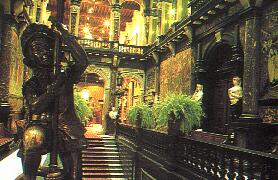 Antigoon: he cut of his hand and threw in the Scheldt. This saving gesture saved
the port of Antwerp, gave it an economic prosperity and a name to the city! In
Flemish “throw a hand” is “hand werpen” which turned into Antwerpen over
the centuries….Serious historians deny of course this version.
Antigoon: he cut of his hand and threw in the Scheldt. This saving gesture saved
the port of Antwerp, gave it an economic prosperity and a name to the city! In
Flemish “throw a hand” is “hand werpen” which turned into Antwerpen over
the centuries….Serious historians deny of course this version.
The interior arrangement of Town Hall is from the 19th century. The
Leys hall decorated with wall paintings evoking the great days of the city, the
wedding room restored after the fire of 1576, the Council room (style Louis XIV) and the cabinets of the Mayor and the City counsellors
are worth a visit.
Corporation houses around the Grote Markt will be the object of my next article.
|
