| Main
Antwerp page
Antwerp
Zoological garden
Antwerp by foot, its
insolent and secret
treasures
Introducing
the walk Keyserley-Leysstraat-Meir
Meir
shopping, slowly loitering to Rubens house
Rubens, his life and his house
Bird
market-Bourla theatre - more shopping
Shopping streets to Groenplaats
Area
around Antwerp Cathedral
Cathedral of our Lady
Grote
Markt and Town hall
Guild
houses-Vlaaykensgang
Hoogstraat and Grote
Pieter Potstraat
Printers museum
Plantin-Moretus
Museum Mayer van
den Bergh-Maagdenhuis
Strolling
to the Carolus Borromeus church
Rockoxhuis-
Rubens tomb at St.Jacobskerk
Cogels-Osylei area, unique in the world (1)
Cogels
Osy area, unique in the world (2)
|
The cathedral
of Our Lady (Onze Lieve-Vrouwkathedraal) is the symbol of Antwerp.
This marvelous edifice that spreads out 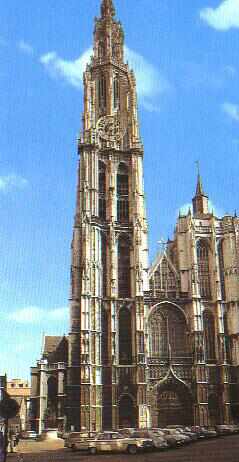 on 1 hectare is the
biggest gothic cathedral of the old Netherlands (Belgium and Holland).
Venerated since 9 centuries it’s home is Antwerp all right and
undissociable from its skyline with its123 meters high spire and strange
bulb cupola at the summit of the crossing point of the transept, well
visible from the outside, wherever you are to observe the
on 1 hectare is the
biggest gothic cathedral of the old Netherlands (Belgium and Holland).
Venerated since 9 centuries it’s home is Antwerp all right and
undissociable from its skyline with its123 meters high spire and strange
bulb cupola at the summit of the crossing point of the transept, well
visible from the outside, wherever you are to observe the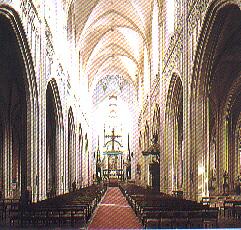 cathedral.... cathedral....
In the 9th century, it was a small chapel, located outside
the city walls. Its history begins when the roman church (12th
century) was improved to a parish church. The church suffered a lot of
changments in the 13th and 14th century until it
was demolished. Then they started the actual cathedral, the city of
Antwerp being at that time one of the richest in Europe. Its construction (1352-1521) took almost two centuries.And at the start it was
planned to build it three times bigger: nothing was too much to show off the
prosperity of the city! The choirs (1352-1356) are the most ancient part. The
foundation for the towers was built in 1420 and 1430 with Pieter Appelmans as
the main architect.Masterwork of Gothic, it has seven naves and 125 pillars!!
widening the church to 67, long 119 meters and some vaults going up to 27
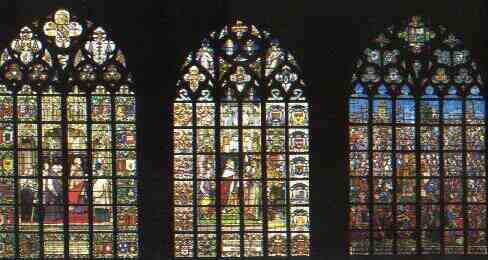
meters. 128 windows are coloured, its roofs cover more than a hectare! The spire
towers123 meters high (said that already before;-)), with a carillon with 47
bells All professions and corporations wanted to have their own altar in the
church, which makes 57 of them.
Like all its sisters, the cathedral passed highs and lows. In the lows, the
gigantic fire of 1517, the "iconoclastic" raids of the protestants
(1566 and 1581). Destroyed paintings, damages altars, dispersed relics. The good
sides of all this unpleasantness was that each destruction was rebuild with a
new embellishment. The Counter reform re-established the cult in all its fasts.
But when the French occupied Antwerp, they had the brilliant idea to make the
church into their horses stable and ordered the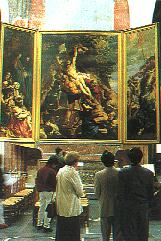 destruction of the cathedral!!
They could use the iron, lead and stones for their destruction of the cathedral!!
They could use the iron, lead and stones for their 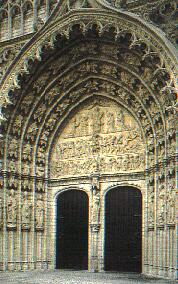 own purpose. Luckily a
certain architect Jan Blom slowed the official execution so much down that
finally the project was abandoned. own purpose. Luckily a
certain architect Jan Blom slowed the official execution so much down that
finally the project was abandoned.
The fact that the building of the cathedral lasted for 200 years means that
different architects had their saying in the building of the cathedral. And the
most recent have not been the most unskilled. From 1973 to 1993, the edifice was
cleaned, furbished, restored and consolidated from the ground to the highest
bell tower. The underground was
searched, its treasures enhanced. In one short word, a complete and successful
"lifting”!
Don't start your visit without the leaflet given at the entrance (there is an
entrance fee though). All the masterworks are clearly marked on it.....But first
you enter through the central portal, neo-gothic style, coming from the
Handschoenmarkt, representing the “Last Judgment”. Not to enter in this
cathedral is a crime of lese-majesty!It shows its most precious treasures and
paintings especially from Rubens: four marvels, with a realism grazing
the baroque: "the Cross set-up" (1610), " Christ
resurrection"(1612), " La Descente de la Croix"(1612),
and "Assumption of the saint Virgin"(1625-1626. Colours explode in your face. Not surprising: it is said
that Rubens composed his famous red colours with pigeon's blood! You will see
also two magnificent retables, Our Lady of the Peace and the Legend of Saint-Barbe,
as well as the recumbent effigy of the tomb of Isabelle de Bourbon. And don't
forget to admire the tower.
Want a little anecdote? At the entry of the cathedral, just to the right side
when you exit you can see a wrought iron well made by Quinten Metsys, the famous
Flemish painter and iron wrought genius. I
heard the following anecdote since I was a child but I take the story in right
chronology out one of my favourite travel guides. (Quote): young Metsys was a
blacksmith. He fell in love with a painter’s daughter, but the
"father-in-law" was absolutely opposed to marriage....So, whenever he
finished a painting, the good man granted himself a little feast in town. And he
left his daughter alone.....and who came for a secret visit? Our Metsys of
course! The young blacksmith painted a fly on the picture the father just
achieved. When the good man returned from his libations, he strived to chase the
fly of his painting, the insect looked so realistic!! Good loser, he admitted
the talent of the young Metsys and accepted him as his son-in-law.(unquote).
Look closely at the well: there is a Flemish inscription "De smidt die uit
liefde schilder werd", translated : "The blacksmith who became a
painter out of love".Some more inside views of
the cathedral:
|
