|
Louvre Paris to visit in a hurry Site Home - What's New?-Feedback - About Jack-Travel/Art Links |
|
Louvre Introduction Fast Louvre French painting section
More foreign paint section |
Paris-Louvre-Fast Louvre (in a hurry) |
||||||||
| ...discover PARIS THROUGH THE AGES in the very best way possible :on foot with your own personal guide !!!!! | |||||||||
|
Some of you or maybe most of
you don’t have the time or the patience to visit a museum like the Louvre a
whole day, and even two days. Schedules are compelling and Paris is big. For
those I will give a Louvre itinerary suggested by the Routard with some
adaptations. Imagine, you could see the main items to BE SEEN in about 4 hours.
But this is a minimum.
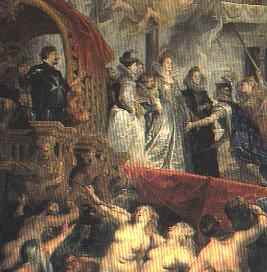
1) The best thing to do is to start from the Napoleon hall, and head to the Richelieu wing. First to visit is a nice, big ensemble of large oils painted by Rubens between 1622 and 1625. This was an order from Catherine de Medicis, who wanted her reign to be remembered through the works of this great artist.(quite normal since she paid the bill!). 2) Back the escalator take
the so-called " French
circuit" continuing in the Sully wing. Beforearriving at Sully 4 admire
"Les Quatre Saisons" by Poussin, after the rotunda. Poussin was a theoricien, philosopher, poet and painter who lived all his life in Rome,
haunted as he was to be perfect in his art. In Sully 4, the "Saint Thomas" by Georges de la Tour who liked
to paint intimate night scenes only lit by the light of a candle and radiating
an aura of mystery. The apostle
Saint Thomas is now more expensive than a rock-star! Bought for 32 million FF
thanks to a public subscription. (3) The story of Alexander the Great is represented by gigantic paintings called “Batailles” by Le Brun. You must first pass trough Sully 4 and 5. Louis XIV, who owned the paintings liked to be compared to the antic hero, even if he conquered only the Alsace.... (Routard 1999)
(4) The next 36 halls are
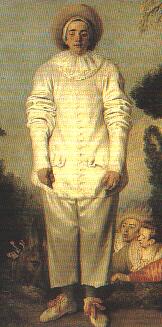
dedicated to French Paintings from the 18th and 19th. First the “Gilles” by Watteau. It is a symbolic and personal portrait of a comedian, some say even it
is an auto portrait. Watteau, at the beginning of the 18th century,
opened new era, with new subjects and techniques. If scenes and personages of
the contemporary French and Italian theatre inspired him and it is by
transporting them in the unreal world of dreams that this delicate colourist and
remarkable draughtsman can show his genius. The “Embarquement pour Cythere”
(a second version is in the Charlottenburg castle in Berlin) is also on display.
You can conclude the French painting circuit by continuing through the cour
Carree until room 73, turn around to reach the Henri II or Henri IV stairs. (5) If you want to make a trip in history back to medieval Louvre, don't heisitate to go and visit the origins of the French monarchy. What am I talking about? The "trenches" of Louis Philippe" and a dungeon, like it was in old times! In the adjacent room a lot of excavation findings are exhibited like the helmet displayed of Charles VII, le Fou. More findings all over the place.
6) At the exit of the
Louvre Medieval, take the Henri II stairway to join the " salle des
Cariatides". At the end of this hall, make a left and stop in front of the
"Venus de Milo"! One of the master pieces of Antique Art and one of
the most perfect examples of woman’s beauty, the original was discovered in
1820 on the island of Milo and should be dated 2nd century BC. Admire
the finesse of the drape and the Paros marble.
Then in the salle Molien,
see the “Radeau de la Meduse" presented at the 1819 salon by Theodore Gericault, which is considered as the first manifestation of our Romantic picuralism. The impetuosity and dramatic intensity of this “faits divers” (the
survival of 15 shipwrecked makes it to one of the master pieces of French
painting and it is justified that it is exposed in the same room as Delacroix.
"
(9) Come back again and turn
left. The first part (east) of the great " Galerie”is open now. See the
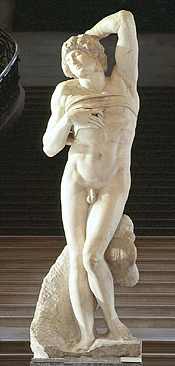
"Slaves" by Michelangelo (sculpture department). A genius homosexual,
he had the tendency to undress more male than female models. (10) You will reach the exit by descending to the mezzanine and arrive under the pyramid. Bibliography --Vie et histoire des arrondissements de Paris, ed.Hervas (1985-1988) --Nouvelle Histoire de Paris, ed.Hachette --Histoire et dictionnaire de Paris, by A.Fierro, ed.Laffont, 1996 -- Guide du Routard 1998-1999 (Ed.Hachette) --Paris, 2000 d'histoire, by J.Favier, ed.Fayard 1997 --Naissance de Paris, by M.Fleury, ed.Imprimerie Nationale 1997 –« Louvre-la visite », by Pierre Quoniam (ed. Reunion de musées nationaux 1997)—“Les très riches heures “ by the Duke of Berry—“Down and Out in Paris and London”, by Georges Orwell. |
|||||||||
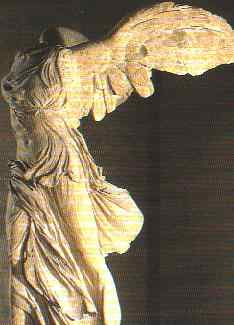 (7)
Return on your steps and stop at the landing in front of "The Victoire de
Samothrace".
(7)
Return on your steps and stop at the landing in front of "The Victoire de
Samothrace".
 talent.
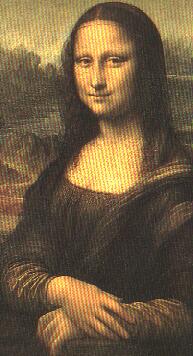
And finally you will be at the "Joconde" or Mona Lisa. The most
admired and commented work of universal painting. The woman is Monna Lisa Gherardini, married in 1495 to a Florentin noble patrician, Francesco del Giocondo, hence the nickname “La Gioconda”. Old Leonard himself considered
this work as his masterpiece. He painted it between 1503 and 1505 and was so
attached to the painting that he never delivered it to the husband who ordered
it and took it with him in 1516 when Francois 1er called him to France which
made him move to Amboise in the chateau de Cloux where he died three years later.
The “Gioconda” became the most precious item in the king’s collection.
talent.
And finally you will be at the "Joconde" or Mona Lisa. The most
admired and commented work of universal painting. The woman is Monna Lisa Gherardini, married in 1495 to a Florentin noble patrician, Francesco del Giocondo, hence the nickname “La Gioconda”. Old Leonard himself considered
this work as his masterpiece. He painted it between 1503 and 1505 and was so
attached to the painting that he never delivered it to the husband who ordered
it and took it with him in 1516 when Francois 1er called him to France which
made him move to Amboise in the chateau de Cloux where he died three years later.
The “Gioconda” became the most precious item in the king’s collection.