|
Louvre sculpture section Paris Site Home - What's New?-Feedback - About Jack-Travel/Art Links |
|
Louvre Introduction
More foreign paint section
Sculpture section
|
Paris-Louvre-Sculpture section |
||||
| ...discover PARIS THROUGH THE AGES in the very best way possible :on foot with your own personal guide !!!!! | Studio to rent in the Marais! Short term rental, direct owner, no fee, personal reception and free courteous help! | ||||
|
The sculpture section in the Louvre was mainly supplied by the suppression, in
1817, of the
Jumping to the 17th century, with a succession of diverse tendencies: classicism, realism,mannerism, baroque and monumental sculptures, funerary monuments like the elegant obelisk) to the glory of the duc de Longueville, the four equestrian groups by Coysevox (1706) and Guillaume Coustou (1745) for the parc de Marly whose copies stand at the entrance of the Champs-Elysees at the Place de la Concorde and which are here, regrouped in the courtyard of the same name. The flashing "Milon de Crotone" by Puget, intended for the park in Versailles, where Milo, presumptuous athlete, is imprisoned in the bole he wanted to split...The gracious "Mercure attachant sa talonniere" by Pigalle (1744) or the famous "Baigneuse" (1755) by Falconnet.
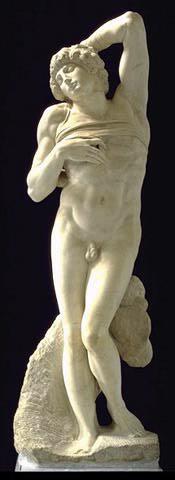
Amidst the most important and famous are the "dying slave and "rebellious slave" that
Michel-Angelo (1513-1515) sculpted for the tomb of pope Julius II (galerie Mollien).
When the Vatican authorities refused these works, Michel Angelo offered them to his friend Roberto Strozzi, who gave it to the king of France, Henri II. This one gave it to the connetable de Montmorency who decorated his home in Ecouen with the sculpture. When the cardinal de Richelieu took over in 1632, he placed it is his château in Poitou and finally was transported to Paris where it was a part of the musée des Monuments Français. And that's how it came finally to the Louvre. |
|||||
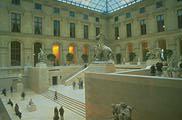 Musée des Monuments Français, of which a part passed into the Louvre collections. Obeying to a chronological order, they are displayed in articulation around the large covered courtyards Marly and Puget on the ground floor of the Richelieu wing, however you can still find sculptures of the 12th to the 16th and Italian sculptures from the 11th to the 15th century on the mezzanine level of Denon. For the medieval part (rooms 1 to 10) each gallery is organized around one work or one theme. Roman sculptures first like the sculptured capital of an ancient church "Daniel entre les lions", end 11th century, or "Le Prophete", of another roman capital of Notre-Dame-des-Doms in Avignon, second half of 12th century. "Tate de Christ", in painted wood, or the rustic "Vierge Auvergnate".