Louvre history Site Home - What's New?-Feedback - About Jack-Travel/Art Links


Paris Shopping Paradise!!

Paris sketches (daily life)

Hidden, unknown Paris 

Secrets Notre Dame 
Paris

Paris impressionist walk

Paris literature walk

Paris flea and other markets

10 very special shops

Parisians in Paris

Paris bridges

Special shops in Passy

Unknown parks and gardens

Louvre

Introduction

A little bit of history

Louvre figures and vandals

Schedules, prices, passes

Fast Louvre

Oriental antiquities

Greek, Etruscan, Roman

French painting section

Flemish painting section

Italian painting section

More foreign paint section

Sculpture section

Paris - Louvre - A little bit of History

Paris main page

...discover  PARIS THROUGH THE AGES in the very best way possible :on foot with your own personal guide !!!!! Studio to rent in the Marais! Short term rental, direct owner, no fee, personal reception and free courteous help!

Paris dining world!!!!

Book a Paris hotel on line


I postponed and postponed but once I HAD to start including the most important landmark and museum of Paris in my Paris site: THE LOUVRE MUSEUM. In arrondissement one of the Paris visit page I have already resumed a brief essay about the birth of the Pyramide du Louvre and the project of the New Louvre.
I will often make references to the “New Louvre” or the “Grand Louvre”, but what happened to the old Louvre? The answer is: a lot! Astonishing changes have been made, not without the known controversies, poisoned press reviews and other sweetness that happen all over the worlds in such cases. But he new Louvre became a tremendous success. The world’s largest museum is still labyrinthine, but a joy to discover for old hands as well as first-time visitors. And only the French would be so bold as to completely re-do their major world museum.

Medieval Louvre

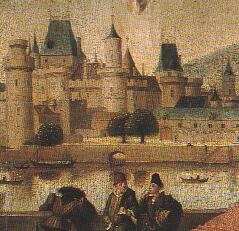
The greatest museums once started as small. Originally a medievalfortress, built by Philippe Auguste, around 1200 at the weakest defence point of Paris in a place named “Lupara” which will become “Louvre”. When this fortress lost its military role, Charles V (1364-1380), by extending the edifice made it a chateau where he established his extensive library in one of the towers. But soon, the Hundred Years War, the nauseating odours of the open sewers around the chateau making the atmosphere unbreathable, the attraction of the chateaux in the Loire valley moved everybody out of Paris for more than one and a half century. If you want to have a good picture of the impressive beauty of the medieval Louvre, you have to read “Les très riches heures “ by the Duke of Berry.  Art historians thought for a long time that this breviary with splendid miniatures was just an idealizing description of the Louvre, but a recent research proved that the old medieval chateau of Charles V really looked as a fairy tale castle.
The comebacks to Paris lead to the destruction of the medieval chateau fort. In 1546 François Ier decided to build a residence in Renaissance style. 

Louvre facade Lescot

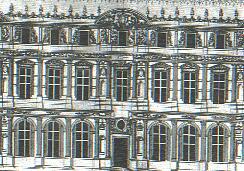
Blue prints were made by the architect Pierre Lescot and he led the building works during the rest of his life. Successive monarchs added and destroyed until 1672, when Louis XIV, wary of Paris, moved to Versailles. Later, a palace (palais des Tuileries) was built by Catherine de Medicis and connected to the Louvre by Philippe Delorme and Jean Bullant. Louis XIII, then Louis XIV, Lemercier and Le Vau will add the rest of the constructions around the actual “Cour Carrée”. A lot of water will flow under the Pont Neuf before the Louvre was finally intended to have an artistic dimension thanks to Henri IV and Catherine de Medecis. 
The nucleus of the huge art collection was already made by François Ier,centuries earlier. He sent a certain Andrea del Sarto to Italy to “chase” some masterpieces and make bronze copies of Antiquity sculptures. That’s how François Ier left 4 Raphaels, 4 Leonardo da Vinci (of which the famous Mona Lisa) and a Tiziano Vecello.
The Louvre fell into disrepair until the Academy of Arts chose its empty halls for “painting salons” in 1725. During the revolution, in a rare moment of creative fervour, forgetting to guillotine some poor clods, the rebels decided to inaugurate the palace as a museum, ironically fulfilling the plans of the French kings, and especially the king they had just beheaded. Opened in August 1793, the museum benefited greatly from the royal treasures and from Napoleon’s subsequent efforts to relocate much of Europe’s artistic wealth. However, after the Waterloo disaster, many of the stolen masterpieces were reclaimed. 
Finally, the Paris Commune in 1870offered history one of the most impressive and stunning architectural perspectives: La Voie Triomphale (The Triumphant Road). A unobstructed view from the statue of Louis WIV by Le Bernin and the Arc du Carrousel until the Grande Arche of the Defense passing the place de la Concorde and the Arc de Triomphe. How did they manage that? Very simply, by putting the palais des Tuileries (built by Catherine de Medicis, remember?) on fire, which stones were scattered all over France, even so far as America.

Bibliography

--Vie et histoire des arrondissements de Paris, ed.Hervas (1985-1988) --Nouvelle Histoire de Paris, ed.Hachette  --Histoire et dictionnaire de Paris, by A.Fierro, ed.Laffont, 1996 -- Guide du Routard 1998-1999 (Ed.Hachette) --Paris, 2000 d'histoire, by J.Favier, ed.Fayard 1997 --Naissance de Paris, by M.Fleury, ed.Imprimerie Nationale 1997 –« Louvre-la visite », by Pierre Quoniam (ed. Reunion de musées nationaux 1997)—“Les très riches heures “ by the Duke of Berry—“Down and Out in Paris and London”, by Georges Orwell.