|
Louvre the Oriental antiques section Site Home - What's New?-Feedback - About Jack-Travel/Art Links |
|
Louvre Introduction Oriental antiquities French painting section
More foreign paint section
|
Paris-Louvre-Oriental antiquities |
||||||
| ...discover PARIS THROUGH THE AGES in the very best way possible :on foot with your own personal guide !!!!! | Studio to rent in the Marais! Short term rental, direct owner, no fee, personal reception and free courteous help! | ||||||
|
Oriental
Antiquities: It
is an almost complete panorama of ancient civilisations of Minor Asia that is
displayed in this department.
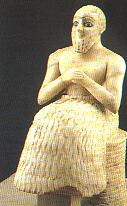
A particularly rich section is the one dedicate to archaic Mesopotamia, Sumer and Akkad, around the cour "Khorsabad" (galleries 1 to 6) and further on, the Iranian (galleries 7 to 10).”Stele des" vautours” (Vulture stele) from 2450 BC, an alabaster small statue from Mari,master piece of the Sumerian inspiration: it is dedicated to the goddess Ishtar, intendant of EBIH-Il with eyes set with lapis-lazuli. See also one of the most
precious of this department as well of the museum, a basalt stele where the
firstlaws of humanity were engraved: the Hammourabi Code..not only an art work
but of first historical importance. Other
works are varied: tapestries (of which the Persian tapestry called " de
Mantes", gallery 11), textiles, arms, miniatures, ceramics, glasswork and
art objects, and numerous small statues of Goudea. In October 97 the Sackler
wing opened with the Oriental Antiques (Sully wing at ground level from room 10
up). Also 13 new galleries opened as a continuation of the Iranian circuit (which
starts in the Richelieu aisle) with Iran from the Iron Age, the Levant
countries, Arabia before Islam, Cyprus, etc.. The must of the Oriental Antiques
is the statue discovered at Ain Ghazal (Jordania), dating 7000 B.C. and lent to
the Louvre for 30 years by the Hachemite kingdom. Height 1.05 meters it presents
a funny modern attitude, relaxed, cool, hands in the pockets, a slight irony in
the expression.
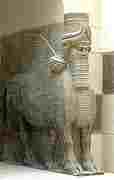
The summit of the visit is in the cour "Khorsabad" itself, evoking the entrance of the palace of the Assyrian king Sargon II is. Vestiges testifying the impressive power of Assyrian civilization, from the 9th to the 7th century BC are mostly spectacular, like the two original bulls guard the passage. Notice! They have five paws.
You can look at them as well
as face to face as from profile! Elements
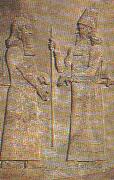
of the décor of the palaces of Nimroud, Ninive and especially Khorsabad evoke
the great-armed feats of theses building kings especially Sargon II, represented
here in his function of supreme administrator, instructing his minister. Bibliography: The Louvre, Seven Faces of a Museum; The Louvre (Collection Guides Gallimard); The Louvre-the Museum-the Collections-the New Spaces (Connaissances des Arts); Louvre, la visite, Pierre Qouniam (Reunion des Musees nationaux) |
|||||||