|
The works included in this department cover the Greek, Etruscan and Roman civilisations.
The Greek statuary is presented in chronological order (the orientalising era,
the Archaic, Classical and Hellenistic periods).
Since December 1997, the art of the Cyclades, the Crete and Mycenian
civilisations are displayed in a completely new setting in rooms located in the
Denon Wing.
Three rooms are dedicated to Etruscan works (sarcophagi, vases, paintings and jewellery). The Roman collections include mainly statuary, mosaics, bronzes and
gold and silver work.
If
you want to do the circuit chronologically, a new access: Denon mezzanine, lower
Daru gallery.
Notice the wrought ceiling (old
apartments of Anne d'Autriche) in room 5, which is a rotunda.
Room 7 is called salle du Parthenon where a magnificent piece shows the art of
Greek sculpture rising to a very high level. The “Ergastines”, a frieze of
the Panathenees. ", executed between 442-432 BC. A part of the frieze of
this famous monument (400 B.C.) where young noble girls make a sacrifice to
Athena. All the rest has been pinched by the English!
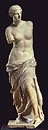 Hall 12, something not to
be presented anymore: the Venus of Milo, discovered in 1820 on the island of
Milo and presumed dating from the 2nd century BC. Seen as the model of perfect beauty of a woman. Hall 12, something not to
be presented anymore: the Venus of Milo, discovered in 1820 on the island of
Milo and presumed dating from the 2nd century BC. Seen as the model of perfect beauty of a woman.
Room 17, salle des Cariatides was richly decorated by Jean Goujon and
used to be the place were a lot of prince marriages and royal feasts took place.
Some amusing anecdotes happened here:
Henri III,
the gay king, ordered 120 pages to be whipped cause they mocked him. During a
ball, that same year, in front of the whole court, he provoked a scandal and
insulted his sister, the queen Margot, for her immoral behaviour. In 1658,
Moliere played for the first time in front of Louis XIV, one of his plays.
 Rooms 18 to 20 are about the Etruscans. The Romans are in halls 22 to 29. La lot
of beautifully, carved masterworks like urns,vases, sculptures, mirrors,
sarcophaguses, glass work, gold jewels and many more. Just look around and enjoy.
Needless to make a big description. :-)
Rooms 18 to 20 are about the Etruscans. The Romans are in halls 22 to 29. La lot
of beautifully, carved masterworks like urns,vases, sculptures, mirrors,
sarcophaguses, glass work, gold jewels and many more. Just look around and enjoy.
Needless to make a big description. :-)
Hall 21 contains superb Lebaneses mosaics, and a lot of artefacts shown in well
laid out display windows.
Continue in next halls with the Pompei remains, the mosaics called "Les
Saisons".
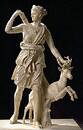
The room has a superb
setting, and the quality of works displayed here is at a high level. Very
important pieces are gathered here, like " le Gaulois blesse", "Artemis"
(ditto Diane de
Versailles), " Les trois Graces", "Silene portant Dyonisos
enfant", "Hermes attachant ses sandales".The Roman section ends with room 6 and 7 of the Sully section on the first floor.
 |
|
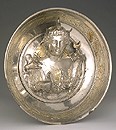
Boscoreale |
 Jewellery
is richly presented with a magnificent collection and a large choice of
silverware, like the ones discovered at Boscoreale, near Pompei. At the end of
the great staircase the world famous "Victoire de Samothrace", 2nd
century B.C, fiercely deploying her wings, looking like the bow of a ship,
probably commemorating a naval victory of the Rhodians at the end of the 2nd
century BC. Jewellery
is richly presented with a magnificent collection and a large choice of
silverware, like the ones discovered at Boscoreale, near Pompei. At the end of
the great staircase the world famous "Victoire de Samothrace", 2nd
century B.C, fiercely deploying her wings, looking like the bow of a ship,
probably commemorating a naval victory of the Rhodians at the end of the 2nd
century BC.
Bibliography:
The Louvre, Seven Faces of a Museum; The Louvre (Collection Guides Gallimard); The
Louvre-the Museum-the Collections-the New Spaces (Connaissances des Arts);
Louvre, la visite, Pierre Qouniam (Reunion des Musees nationaux), Guide du
Routard 1999.
|
