|
Those who are fed up with the impressive
19th century facades of the 1st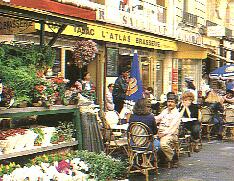 arrondissement, should immediately move to the
3rd.......Which means the MARAIS. The Marais stretches further into the 4th arr
but I will remain for the moment in the 3rd, the northern part of the Marais. A
beautiful area, which character changed often through a turbulent history. Of a
great architectural unity and homogeneity it is an ideal area for promenades in
narrow, medieval streets. arrondissement, should immediately move to the
3rd.......Which means the MARAIS. The Marais stretches further into the 4th arr
but I will remain for the moment in the 3rd, the northern part of the Marais. A
beautiful area, which character changed often through a turbulent history. Of a
great architectural unity and homogeneity it is an ideal area for promenades in
narrow, medieval streets.
More than everywhere else in Paris, look
around, quietly, don't be in a hurry, slow down your pace to inhale the delicate
atmosphere brought here through the centuries. From time to time push a door, or
ring a door opener bell to discover paved yards, interior gardens.
Unfortunately, electronics and security have set in and most of these doors have
now a coded system to open. But try anyway, you never know ;-)
This area was a swamp until the 12th
century. But monks dried the land and made it fit for building. The Jewish
community followed. Beautiful palaces were build when the aristocracy settled
down in the 17th century. And one of the most beautiful squares in
Paris: the place des Vosges, an idea of Henri IV who built also his hotel des
Tournelles. The marquise de Sevigne and the Bishop of Rohan did the same with
their magnificent hotels. When nobility moved to Versailles at the end of the
17th century, the Marais slowly degraded. It lost its attraction, the
noble mansions could be bought by anybody with some money . And when the
supporters of the French revolution chased the stubborn remainders of the elite
with a hard fist (and guillotine), the mansions, palaces and hotels de maitre
turned into ruins and wasteland. The rest of the 19th century precipitated the
ruin of the area , even if a lot of craftsmen lived in the area. But Andre Malraux, state
secretary of culture in 1962, decided that the area deserved a revival. Great
sections of the area were saved by classiffying them into "monument"
protégé as monuments and preserved against the sick
appetite of real estate promoters. He presented a sanitary plan and the maisons
de maitre, hotels particuliers and residences which were fit for demolition,
could not be touched anymore. But the consequence was that the real estate
prices rose into heaven and almost all "original" inhabitants of the
area had to move away or were thrown in the street without mercy. Art galleries, fashion boutiques, cafes
and restaurants replaced ateliers and manufactures in the small alleys.
Nevertheless a lot of really ruined houses had to be demolished but, without
these anyway irrecoverable constructions, the Marais mansions found their old
brilliance and splendor again. Loiter, walk, and look at the iron wrought
details, stunning porches and portals. Whenever
you can get in somewhere, do it, or else admire it from the outside. A lot of
these houses were divided into apartments and sold to wealthy industrials,
artists or writers.
If you want to walk on a Sunday and
admire nice and cute shops, go to the rue des Francs-Bourgeois where everything
is open. Conviviality is the main ambience around the Carreau du Temple and in
the rue de Bretagne.
But let's start the 3rd arrondissement.
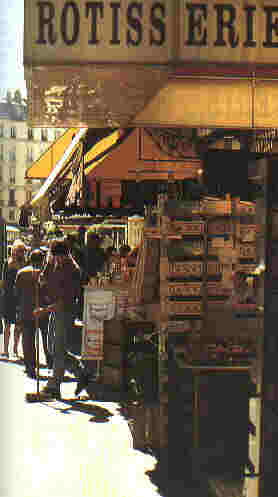
Quote Michel Dansell: ” Numerous hotels particuliers, which flourish here as
water-lilies in a "swamp”. This arrondissement is also vibrant with
pulpous and juicy life as the fruits on the stands in the rue de Bretagne.
 |
|
Rue de Bretagne |
At the Carreau du Temple, there is
always a very animated second hand clothes market, where you can get dressed
from top to toes at very competitive prices. It's also the area frequented by
all jewelers of France and Navarra. A stone throw away, you can buy some grains
at the market "des Enfants-Rouges", to disperse them later in the blue
sky of the very old rue des Oiseaux. In the mean time, not far from there, the
residents of 33, rue Charlot ignore the fatal prediction weighing on their
homes: according to a famous fortune-teller, their building will collapse the
day the marche des Enfants-Rouges will be razed, this market being without any
doubt the oldest in Paris still in activity. Legend or reality? Beware of the
real-estate promoters!” (unquote). And what walk could be more romantic
than a stroll to the picturesque place des Vosges where Victor Hugo and
Richelieu lived in days gone forever. And just around the corner: rue des Francs
Bourgeois with its small shops, not too expensive. A good advice: visit the Marais best
during the week. It's very crowded in the week-ends.
Bibliography:
--Vie et histoire des arrondissements de Paris, ed.Hervas
(1985-1988--Nouvelle Histoire de Paris, ed.Hachette--Le Pieton de Paris, by
L.P.Fargue, ed.Gallimard -Paris, 2000 d'histoire, by J.Favier, ed.Fayard
1997—Paris insolite, by Michel Dansel, ed.Hachette, Naissance de Paris, by
M.Fleury, ed.Imprimerie Nationale 1997--Paris 19eme siecle, l'immeuble et la
rue, by F.Loyer, ed.Hazan, 1994
|