|
Notre Dame de Paris cathedral in Paris Site Home - What's New?-Feedback - About Jack-Travel/Art Links |
|
|
|
Place
des Vosges Carreau du Temple -market-Musee du Judaisme Village Saint - Paul Hotel de Sens Ile de la Cité
|
Paris-Ile de la Cité-Notre Dame de Paris |
|||||
Crossing the pont d’Arcole
over the Seine, let’s walk now towards the centre of France, where a stone
marks the zero km border, and of which all distances in France are measured: the
cathedral of Notre-Dame de Paris. You are now in the touristic heart of Paris
where numerous souvenir shops will remind you your tourist status, long before
your eyes will contemplate the cathedral. Overwhelming! I can easily figure that
must have been the feeling of the medieval inhabitants of Paris in front of this
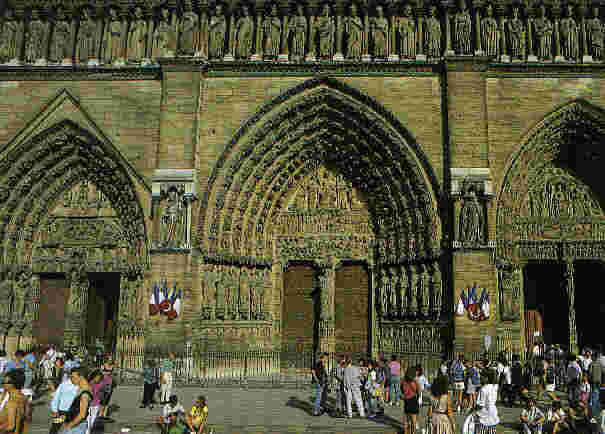
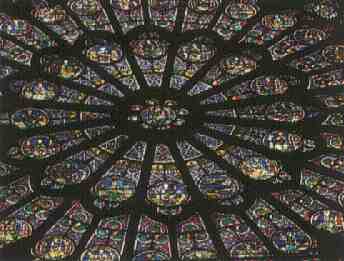
impressive but beautiful and harmonious facade. The cathedral suffered a lot of damages during the French revolution. Citizens beheaded the sculptures of the facades, assuming these were the heads of the French kings. To make it complete they looted the treasures and renamed the place” Temple of good understanding”. But it was during the 19th century that the church became a world wide known monument, thanks to Victor Hugo and his “Notre Dame de Paris”. For those who never read the book, I recommend it strongly, it is a masterpiece in the description of Paris and its people during the middle ages. The church is 130 meters long, 48 wide and has a height of 35. The two towers of 69 meters have a fantastic outlook on Paris. Before entering the cathedral, admire the luxurious decorations of the façade. Three entrances, all decorated with relevant, incredibly wonderful sculptures. Above these portals you can see the “Galerie des rois” with 28 statues of the kings of Israel and Judea (restored by Viollet-le-Duc after their decapitation by the furious mob during the Revolution). Above the galerie des rois, a superb, breathcatching rose window. And everywhere you look, this maze of stone lace, so fine and aerial, hard to believe that people could achieve such beauty during these dark ages.
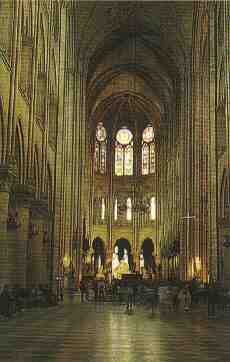
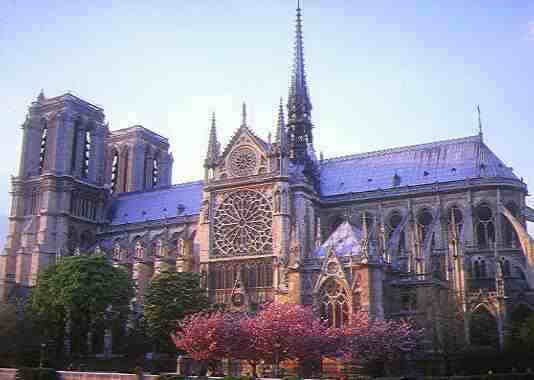
If you want to climb the towers, I can assure you that the view on the ile de la Cite and the rest of Paris is worth the climb of 387 stairs. The spire in front of you houses the relics of saint Marcel, saint Denis and Sainte Genevieve in the bulb at its summit. Inside the cathedral the view is breathtaking. Enormous pillars support the weight of the ceilings but the purity and perfection of the architecture leaves nobody indifferent. But let’s translate the Routard in a brief description: (I quote): “ The transept proposes admirable glass-stained windows and rose windows of the 13th century, admirable in finesse. The choir dates from the 17th century and is dedicated to the Mary Virgin. Louis XIV ordered a “pieta” on which sides the kings Louis XIII and Louis XIV appear, what a modesty!! The exterior bas-reliefs, left of the choir, narrate the life of Jesus and date from the 17th century. In the panel of the “Last Supper”, Judas serves himself first, defying all rules of politeness. “ (unquote)
Try to visit Notre Dame when there is an organ recital, very impressive! It is supposed to happen every Sunday (17.30 no fee) and the second Tuesday of each month (20.30, paying) |
||||||
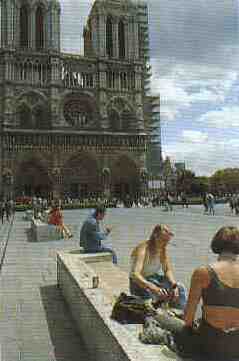 Let’s have a small
historical reminder. It’s in 1163 that the first stone was laid and 170 years
later inaugurated. In the mean time Saint Louis had deposited the Thorn Crown
(today only visible on Good Friday and on Fridays when it’s a fasting-day. Who
the architect of Notre Dame was is still not certain, disputes are still going
on…but it was Maurice de Sully who decided that a church had to be built on
this spot, to compete the Saint-Denis basilica.
Let’s have a small
historical reminder. It’s in 1163 that the first stone was laid and 170 years
later inaugurated. In the mean time Saint Louis had deposited the Thorn Crown
(today only visible on Good Friday and on Fridays when it’s a fasting-day. Who
the architect of Notre Dame was is still not certain, disputes are still going
on…but it was Maurice de Sully who decided that a church had to be built on
this spot, to compete the Saint-Denis basilica.