
|
Place de l'hotel de ville Site Home - What's New?-Feedback - About Jack-Travel/Art Links |
|
|
|
Place
des Vosges Carreau du Temple -market-Musee du Judaisme Village Saint - Paul Hotel de Sens Ile
de la Cite Place de l'Hotel de Ville
|
Paris-Place and Hotel de Ville |
|
|
|
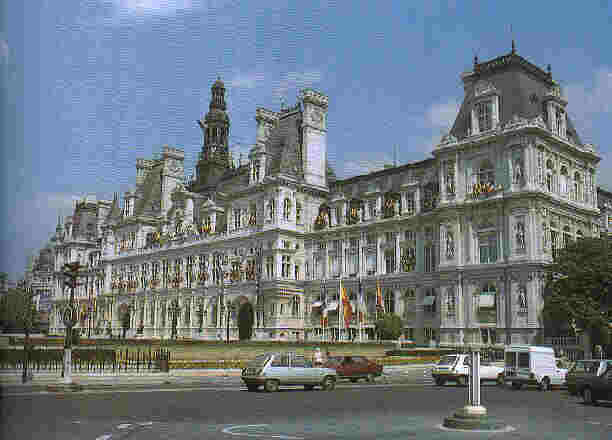
Honoré de Balzac, the great French writer about the life and customs in Paris of the 19th century, had this ferocious description of the Parisian people in « La Fille aux Yeux d’Or » in 1834 : “Look at them, these Parisians! They scare the hell out of you…! Yes, the bourgeois look terrible: bony, meagre, scanty, yellow or burnt by the sun”. You can verify Balzac’s description every day in front of the centre Pompidou, still in renovation today (except the temporary exhibitions), where a motley crowd, composed by students, clochards, backpack tourists, fire-eaters, card fortune-tellers and other clear-sighted camp in front of the “steamship”. Let’s continue our walk in the 4th arrondissement. Leaving the Marais but still staying in the 4th take the rue Saint-Martin, the rue de Rivoli towards the place de L’HOTEL DE VILLE, a white 19th century building.
During the French revolution it was one of the most important political centres. After the taking of the Bastille the mob stormed the building and murdered the prefect Flesselles. This place was used for executions a long time before the
guillotine was even invented. How many heads rolled down here in front of an
enthusiastic but shivering public, which had no other distractions since soap TV
was not invented yet! It’s here that Marat, Robespierre and Danton held their
famous speeches. And the marquis de la Fayette, well known by the American
revolutionaries, added the royal white to the blue and red colours, which
created the French flag. The hotel de ville, put on fire in 1871 by the “Commune
de Paris” revolutionaries, was completely destroyed and a new one build, same
style (Neo-Renaissance) but bigger. Renovated and cleaned thoroughly in 1982 it
is shining again as in times long gone by. It is now the centre of cultural or
sport manifestations like the giant Christmas crib, the winter ice-skating rink
or the giant TV screen that was set up for the world soccer games in 1998
(that’s over now).Cross the pont
“d’Arcole” to arrive at the cathedral Notre-Dame. But that’s for the
next article…. Bibliography: --Vie et
histoire des arrondissements de Paris, ed.Hervas (1985-1988) |
|||
 Since Antiquity, the shores of the Seine were very swampy
at this spot and soon the Parisians created a small harbour. It grew bigger and
was known as the “Port de la Greve” in the 12th and 13th
century. The adjacent square (the place de Greve, now place de
l’hotel de ville). The place de Greve was the meeting place of all the
unemployed (origin of the expression: faire la greve: to strike). Also a place
for celebrations and executions. In 1357, the “prefet” Etienne Marcel built
the first town hall of Paris on this square. He chose a house, enhanced with
columns, and gave it a Renaissance style. Between 1310 and 1830, all outcasts, pariahs, thieves and
bandits were attached at the pillory and severely beaten and tortured. Reread
“Notre Dame de Paris “ by Victor Hugo: “”The place de Greve was a horrible dark place, and so
was the sinister town hall. Death was always present here by the presence of the
gallows in the middle of the square, a pillory, chains and scaffold. This square
of Death had always a morbid attraction on people””””
Since Antiquity, the shores of the Seine were very swampy
at this spot and soon the Parisians created a small harbour. It grew bigger and
was known as the “Port de la Greve” in the 12th and 13th
century. The adjacent square (the place de Greve, now place de
l’hotel de ville). The place de Greve was the meeting place of all the
unemployed (origin of the expression: faire la greve: to strike). Also a place
for celebrations and executions. In 1357, the “prefet” Etienne Marcel built
the first town hall of Paris on this square. He chose a house, enhanced with
columns, and gave it a Renaissance style. Between 1310 and 1830, all outcasts, pariahs, thieves and
bandits were attached at the pillory and severely beaten and tortured. Reread
“Notre Dame de Paris “ by Victor Hugo: “”The place de Greve was a horrible dark place, and so
was the sinister town hall. Death was always present here by the presence of the
gallows in the middle of the square, a pillory, chains and scaffold. This square
of Death had always a morbid attraction on people””””