|
In my last article I left you rue
Payenne. Make now a right into the rue des Francs Bourgeois, another right to
the rue Elzevir and let's visit the MUSEE COGNAQ JAY located in the hotel de
Donon.
Ernest Cognaq and Louise Jay, founders of the departemnt stores "La Samaritaine"
, gathered a beautiful art
collection, mostly of the 18th century, now displayed in this superb house of
the 16th century. The museum, with a lot of small stairs, corners, small
galleries is a delight for the eyes. Cute and beautiful. An ensemble of
beautiful items of the 17th century, splendidly displayed. Exquisite
furniture, fine art objects, Sax porcelain and a lot of paintings. The galleries
are decorated with some masterworks like Fragonard, Chardin, Watteau, Boucher,
Latour, even a Rembrandt and Rubens even if the 17th century was not Cognaq's
favorite, Greuze, Canaletto and more... All this constitutes a delicious
ensemble of perfect coherence. I�m sure that the intimate and relaxed
atmosphere of this museum will please you.
Let's return to the rue des Francs
Bourgeois, turning right coming from Cognaq Jay. Before you cross the rue
Vieille du Temple, have a look at the corner house, la Maison de Jean Herouet,
very characteristic medieval home. But the present state of the house gives us only a very
pale idea of how this house was really in
1510, very badly damaged in 1944 and restored with mediocrity.
The RUE DES FRANCS BOURGEOIS is a
succession of hotels (not to lodge !) with original facades. Look at no.30,
hotel d'Almeras built in brick and stone with a very original baroque portal. At
no.26, the hotel de Sandreville is a fine example of Louis XVI architecture, at
no.31, hotel d'Albret with parts of different periods (16th -18th century) . At no.34 an old pharmacy
and at no. 29, the ancient bakery kept
its begin 20th century facade.
The corner of the rue Pavee is marked by the hotel de LAMOIGNON (no.24), built
in 1584 for Diane de France, duchess of Angouleme. The chairman of Parliament
Lamoignon lived here from 1658 to 1677. It is now the Historical Library of the
City of Paris.
Continue the rue des Francs Bourgeois
and make a right in the rue de Sevigne. You will soon come on a square, the
Place du Marche-Sainte-Catherine, one of my favorite squares in the Marais.
Recently transformed into a pedestrian zone it is an adorable place where it is
good to sit on a terrace in the nice sunny days and inhale the so special
perfume of Paris, the Marais, the ancient and the modern.. Continue
the rue de
Sevigne until the rue de Rivoli, make a left and admire the HOTEL DE SULLY at no
62, the mostbeautiful city palace
built in the beginning of the 19th century (in Louis XIII style).
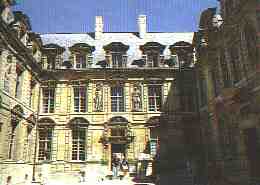 |
| Hotel
de Sully |
Its successful
restoration made it one of the most prestigious palaces of the Marais.It takes
its name from Sully, finance secretary, who bought it in 1634 and is enhanced by
a beautiful garden communicating with the Place des Vosges, subject of my next
article. You can either accede the place des Vosges through the garden of the
hotel de Sully or take the rue de Birague, if you continue the rue de Rivoli,
and make a left.
Bibliography:
--Vie et histoire des arrondissements de Paris, ed.Hervas (1985-1988)
--Nouvelle Histoire de Paris, ed.Hachette
--Le Pieton de Paris, by L.P.Fargue, ed.Gallimard 1997
--Histoire et dictionnaire de Paris, by A.Fierro, ed.Laffont, 1996
--Dictionnaire des monuments de Paris, by J.Colson and M.C.Lauroa ed.Hervas 199
--Guide du Routard 1998-1999 (Ed.Hachette)
--Paris, 2000 d'histoire, by J.Favier, ed.Fayard 1997
--Paris 19eme siecle, l'immeuble et la rue, by F.Loyer, ed.Hazan, 1994
--Leaflet of the musee Cognaq-Jay
|
