|
Musee du Judaisme-Carreau du Temple Site Home - What's New?-Feedback - About Jack-Travel/Art Links |
|
|
|
Place
des Vosges Carreau du Temple Village Saint - Paul Hotel de Sens Ile
de la Cite
|
Paris -Marais-Carreau du Temple Market-New Jewish museum |
New naughty and horrible anecdotes
|
||||
|
|
||||||
|
Let's now pay a visit to the "Carreau du Temple", rue Dupetit-Thouars and rue Perree. Just continue the rue Vieille du Temple until the rue de Turenne where you make a left. Arriving rue de Franche-Comte make another left and you are at the Carreau du Temple.
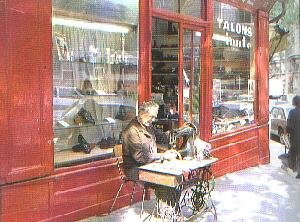
This “cheap clothes” market, covered today by a metal and glass construction was already alive end 18th century and held every day. But it was not always like that. The structure replaced the metallic pavilions of Legrand (1863-1865), which had replaced an oval construction of 1788. The idea was to cleanse the Temple Enclosure (Enclos du Temple), a haunt of people with very questionable professions, to turn it into a genuine commercial center. The Temple enclosure gained even some tax advantages at that time, privilege that still exists today. So, already in the middle of the 17th century, commerce of fake jewelry developed here, said "pierrerie du Temple" which is still tangible today with the ensemble of ateliers, gold shops, fantasy jewelry (rue du Temple). The old clothes were also an important part of the trade that was going on here and it survived in the market, the streets all around where the clothes are often exposed on the street pavements like the rue Perree, Caffarelli and Picardie. Inexpensive (but beware for the quality) you can even try to bargain, if you like that kind of sport. Price competition, since beginning of the 20th century with the Puces at Clignancourt is heavy and the bargain hunters slowly abandon the place, but the ambiance is still lively. In the seventies there was a plan to tear down the whole Carreau area (another brilliant idea of president Pompidou) but the neighborhood defended their market with determination and finally the project aborted.
Each morning, at 7.30 AM, the market opens with the ringing of a bell and the bargain hunting can begin in the renewed hall. It is fun to watch the folkloristic way of allocating the stalls: every merchant puts an aluminum medal in a basket and a drawing is held. The first picks the best place and so on... (anecdote of the Routard 1998/99). Don’t be fooled, most clothing is new but the old tradition of bargaining id still very alive and creates that very animated ambience. During the week you should loiter around the Cite Dupetit-Thouars. You will have the opportunity to discover the former billiard manufacture of Henin senior, where an old billiard-table is still displayed. Continue the rue Dupetit Thouars until the rue du Temple and make a left. Look into the 5th street on the right, rue de Montmorency at no.51, a famous house, the HOUSE OF NICOLAS FLAMEL, said to be the oldest house in Paris (1407). Return to the rue du Temple and take the next right, rue MICHEL-LE-COMTE, in full renovation to admire the houses. Return again to the RUE DU TEMPLE. Hotel d'Avaux, no. 71 has a very original facade, majestic portal with powerfully sculptured savage heads. All around the vast courtyard there is a succession of well ordinate colossal Corinthian pilasters. In 1680 it was bought by the comte de Saint-Aignan. It's here that a few months ago a brand new museum was opened: "MUSEE DU JUDAISME", not just another Shoah museum but an absolute must of all who are interested in the history, traditions, way of life and genesis of the Jews since Antiquity until our times. It was opened in fall 1998 and is one of the most beautiful Jewish museums I have ever seen. The splendor of the rooms, the beauty of the display, the magnificent art works, the excellent didactic itinerary laid out about the history of Judaism throughout the ages, about the customs, Jewish celebrations, the religion, the way they were chased everywhere and so on until the Shoah and the creation of Israel. Bibliography: --Vie et
histoire des arrondissements de Paris, ed.Hervas (1985-1988) |
||||||
|
|
||||||