|
A dark, narrow alley leads
to a little garden, or better said a fountain...without light, without air, a
pestiferous receptacle for the dirt that falls down from the first
floor...." That's the way the French writer Eugene Sue (1804-1857)
described the rue du Temple 17 during the renovation of this area. Our walk starts here (a side street
of the rue de Rivoli, near the BHV department store).
The
rue du Temple is one of the oldest of the area, noticeable by its narrow,
surelevated houses, mainly with jewellers and trinket shops. At the right you will see the HOTEL DE SOUBISE, where the state archives
are stored.Unfortunately you cannot visit them but you can admire a few
exemplars in the MUSEE DE L'HISTOIRE DE FRANCE, rue des Francs Bourgeois.We
make a left at the rue Rambuteau and a right in the rue des Quatre Fils and we
arrive at the HOTEL DE ROHAN, built in 1708 for Armand de Rohan, bishop of
Strasbourg at 87, rue Vieille du Temple. Last time I went there it was closed
for renovations but it should be open again. Maybe you can now admire the
"sun rose" by Le Lorrain, sculpted with delicacy.
 |
|
Hotel Bruant-Musee
Serrure |
At the right, on the
rue de la Perle no.1, the "MUSEE DE LA SERRURE" (Lock museum). The key
manufacturer Bricard organized this small private museum in the hotel Liberal
Bruant (1685). On display, keys and locks from the Gallo-Roman times until the
19th century, with a few items from the royal house.
We continue and make a left
into the rue de Thorigny. We arrive at a very important and beautiful museum,
the MUSEE PICASSO, at the left side, located in a superb hotel de maitre, the
hotel "Sale". It was built in the 17th century for a “ tax collector
on salt” (gabelle in old French), Robert de Fontenay. The fortune he made like
that (today he would be sentenced to jail for practises like that!) Salt,
meaning “sel” in French, you can guess where the name of "l'hotel Sale" came from. The facade on the courtyard is not
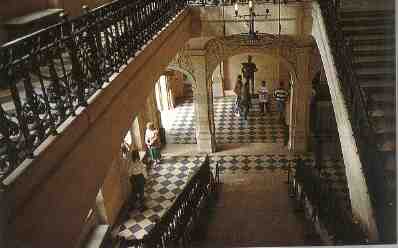
very decorated but inside is a magnificent interior stairway, enhanced with "ignudi"
(antique busts) and a lot of sculptures. The museum, besides being an ideal
setting for Picasso's works, presents a perfect retrospective of his life
production, not with minor works but with master pieces covering his total
career from the beginning to the end. It’s after his death in 1973 that about 200 paintings, 160
sculptures, 80 ceramics and 3000 drawings and sculptures were given to the
French state as succession duties (inheritance taxes)
The exhibition halls,
very well lit, are easy to walk and you are constantly informed by concise and
understandable (!!) information panels.
 |
|
Musee Picasso-interior and staircase |
The presentation of the collection is
chronological, beginning with the "blue" period, the "pink"
period and studies for the "Demoiselles d'Avignon". Now come the most
representative works of the cubist period. Cubist masterworks as "l'Homme a la guitare", "Nature
morte a la chaise cannee" were created.
The displayed works
continue in the same
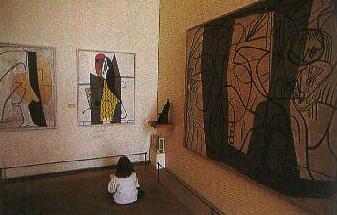 chronological order with other remarkable pieces like the
plastic "Woman with the baby-carriage" and absolute top works like
"L'Homme a la Pipe", "Le peintre et son modele", "
Portrait d'Olga". Other works to see on the first floor: "the
"Pan Flute" (1923) and the "Kiss" (1925) which violent
character reflects a crisis period the artist had at that time.
During your itinerary
continues you will notice the incredible number of extra-marital adventures this
man had and how it affected his paintings. New forms, from the cubist to the
neo-classic period, baroque (see the heavy nudes) to surrealism.
chronological order with other remarkable pieces like the
plastic "Woman with the baby-carriage" and absolute top works like
"L'Homme a la Pipe", "Le peintre et son modele", "
Portrait d'Olga". Other works to see on the first floor: "the
"Pan Flute" (1923) and the "Kiss" (1925) which violent
character reflects a crisis period the artist had at that time.
During your itinerary
continues you will notice the incredible number of extra-marital adventures this
man had and how it affected his paintings. New forms, from the cubist to the
neo-classic period, baroque (see the heavy nudes) to surrealism.
Don't forget to visit also
Picasso's private collection of other painters: Chardin, Cezanne, Matisse,
Derain, Rousseau, and Renoir (those seem to have influenced him most of all)
Bibliography:
--Vie et histoire des arrondissements de Paris, ed.Hervas
(1985-1988--Nouvelle Histoire de Paris, ed.Hachette--Le
Pieton de Paris, by L.P.Fargue, ed.Gallimard 1997--Histoire et dictionnaire de
Paris, by A.Fierro, ed.Laffont, 1996--Dictionnaire historique des rues de Paris,
by J.Hillairet, ed.Minuit--Dictionnaire des monuments de Paris, by J.Colson and
M.C.Lauroa,ed.Hervas 1992--Guide du Routard 1998-1999 (Ed.Hachette)--Paris, 2000
d'histoire, by J.Favier, ed.Fayard 1997--Naissance de Paris, by M.Fleury,
ed.Imprimerie Nationale 1997--Paris 19eme siecle, l'immeuble et la rue, by
F.Loyer, ed.Hazan, 1994
|
