
|
Place des Vosges-Musee Victor Hugo Site Home - What's New?-Feedback - About Jack-Travel/Art Links |
|
|
|
Place des Vosges Carreau du Temple -market-Musee du Judaisme Village Saint - Paul Hotel de Sens Ile
de la Cite
|
Paris -3rd/4th arr-Marais-Place de Vosges-Musee Victor Hugo |
New naughty and horrible anecdotes | |||||||
|
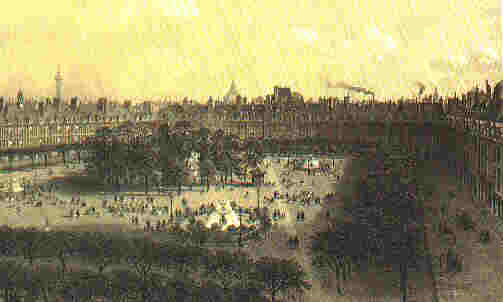
Arriving through the rue de Birague, here is the most beautiful square in Paris: PLACE DES VOSGES.The history of this square is a long one. It’s in the Hotel de Tournelles that Henri II died of the wounds he received after a tournament. His wife, Catherine de Medicis tore the building down and on the spaces that were set free, a horse market was set up for some time.
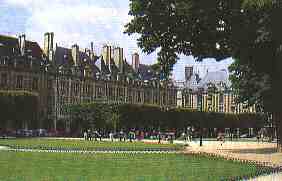
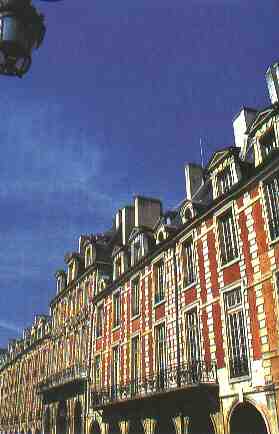
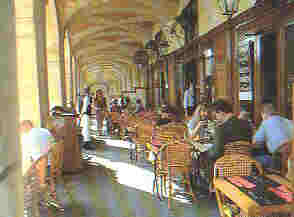
The place was also a favourite duelling spot! King Henry IV decided to build a new hotel des Tournelles and as he had certain ideas about aesthetic and economical preoccupations, he decided, in 1605, the building of a square based upon new architectural criteria. : regular plan, identical facades interrupted by two symmetrical pavilions: Pavillon du Roi et Pavillon de la Reine. Until that time, you could build anyhow, anywhere, as you pleased without any prepared plan. That's what gives this special touch to the old streets of the Middle Ages. The inauguration took place for the double marriage of the king and his sister in 1612 and it soon turned out to a very residential area. Henri IV started then to build houses around the square (financed by the authorities) and soon the wealthy aristocracy settled down here (the marquise de Sevigne was born at no.1). First called “Place Royale”, it is an example of admirable planning and lay out , surrounded by arched galleries in front of the beautiful houses .
Take your time, look and walk around, admire the great refinement of
colors: the roofs are blue and the windows are in white stone and red brick, just like the arches. The
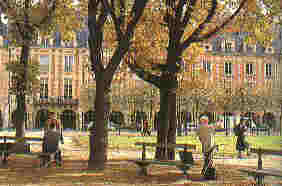
central garden you see now didn’t exist at that time. It is planted with tile
trees today and houses a statue of Louis XIII set up in 1825.
Look at the
Pavillon de la Reine, with its sculpted doors, monumental staircases, splendid
ramps, interior yards and gardens. Finally, the place Royale was renamed Place
des Vosges, to honour the first region in France who paid taxes in 1800.
At no. 6,
the house of Victor Hugo is a museum: LE MUSEE VICTOR HUGO. Closed on Mondays,
no charge on Sundays.
Bibliography: --Vie et
histoire des arrondissements de Paris, ed.Hervas (1985-1988) |
|||||||||
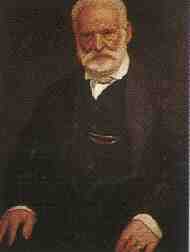 Rohan-Guemenee. The novel “Notre Dame de Paris” had made him a
fortune! 1832 to 1848.
Rohan-Guemenee. The novel “Notre Dame de Paris” had made him a
fortune! 1832 to 1848.