|
Musee Carnavalet Site Home - What's New?-Feedback - About Jack-Travel/Art Links |
|
|
|
Musee Carnavalet Place
des Vosges Carreau du Temple -market-Musee du Judaisme Village Saint - Paul Hotel de Sens Ile
de la Cite
|
Paris -3rd/4th arr-Marais-Musee Carnavalet |
New naughty and
horrible anecdotes
|
|
Getting out
of the Picasso museum, rue de Thorigny, make a left into the rue du Parc-Royal
and a right into the rue de Sevigne. We are at the entrance of a museum
CARNAVALET, museum of Paris history, rather unknown by the foreign tourist who
thinks: “what the hell should I go to a Paris history museum? What will they
show to me?”. That’s ‘ a wrong attitude. The Carnavalet is one of the
nicest, charming and relax museums in Paris,
Different periods are highlighted: Paris until the 16th century", "Paris from Louis XIII and Louis XIV", "City administration in the 17th and 18th century", "Paris in the first half of the 19th century", and "From the Second Empire until today". The collection starts with the section of the origin of Paris until Louis XVl. It is housed in the hotel Carnavalet. From the French revolution until nowadays is housed in the hotel Le Peletier de Saint Fargeau. Four galleries were created to display the archeological finds. You will see a curious mould of the face of a 6 months old baby found in a sarcophagus. You can admire the salon of the hotel d’Uzes, with admirable wainscoting, a décor of a military café in the rue Saint-Honore. Next you will enter the hotel Le Peletier de Saint Fargeau, through a special passage to see Paris history until nowadays. Furniture and paintings are shown as much as possible in an "ensemble" which should represent the historical context. Here the “Collections de la Revolution” are reunited with portraits “Serment du Jeu de Paume “ by David, “Madame Recamier” by Gerard, a Parisian residence like it was during the reign of Louis XIV, a replica of the apartment of Marcel Proust, a "Salon des Cafes de Paris". Admire also some small-scale models of the Bastille, made by Paloy out of original stones of the famous prison. Objects, consoles, tables, beds, couches. Exit Carnavalet. The sun shines (?) and we continue our walk by returning left to the rue du Parc-Royal. Magnificent homes of the 17th and 18th century line the street. At night, don't worry about safety, you're perfectly all safe in the Marais at any time of the day. When you see an open door or a door you could open by pushing a bell, don't hesitate, you could stumble upon a beautiful courtyard, or a Louis XIII staircase. Look at nice the facades of the houses. Pass the rue Payenne where at no.5 the "Temple de l'Humanite" is housed, a replica of the positivist church of Rio de Janeiro. At no.11 hotel de Marle, which has painted ceilings and beams from the 17th century, restored with much care and fidelity to house the Swedish cultural center. This center organizes only exhibitions of contemporary artists. At no.13, the hotel de Chatillon, epoch Louis XIII. Bibliography: --Vie
et histoire des arrondissements de Paris, ed.Hervas (1985-1988) |
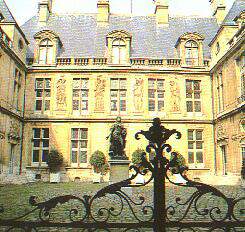 partly due to its location in the
heart of the Marais and it’s superb proportions. The items displayed are of a
great value and as I said before, totally dedicated to the history of Paris: the
prehistoric Paris, medieval Paris and all periods of trouble like the French
revolution and the 19th century with Napoleon, Louis-Philippe and Napoleon III.
Let your imagination work while you look around. Let the personages get life in
your mind, hear them speak, exhorting people to build barricades and ask for a
better existence. See the guillotine, the terrorized aristocrats waiting for
their execution, be a child and feel yourself in a historical movie.
partly due to its location in the
heart of the Marais and it’s superb proportions. The items displayed are of a
great value and as I said before, totally dedicated to the history of Paris: the
prehistoric Paris, medieval Paris and all periods of trouble like the French
revolution and the 19th century with Napoleon, Louis-Philippe and Napoleon III.
Let your imagination work while you look around. Let the personages get life in
your mind, hear them speak, exhorting people to build barricades and ask for a
better existence. See the guillotine, the terrorized aristocrats waiting for
their execution, be a child and feel yourself in a historical movie.