|
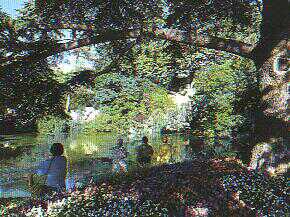 The
inhabitants of Passy who want to escape a moment from the hectic life of their
work and social environment have the largest forest of Paris at their doorstep,
matter of speaking. The bois de Boulogne is especially appreciated by tired
tourists, joggers, horse gamblers and cavaliers, parents with children, looking
for some fresh air in the weekend, the overstressed workers of the grand city
and ---despite some deny it ;-)—those who are looking for a special kind of
love! Indeed, at night it is a very special fauna that comes out of the wood. Be
careful not to get lost, or else the night movie will be forbidden for the less
than 18 years old ;-). The
inhabitants of Passy who want to escape a moment from the hectic life of their
work and social environment have the largest forest of Paris at their doorstep,
matter of speaking. The bois de Boulogne is especially appreciated by tired
tourists, joggers, horse gamblers and cavaliers, parents with children, looking
for some fresh air in the weekend, the overstressed workers of the grand city
and ---despite some deny it ;-)—those who are looking for a special kind of
love! Indeed, at night it is a very special fauna that comes out of the wood. Be
careful not to get lost, or else the night movie will be forbidden for the less
than 18 years old ;-).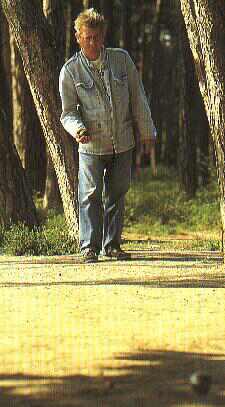
The 25 hectares of the bois are also to avoid on Sundays except if you like
promiscuity. Indeed, you look since early morning at an invasion where entire
families equipped with the ordinary Sunday camping materials occupy every square
centimetre. In the evening it’s the departure, Capharnaum, the other way;
accompanied by a concert of horn blowers, crying children and highly stressed
parents ;-).
But the other days it is worth a promenade. The name "Boulogne" comes
from a sanctuary dedicated to Notre-Dame de Boulogne by Philippe le Bel and was
given to the city of Paris by Napoleon III. Originally they were only stone oaks
growing here in medieval times. Alas, these trees were hacked down in 1814 to
provide fir wood to the occupying foreign armies who had vanquished Napoleon.
Now they are chestnut trees, acacia’s and plane trees.
In the beginning (medieval times) it was a favourite terrain for the nobility to
haunt because a lot of deers crowded the forest. But it was so dangerous that
even to get off your horse for a minute you could be attacked by bears, wolves
or wild boars. People travelling with the stagecoach had to be careful not to be
attacked by bandits and for ruffians. It's under Louis XIV, that the first
efforts were made to design the park for safe and regular hunting. Colbert changed the forest to transform it into a very
popular place for the Parisians by building a lot of lanes. When the Regency period began (1715-1723) the Bois 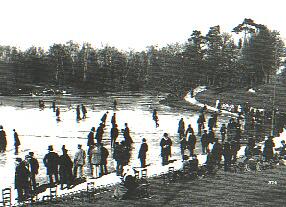 became
a place for elegant and very trendy mundane excursions. Seen and must be
seen! Summerhouses were built,
elegant residences in the green environment with names like La Muette,
Bagatelle, Saint-James and Le Chateau de Neuilly. The first montgolfieres (hot
air balloons) will rise here. It was not until Napoleon III had the surrounding
wall of the Royal hunting ground demolished and let Hausman refit the Bois,
modelling the park on Napoleon's cherished Hyde park in London. He added also grottos, waterfalls, sinuous paths,
pagodas, lakes, and even an original Swiss
Chalet. Finally Napoleon III added more curving lanes and two lakes: ”Lac
Inferieur” and “Lac Superieur”! became
a place for elegant and very trendy mundane excursions. Seen and must be
seen! Summerhouses were built,
elegant residences in the green environment with names like La Muette,
Bagatelle, Saint-James and Le Chateau de Neuilly. The first montgolfieres (hot
air balloons) will rise here. It was not until Napoleon III had the surrounding
wall of the Royal hunting ground demolished and let Hausman refit the Bois,
modelling the park on Napoleon's cherished Hyde park in London. He added also grottos, waterfalls, sinuous paths,
pagodas, lakes, and even an original Swiss
Chalet. Finally Napoleon III added more curving lanes and two lakes: ”Lac
Inferieur” and “Lac Superieur”!
From the Place de l'Etoile it is the avenue Foch, perhaps the most residential
street in the capital, that leads to its gates. Enter the park and look up in the northern part of the bois de Boulogne stands
the MUSEE DES ARTS ET TRADITIONS POPULAIRES, at 6, av. du Mahatma Gandhi, striking
and gripping " homage to draftsmen's , French craftsmanship and peasant
civilisation and it is gradually extending its interest to take in the modern period.
An unrecognised museum, unfortunately, with exceptional pieces. If your kids are
too young to be interested by popular traditions and professions take them
better to the JARDIN D’ACCLIMATATION, an amusement and popular park for
children. A basin with dolphins, animals of a Normandy farm, the plant museum, a
miniature railway and a lot of other attractions that make your time pass
quietly while the children are playing.
Rest a while on your bench until my next article on the Bois de Boulogne, it’s
not over yet
Bibliography
--Vie
et histoire des arrondissements de Paris, ed.Hervas (1985-1988--Nouvelle
Histoire de Paris, ed.Hachette--Le Pieton de Paris, by L.P.Fargue, ed.Gallimard
199 --Dictionnaire historique des rues de Paris, by J.Hillairet, ed.Minuit
--Guide du Routard 1998-1999 (Ed.Hachette)--Paris, 2000 d'histoire, by J.Favier,
ed.Fayard 1997—Trocadero buurt, prachtwandeling en museums, by.J .Fuherschien
(ed.Alkhuys, 1995)
-Bois de Boulogne, poumon de Paris, J.Fremd (ed.Dupuis 1994)
|
