|
 Immediately
north of the Bois de Boulogne lies peaceful Neuilly, crossed by the avenue de
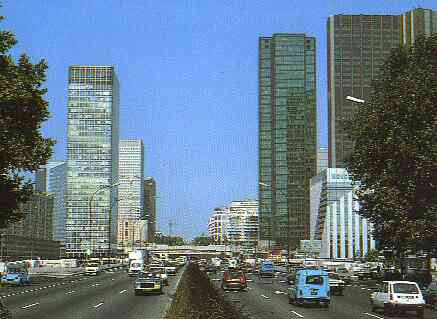
Charles de Gaulle. This luxurious area used to be an oasis in a desert called LA
DEFENSE, America on the Seine. Once a desolate commuter land of office
blocks, the government decided in the beginning fifties to build a modern business area
west of Paris to redevelop commercial and economic activity and tear down ugly
small plants, neglected houses and automobile junkyards. !! The project was
given to EPAD (Etablissement public d'amenagement de la region de la Defense).
The first phase of building was completed in the late 1960's as they proposed a
huddle of office towers not exceeding 100 metres above a Immediately
north of the Bois de Boulogne lies peaceful Neuilly, crossed by the avenue de
Charles de Gaulle. This luxurious area used to be an oasis in a desert called LA
DEFENSE, America on the Seine. Once a desolate commuter land of office
blocks, the government decided in the beginning fifties to build a modern business area
west of Paris to redevelop commercial and economic activity and tear down ugly
small plants, neglected houses and automobile junkyards. !! The project was
given to EPAD (Etablissement public d'amenagement de la region de la Defense).
The first phase of building was completed in the late 1960's as they proposed a
huddle of office towers not exceeding 100 metres above a pedestrian
zone, build around an esplanade situated in the historic axis Concorde
-Champs- Elysees and covering the traffic roads. The CNIT (Centre National des Industries et
des Techniques) , was the first resident as a focus of La Defense but seems
today a bit outdated. It looked like a huge, turned upside down mussel of concrete,
resting only
on 3 points of support, in that time an architectural prowess. The RER was
extended but suddenly recession hit and the planning corporation teetered on the
brink of bankruptcy. At the recovery of the 80's La Defense took finally
permanent root, towers soared to twice the height and the business world moved
in. Since then there
are about 28.000 houses, 2.500.000 square meters office surface and 300.000
square meters shopping surface being build and 70,000 parking places. 110,000 employees working
at the 1300 companies, half of them being executives, with annual sales volume
equivalent to France's national budget. Twelve
of the top 20 French companies have their offices at la Defense. A new generation
of buildings were born, cheaper, architecturally more elaborated. In 1981 the
shopping centre “Les Quatre Temps” was opened and made an end to the
stressing silence in the area and streets, providing also a social focus for the
complex. President Mitterand had already decided to
integrate the Defense into his great architectural projects and had launched the big
contest that would finish by building the "Grande Arche" (the great
Arch).
pedestrian
zone, build around an esplanade situated in the historic axis Concorde
-Champs- Elysees and covering the traffic roads. The CNIT (Centre National des Industries et
des Techniques) , was the first resident as a focus of La Defense but seems
today a bit outdated. It looked like a huge, turned upside down mussel of concrete,
resting only
on 3 points of support, in that time an architectural prowess. The RER was
extended but suddenly recession hit and the planning corporation teetered on the
brink of bankruptcy. At the recovery of the 80's La Defense took finally
permanent root, towers soared to twice the height and the business world moved
in. Since then there
are about 28.000 houses, 2.500.000 square meters office surface and 300.000
square meters shopping surface being build and 70,000 parking places. 110,000 employees working
at the 1300 companies, half of them being executives, with annual sales volume
equivalent to France's national budget. Twelve
of the top 20 French companies have their offices at la Defense. A new generation
of buildings were born, cheaper, architecturally more elaborated. In 1981 the
shopping centre “Les Quatre Temps” was opened and made an end to the
stressing silence in the area and streets, providing also a social focus for the
complex. President Mitterand had already decided to
integrate the Defense into his great architectural projects and had launched the big
contest that would finish by building the "Grande Arche" (the great
Arch).
In 1972 a huge international contest
started. The project that impressed President Mitterand amongst the 424
proposals was the one attributed to a totally unknown Danish
architect, Otto von Spreckelsen in 1981. It was the project showing the most
strength and purity. It was built exactly in the historical axis: Palais du
Louvre-Champs-Elysees-Arc de Triomphe. In the 110 meters high wings several
ministeries were located, big companies, exhibition halls and
the human rights
organisation “Fondation des Droits de l’Homme”. Otto von Spreckelsen died
two years before "his " arch was opened.
Incontestably, 1989, with the inauguration of the Grande Arche and its immediate
consecration thanks to the summit (July 14) of the 7 most industrialized
countries, marked the official upraise of the Defense. Previously, the Defense
was a place to see from afar, with a certain disdain. The spectacular Arche changed
that, seducing public and 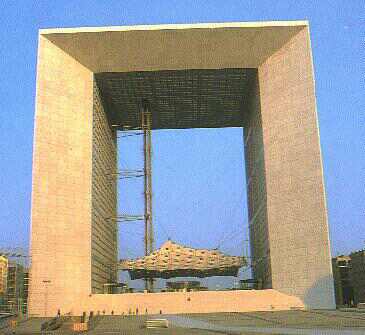 politicians
alike. politicians
alike.
Its economic power is
impressive and from the 50 biggest world groups, 13 are represented.
When you walk today in the area you have the impression to have landed in a
futuristic dream, where different materials and straight lines are melted into a
splendid unity. Very busy during the day, it is extremely deserted at night.
But the Defense cleaned up its image and from an ugly ensemble without soul it
became a
tourist destination! Especially to visit the Grande Arche. But also the
diversification of the cultural events mostly in the CNIT building (concerts,
festivals, exhibitions, the new Imax Dome movie theatre, the Automobile museum,
etc....), together with the increasing number of restaurants and hotels blew a
joyful and agreeable atmosphere during the day in this area. Every year on June
21 there is a music festival where they try, like from Wagner to Stravinsky, to
create a total art of work with concerts and a combination of fountains and
light effects. It gained also a more human face with the 60 outdoor sculptures,
works of great artists, a monumental fountain with its 70 waterspouts. Even
plane trees, petanque players, squares......
Bibliography
--Vie
et histoire des arrondissements de Paris, ed.Hervas (1985-1988--Nouvelle
Histoire de Paris, ed.Hachette--Le Pieton de Paris, by L.P.Fargue, ed.Gallimard
199 --Dictionnaire historique des rues de Paris, by J.Hillairet, ed.Minuit
--Guide du Routard 1998-1999 (Ed.Hachette)--Paris, 2000 d'histoire, by J.Favier,
ed.Fayard 1997-Geschichten aus Paris : La Defense, ein umstrittenes
project, By K.Lagerman (Munchner Verl.Bib. 1996)-
La Defense a visage humain, par J.Lamy (Suresnes prss.1998)
|
