|
Let’s approach the 16th
arrondissement from another angle. If you want to enjoy fully a view on the
Seine, start at the Place de l’Alma. There is the famous bridge where Diana
was killed in that terrible accident in the underground tunnel. The original
bridge was replaced in 1970 by a metallic one, keeping only the famous sculpture
of the “Zouave du Pont de l’Alma”, who was a symbol for the victory on the
Russians in the Crimean War of 1854. The Zouave serves also as a tide-gauge,
almost “drowning” in 1910. At the other side of the bridge is the entrance
of the
“MUSEE DES EGOUTS “(the sewer museum). Open every day except Thursday and
Friday from 1.00to 16.00 (17.00 in the summer). It is totally dedicated to the
way Parisians solved the water problems since 1370. The museum was designed by
engineer Belgrand who renewed the whole sewer system in the 19th
century still existing today. You can walk into them and visit. As strange as it
might be, it doesn’t have any particular smell, as you would expect.
Via the avenue du President Wilson you pass the MUSEE D’ART MODERNE DE LA
VILLE DE
PARIS, a feast for the amateurs of modern and abstract art. The edifice owns a
few very important pieces: the vast composition of Dufy (60 to 10 meters) “La
Fee Electricite”, realized for the hall of light in the 1937 World Fair. Four
enormous canvasses of Robert and Sonia Delaunay, “Rhythms” (1938), “La
Pastorale “by Matisse, “La
Femme a l’Eventail “ by Modigliani and many others. But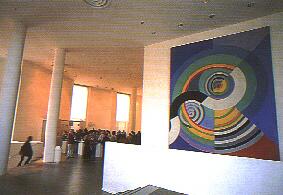 it’s for the era after 1930 that the museum is
particularly rich and all movements are represented: surrealism, expressionism,
lyrical abstraction, new realism, narrative figurative etc….
it’s for the era after 1930 that the museum is
particularly rich and all movements are represented: surrealism, expressionism,
lyrical abstraction, new realism, narrative figurative etc….
Finally
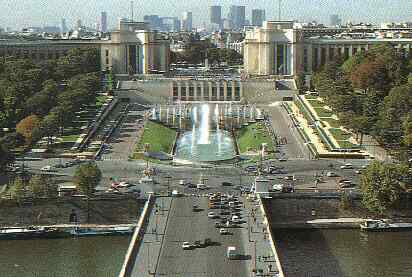
we arrive at the PLACE DU TROCADERO where you have such a magnificent view on
the Eiffel tower. The equestrian statue of Marechal Foch stands in the middle of
the square where the large avenues to Alma, Etoile, Bois de Boulogne and Passy
start. Several museums surround that place housed mainly in the impressive
PALAIS DE
CHAILLOT. Also built for the fair of 1937, this monumental and complex building
used to be a middle east palace built for the fair of 1878. They tore it down
and built that cube pavilions that you see now.
Between the two parts lies a 60 meters wide terrace with a magnificent view on
the two buildings. In the left one is the Theatre de Chaillot, offering 1800
seats since its renovation in 1975. A famous director was Jean Vilar, creator of
the Festival de theatre d’Avignon. He deceased a few years ago.
Four museums are housed in the Palais: LE MUSEE DE L’HOMME, (museum of
mankind) that needs a good refurbishing, but I heard it's on his way. It’s a
world in trip in miniature. You can see one of the world’s most important
collections of ethnology, anthropology and prehistorical history.
Mummies, shrunken heads, exquisite crystal skulls, masks from
Central-Africa, European peasants dresses, shadow puppets from India and Aztec
art.. Four hundred instruments from all over the world. Generally the
presentation is poor and shows or an evident lack of funds, maintenance and organization.
You can see one of the
world’s most important collections of ethnology, anthropology and
prehistorical history.
A section is
dedicated to mummies, warrior trophies like shrunken heads and tattoos,
exquisite crystal skulls, masks from Central-Africa, European peasants
dresses, shadow puppets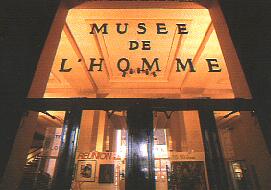 from India and Aztec art.. Four hundred instruments from
all over the world.
from India and Aztec art.. Four hundred instruments from
all over the world.
The anthropology section explains us more about the development of the different
“races” (skin colour, body structure, blood groups).
 Another
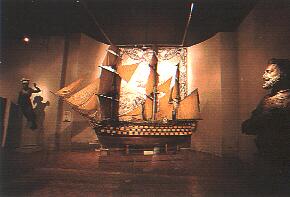
very interesting museum is the MUSEE DE LA MARINE. Yes, in the coat of arms of
Paris you can see a sailboat! The museum houses a very rich collection with
unique pieces representing all five marine disciplines: war,
commerce, pleasance, fishing and scientific. Gigantic collection of ship models,
navigation technology, canons and a lot more like majestic bow figures and stern
decorations in gilded wood of the Reale, admiral ship of Louis XIV, historic
diving-suits, the imperial dinghy of Napoleon etc....... Small scale models
created by a decree of Colbert on 31st October 1678 to realize models of every
new built boat. Other precious models, remains of shipwrecks by Charcot or
Laperouse, naval instruments, together with steam machinery, bathyscaphs and
sail boats like the famous Pen Duick V, legendary boat of Eric Tabarly. This
collection of about 300,000 objects is completed by an important document
database. Another
very interesting museum is the MUSEE DE LA MARINE. Yes, in the coat of arms of
Paris you can see a sailboat! The museum houses a very rich collection with
unique pieces representing all five marine disciplines: war,
commerce, pleasance, fishing and scientific. Gigantic collection of ship models,
navigation technology, canons and a lot more like majestic bow figures and stern
decorations in gilded wood of the Reale, admiral ship of Louis XIV, historic
diving-suits, the imperial dinghy of Napoleon etc....... Small scale models
created by a decree of Colbert on 31st October 1678 to realize models of every
new built boat. Other precious models, remains of shipwrecks by Charcot or
Laperouse, naval instruments, together with steam machinery, bathyscaphs and
sail boats like the famous Pen Duick V, legendary boat of Eric Tabarly. This
collection of about 300,000 objects is completed by an important document
database.
Next article a few other museums like the musee du Cinema, the musee Guimet and
the musee Marmottan.
Bibliography
--Vie
et histoire des arrondissements de Paris, ed.Hervas (1985-1988--Nouvelle
Histoire de Paris, ed.Hachette--Le Pieton de Paris, by L.P.Fargue, ed.Gallimard
199 --Dictionnaire historique des rues de Paris, by J.Hillairet, ed.Minuit
--Guide du Routard 1998-1999 (Ed.Hachette)--Paris, 2000 d'histoire, by J.Favier,
ed.Fayard 1997—Trocadero buurt, prachtwandeling en museums, by.J .Fuherschien
(ed.Alkhuys, 1995)
|
