|
Like I said in previous
article, the west of Paris was only annexed to the city in 1860. Idyllic
villages like Neuilly, Monceau, Batignolles and Clichy were amid green pastures.
You cold find cheese makers, farms and vegetable gardens with here and there an
inhabited house. But as
soon as the financiers smelled the money they bought the land, and kicked entire
housing areas out of the ground, all built in Haussman style. Today these areas
are very trendy with the French and foreign companies having a preference for
the 16th, 8th and 17th
 arrondissement. arrondissement.
Let’s start our walk at the CEMETERY OF PASSY (see previous article). It's the
only cemetery in Paris with a heated waiting room.
A small graveyard, sheltered by a bower of chestnut trees, classic, old-world cemetery with beautiful
grounds but it contains many grave sites, monuments and the final resting places of:
the painter Edouard Manet (1832-1883), firmly established as the leader of the Impressionists, mainly because of his rejection of convention. His paintings featured bold, flat areas keyed to bright
colors, offset by solid areas of black, painted without modelling or chiaroscuro.
Also great figures since 1850, including Tristan Bernard, Giraudoux, Claude
Debussy. Also resting here are composer Gabriel Fauré, aviator Henry
Farman, and actor Fernandel.
Via
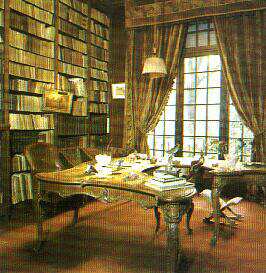
the rue Benjamin Franklin you reach the musee GEORGES CLEMENCEAU , housed in the
originally kept edifice of this man of thousand skills, nicknamed ‘the
tiger”. Clemenceau died in this house. You can see his personal pictures,
furnishing and personal objects in the rooms.
When you stroll through this beautiful area it is difficult to imagine that about
1900 it was packed with wineries. Passy was a simple village with wine and
cattle-peasants. The rural atmosphere is still perceptible in the small rue
Vineuse. The village became rich when a well was discovered in the 18th
century holding iron in it.
The mineral water became more important than the wine but in the picturesque
passage rue des Eaux (Water street: is it a coincidence??) there is a little
WINE MUSEUM that reminds the old days.
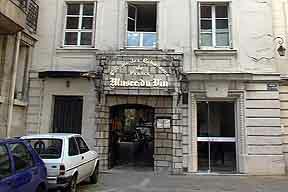 It's in fact
only 200 meters from the Eiffel Tower, beautiful and impeccably conserved 14th century wine cellars of the former Passy Abbey. The It's in fact
only 200 meters from the Eiffel Tower, beautiful and impeccably conserved 14th century wine cellars of the former Passy Abbey. The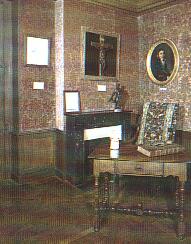 abbey’s former occupants, the Minim monks, who were known as the Bonshommes de Passy, had a few acres just behind the abbey near rue Vineuse
. They kept their renowned wine, enjoyed by Louis XIII in the 17th century, in the cellars that presently house the museum. Passy Abbey was "closed for business" during the French Revolution, in 1789. The rich collections of this museum are displayed in some of Paris' oldest limestone quarries. All the stages of the winemaking art from an earlier time (growing the vines, harvest time, coopering the wooden barrels, maturing the wine....They
show you also how to get rid of
irritating wine stains :-):-)
abbey’s former occupants, the Minim monks, who were known as the Bonshommes de Passy, had a few acres just behind the abbey near rue Vineuse
. They kept their renowned wine, enjoyed by Louis XIII in the 17th century, in the cellars that presently house the museum. Passy Abbey was "closed for business" during the French Revolution, in 1789. The rich collections of this museum are displayed in some of Paris' oldest limestone quarries. All the stages of the winemaking art from an earlier time (growing the vines, harvest time, coopering the wooden barrels, maturing the wine....They
show you also how to get rid of
irritating wine stains :-):-)
Closed on Monday and week from Christmas to New Year. Tourists are the targets
here but you can try it. 35FF for visit and DEGUSTATION.
A
nice walk in Passy could start with the "MAISON BALZAC".
Continue on the rue Raynouard and on 47 here is the house of one of the
world’s most genial writers Honore de 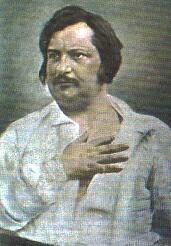 BALZAC. If you know something about
European and French literature, you must know about him. His house is to visit
but closed on Mondays and holidays. What a character that Balzac! All his life
he hid from his creditors! He lived in this house from1840. He barricaded
himself on the second floor of his house and lived incognito until 1847, writing
at his small wooden desk his famous “Comedie Humaine” (the Human Comedy) and
also “Splendeurs
et Miseres des Courtisanes”. His debts and love for writing made him work 16
hours a day and he appreciated particularly the second exit at rue Berton to
escape when his
creditors found out where he lived. The walls still have their paintings and
drawings. You can see his golden watch, his coffee can, (he could drink 30 cups a
day!)
and his walking stick. The knob is from pure gold and turquoise. In 1835 he
wrote to one of his friends, Mme. Hanska: “Because of my walking stick they
think I’m the new Cresus, but all I have are debts!” Now that the house
became a museum, it is still impregnated of the spirit of the illustrious
author. And precisely the house he hated was made the Balzac museum of the city! BALZAC. If you know something about
European and French literature, you must know about him. His house is to visit
but closed on Mondays and holidays. What a character that Balzac! All his life
he hid from his creditors! He lived in this house from1840. He barricaded
himself on the second floor of his house and lived incognito until 1847, writing
at his small wooden desk his famous “Comedie Humaine” (the Human Comedy) and
also “Splendeurs
et Miseres des Courtisanes”. His debts and love for writing made him work 16
hours a day and he appreciated particularly the second exit at rue Berton to
escape when his
creditors found out where he lived. The walls still have their paintings and
drawings. You can see his golden watch, his coffee can, (he could drink 30 cups a
day!)
and his walking stick. The knob is from pure gold and turquoise. In 1835 he
wrote to one of his friends, Mme. Hanska: “Because of my walking stick they
think I’m the new Cresus, but all I have are debts!” Now that the house
became a museum, it is still impregnated of the spirit of the illustrious
author. And precisely the house he hated was made the Balzac museum of the city!
You can get out of the house like I said from the back into the rue Berton. But
that’s for next article….
Bibliography:
--Vie
et histoire des arrondissements de Paris, ed.Hervas (1985-1988--Nouvelle
Histoire de Paris, ed.Hachette--Le Pieton de Paris, by L.P.Fargue, ed.Gallimard
199 --Dictionnaire historique des rues de Paris, by J.Hillairet, ed.Minuit
--Guide du Routard 1998-1999 (Ed.Hachette)--Paris, 2000 d'histoire, by J.Favier,
ed.Fayard 1997—Paris en quartiers : le Nord, by J.Lacouterie (ed.Hervas
185)—Le 16eme, Passy, Auteuil et ses anecdotes, by B.Beyern (own folders)-Une
vie de fuite, Balzac, by P.Bradstein (ed. Minuit 1991)
|
