|
What
about the famous MUSEE DU CINEMA HENRI DE LANGLOIS? Being closed for years
due to the disastrous fire in the Palais Chaillot on July 22 1997, I forget to check each time I was in Paris to see if it
reopened. Notice that I heard they might
move elsewhere…Maybe the American pavilion at Bercy. But let’s not stand still with such unimportant detail ;-)
and describe the museum anyway how I remember it and helped a bit by my
bibliography. It’s a genuine journey through the history of motion pictures,
with a laterna magica, and films of the
impressive Hollywood era (like films of
Fritz Lang and his robots out of Metropolis). Melies studio reconstitution, for
movie addicts who look how was the tracing of celluloid history.
The MUSEE DES MONUMENTS FRANCAIS in the Palais de Chaillot is closed for the
same reasons as the musee du Cinema. Just a few words: Viollet-le-Duc founded
this museum with sculptures and enormous images of Roman period until the 19th
century. Also maps of castles,
small-scale models and reproductions of churches. You can sight see the country
without leaving the capital!
Walking down the avenue du President Wilson to the place d’Iena, let’s visit
at no.6 the MUSEE DES ARTS ASIATIQUES, MUSEE GUIMET. It is scheduled for reopening on January 15, 2001, after a closure of 5 years, for
 thorough renovations. thorough renovations.
From the place d’Iena you can walk along the av. Pierre 1er de Serbie and at
no. 10 the amateurs of fashion history will enjoy the MUSEE DE LA MODE ET DU
COSTUME, Palais Galliera. Located in the city palace (neo Renaissance) of the
countess Maria de Ferrari Galliera. It’s a pity we cannot see all 10,000 objects (with gifts
from the Rothschild and the Monegasque royal family), they are impossible to
display all together because of the damaging influence of light and air.
Permanently they organize thematic exhibitions like” the history of the blue
jean” to show the traditions and evolutions of fashion. A little promenade in
the garden behind the palace is worth a million.
Now you must excuse me but the most important painting museum in this
arrondissement is quite far away from where you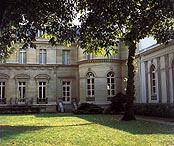 are now. Rue Louis Boilly is at
the end of the jardins du Ranelagh where I had you walking before in my Guimard
articles. Forgot to mention but now I will. You can include the musee Marmottan
to your must visits. Just walk back from Trocadero on the avenue Paul Doumer or
take the metro and exit metro La Muette. Cross the jardins du Ranelagh and enter
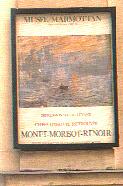
the MUSEE MARMOTTAN in 2, rue Boilly. are now. Rue Louis Boilly is at
the end of the jardins du Ranelagh where I had you walking before in my Guimard
articles. Forgot to mention but now I will. You can include the musee Marmottan
to your must visits. Just walk back from Trocadero on the avenue Paul Doumer or
take the metro and exit metro La Muette. Cross the jardins du Ranelagh and enter
the MUSEE MARMOTTAN in 2, rue Boilly.
World famous museum of Impressionism, it was created in 1932 by the bequest of a
historian and collector, Paul Marmottan. Containing 100 paintings by Monet, donated
by his son. To the numerous Monet paintings the
collection he added an exceptional collection of " enluminures", one
of Europe’s most outstanding groups of illuminated manuscripts from the 12th.
to the 15th. century
of the Wildenstein bequest. Here the famous "Impression,
Soleil levant", which 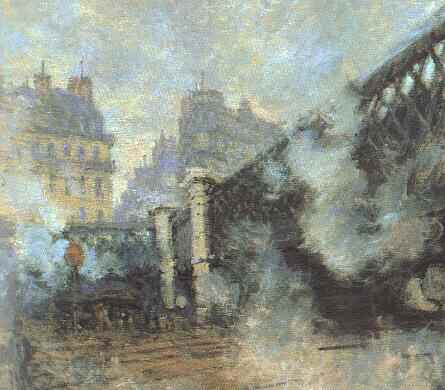 christened the Impressionist movement is at display. It was stolen in November 1985 together with 10 other
masterpieces, and worldwide researches took place. The paintings were finally
recovered. Other master pieces
are “Le Parlement, “Le Pont de l’Europe a la Gare
Saint-Lazare”, Nympheas “.In the basement, the incredible series of works
realized in Giverny by the almost blind painter!
Impossible to cite all the works but you'll discover in the galleries on the
ground floor Empire furnishing, tapestries, stained-glass windows and religious
primitives. To his own works christened the Impressionist movement is at display. It was stolen in November 1985 together with 10 other
masterpieces, and worldwide researches took place. The paintings were finally
recovered. Other master pieces
are “Le Parlement, “Le Pont de l’Europe a la Gare
Saint-Lazare”, Nympheas “.In the basement, the incredible series of works
realized in Giverny by the almost blind painter!
Impossible to cite all the works but you'll discover in the galleries on the
ground floor Empire furnishing, tapestries, stained-glass windows and religious
primitives. To his own works paintings of Monet’s personal collection are
shown in the basement like Pissaro, Jongkind, Boudin, Berthe Morisot and Renoir
painting "Claude Monet lisant", Sisley. And that Monet, a festival
of iris, roses, agapanthus and magnificent white water lilies and so many
others. Oh yes, no lines to get into Marmottan! Exception when there is a
special exhibition. Anyway, not to compare with the lines at Orsay.
paintings of Monet’s personal collection are
shown in the basement like Pissaro, Jongkind, Boudin, Berthe Morisot and Renoir
painting "Claude Monet lisant", Sisley. And that Monet, a festival
of iris, roses, agapanthus and magnificent white water lilies and so many
others. Oh yes, no lines to get into Marmottan! Exception when there is a
special exhibition. Anyway, not to compare with the lines at Orsay.
A private museum specialized in African art is the musee Dapper, av. Victor
Hugo, 50, Always temporary superb exhibitions by themes.
Bibliography
--Vie
et histoire des arrondissements de Paris, ed.Hervas (1985-1988--Nouvelle
Histoire de Paris, ed.Hachette--Le Pieton de Paris, by L.P.Fargue, ed.Gallimard
199 --Dictionnaire historique des rues de Paris, by J.Hillairet, ed.Minuit
--Guide du Routard 1998-1999 (Ed.Hachette)--Paris, 2000 d'histoire, by J.Favier,
ed.Fayard 1997—Trocadero buurt, prachtwandeling en museums, by.J .Fuherschien
(ed.Alkhuys, 1995)
|
