|
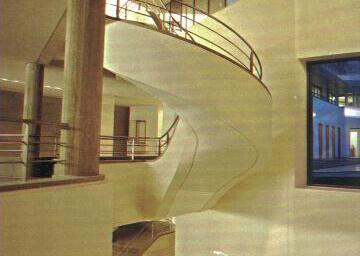 Closed for 5 years due to renovations, the Musée GUIMET reopened on the 15th of January. Closed for 5 years due to renovations, the Musée GUIMET reopened on the 15th of January.
If someone remembers the musée Guimet, museum of Asian arts, he will recall a huge and impressive in the Trocadero area. But it became outdated, old, dusty and unfit to house the largest collection in the world of Asian art objects" in the world. All in corners, lost spaces, not so far from the Louvre, which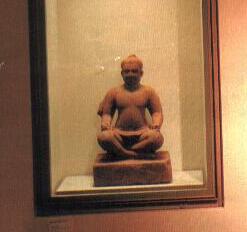 turned during the same time to one of the most modern museums in the universe. Nine years of political and budget discussions, five years closure, for a new Guimet museum, risen out of its ashes. turned during the same time to one of the most modern museums in the universe. Nine years of political and budget discussions, five years closure, for a new Guimet museum, risen out of its ashes.
Quite a story, the foundation of this. Created by the 19th century industrialist and orientalist Emile Guimet, owner of Pechiney. He opened the museum in 1889, giving it to the French state at the same time. It started as a living museum, with different live events taking place constantly, like Buddhist ceremonies celebrated by Japanese monks.
But from 1920 on, the museum will have some reliftings of a doubtful nature. Covering of the main courtyard in 1925, surelevation of the building in 1950, quite ugly. Large rooms are divided into small ones by putting walls, receiving almost no light in 1970. The Pompidou years! The idea was to show as much as possible to the visitor but it turned the museum into an incoherent labyrinth. Because the ceiling was not high enough, Chinese cupboards had to be presented among Afghan art objects. Chinese Art was parceled over different sections. The museum had become bloated, inflated, congested, crammed, close to suffocation.
Measures had to be taken: only one solution, total refurbishing and renovation. Five years and here is the new museum!
Unrecognizable and very harmonious. The collections are presented per country and chronologically on five levels surrounding a grand staircase. The presentation is also much more equilibrated, from one country to another. Take the new Korean section for example: It used to occupy a space of 60 square meters, although it was a splendid collection, and now it is deployed in all its splendor. Another choice
made by the renovators and architects is that you will not see ONE exotic décor evocation, nor Chinese, Japanese or Indian, but sober lines and colors that will not jostle the works, stone, wood, white, gray, sand.
And above all, light, light everywhere, in opposition to the old museum where light seemed to be banned. On the fourth floor there is a rotunda and a terrace from where you have a superb view from the towers of Notre Dame to the Eiffel tower. I make any bet that's where most people will stay for a moment!
The art itinerary also has been totally changed. The accent is put on the fact that Asia can be divided in two major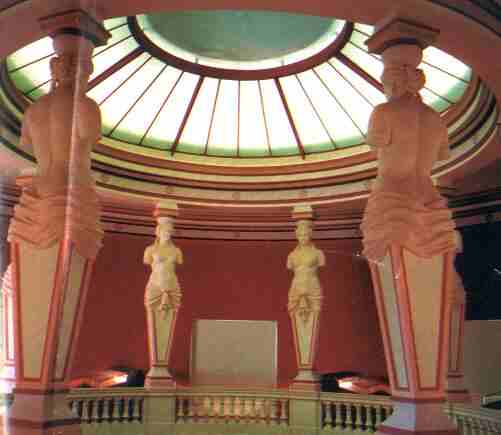 civilization foyers: India, which religious iconography has
traveled up to Japan through the silk road and into whole South East Asia through the maritime routes. On the other side, China, whose ways of life and philosophy served as model for civilization foyers: India, which religious iconography has
traveled up to Japan through the silk road and into whole South East Asia through the maritime routes. On the other side, China, whose ways of life and philosophy served as model for
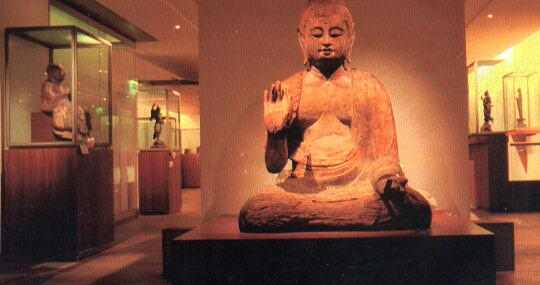 all the Far East countries. Which makes the Musée Guimet, the only museum in the world, able to offer such a compete (and beautiful) panorama to its visitors of Asian arts, from India and Buddhist
Afghanistan up to Japan. In the old museum, 3,500 objects were on display (45,000 in the reserves). In the new museum, the same amount of objects, but the heavy, annoying presentation is replaced by a transparence and clarity, which transforms the visit into a promenade. Other novelty: regularly objects are gathered around main, strong eye catchers like the sumptuous golden artifacts of Mogul India, the fabulous treasure of the maharajahs, (first floor). At the second floor, 60 pieces of Korean, Japanese and Chinese painting, beautifully displayed and laid out, coming from the Imperial Chapel of the Ming dynasty, being the most important of the artistic creations of these countries. Notice that the cellars still hide 600 more of this painted rolls). Himalayan arts are here so unique and splendid, you cannot see such beauty anywhere else in the world (first floor). all the Far East countries. Which makes the Musée Guimet, the only museum in the world, able to offer such a compete (and beautiful) panorama to its visitors of Asian arts, from India and Buddhist
Afghanistan up to Japan. In the old museum, 3,500 objects were on display (45,000 in the reserves). In the new museum, the same amount of objects, but the heavy, annoying presentation is replaced by a transparence and clarity, which transforms the visit into a promenade. Other novelty: regularly objects are gathered around main, strong eye catchers like the sumptuous golden artifacts of Mogul India, the fabulous treasure of the maharajahs, (first floor). At the second floor, 60 pieces of Korean, Japanese and Chinese painting, beautifully displayed and laid out, coming from the Imperial Chapel of the Ming dynasty, being the most important of the artistic creations of these countries. Notice that the cellars still hide 600 more of this painted rolls). Himalayan arts are here so unique and splendid, you cannot see such beauty anywhere else in the world (first floor).
The new Guimet museum is also equipped with all the spaces a modern museography must have: 600 square meters of temporary exhibition space, a 282 seats auditorium, an Asian restaurant, and a 120 square meters souvenir -library-boutique. The old museum, which was, 20 years ago, the example of an old professorial conception a la CALCULUS (the absent-minded professor type of Hergé, creator of Tintin)
Notice that from 25 January 2001 on, the museum will present an exhibition "Asie des steppes d'Alexandre le Grand à Gengis Khan".
|
